
Contents
Editorial
- Love, Paul Overend
Articles
- Three Early Twentieth Century Theologies of Love, Paul Overend
- Committed to Love, Edward Owen
- The Guatemala Masons (2004), Cliff Polubinsky
- One Humanism? Many Humanisms, Martin Spence
Reviews
- Living: A Reminder to Love (in) this World, Ross McCrory
- Review: Transcendence for Beginners by Clare Carlisle, Andy Kemp
- Review: Against the Machine by Paul Kingsnorth, Andrew Edgar
- Review: Magisteria by Nicholas Spencer, Robert Boucnick
- Review: Don't Forget We're Here Forever by Lamorna Ash, Edward Nickell
Regulars
Regulars
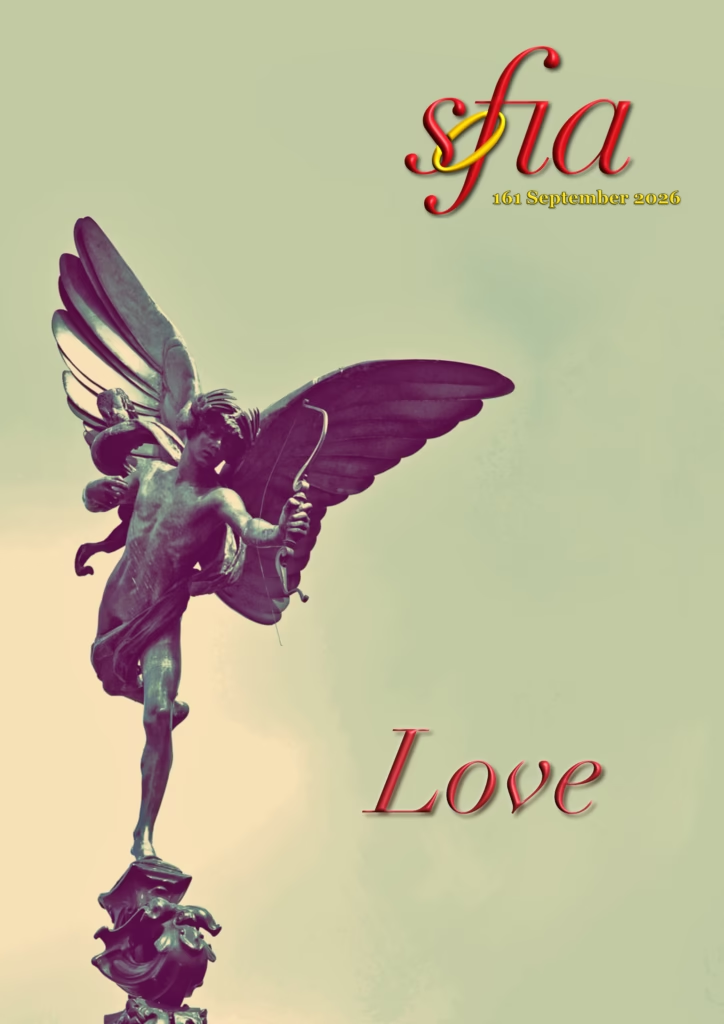
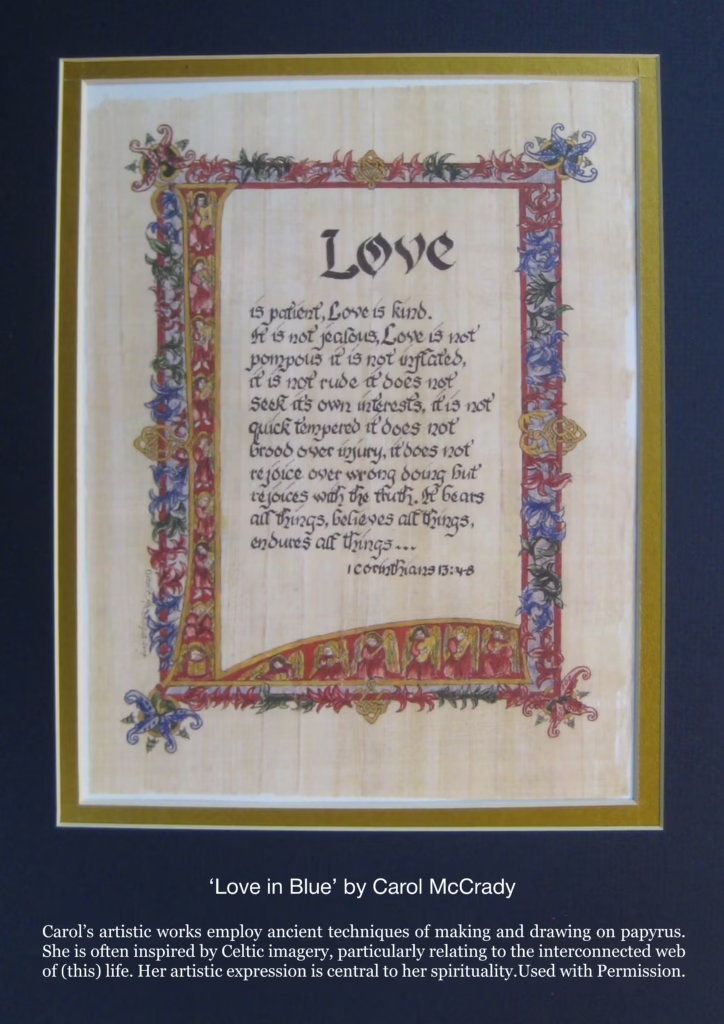
Love
by Paul Overend | editor@sofn.uk
This edition of Sofia is inspired by the third of the three theological virtues of faith, hope, and love, which derive from the Pauline epistles (I Thess. 1.3, 5.8; I Cor. 13.13). We take a fresh look at the theme of love, noting Don Cupitt’s observation that,
Don Cupitt, The World to Come (SCM, 1982), p. 20God now functions in religious language principally as a symbol of the authority of religious values and claims. God is love. The power of God is the power of love, and moral commitment to God is moral commitment to the way of love.
St Francis of Assisi
This edition of Sofia coincides with the eight centenary of St Francis of Assisi’s death, on 3 October 1226. Giovanni di Pietro di Bernardone (b.1181/2), nicknamed Francis (Francesco) by his father Pietro di Bernardone, is remembered for embodying the virtues of faith, hope, and love. Pope Francis’ encyclical Fratelli Tutti describes Francis as the ‘saint of fraternal love, simplicity, and joy’.
For Francis, Jesus’ life and teaching were the Gospel. Identification with Jesus, without compromise, shaped Francis’ heart and life. However, early accounts of Francis, such as the primary and secondary Vita Sancti Francisci and a collection of miracle stories by Thomas of Celano, were written within a few years of Francis’ death to inspire the new order (The Ordo Fratrum Minorum, or ‘Order of Lesser Brothers’) and to defend it against the ecclesiastical criticism that other reform movements had encountered. Such accounts view Francis through hagiographic lenses, using the chivalric romance language of the troubadours’ era as a vehicle for piety.
This has made it difficult if not impossible to separate the historical man from hagiographical myth, but the intellectualising historicity of modernity might not be a fruitful approach to Francis anyway.
Liberation theologian Leonardo Boff commends Francis as an archetype, a humanistic ideal, who ‘belongs not only to Christianity but to all humankind’. (Leonardo Boff, Francis of Assisi: A Model for Human Liberation, Tr. by John W. Dierkcksmeier (Orbis, 1982/2006), p. x.)
Boff notes that Francis lived at a turning point in social history and was a corrective to the economic and ideological systems. His was an age of early scholasticism (Lanfranc, Anselm, Peter Abelard, Peter Lombard) and of mercantile capitalism (his cloth-merchant father was one of the emerging bourgeoisie). Yet Francis challenged the prevailing emphases on lógos (reason) and téchnē (craft, trade), of scholastic learning and utilitarian economic rationality, with a humanised érōs (love) and páthos (feeling, affectivity), of loving-tenderness and compassion. He made the liberating choice of foolishness and a poverty rooted in the Gospel, identifying with Christ and with the oppressed ‘poor of God’ (Hebrew anawim), in fraternal equality, wonder and joy.
In our own age, marked by systemic change brought about by AI and the failures of extractive capitalism — ecological collapse, global economic inequality, and wars over resources — Francis’ voluntary simplicity of life and confraternalisation with nature commend him again, as a model of sanity and environmentalism.
In a feature for Francis’s anniversary, Anglican Franciscan priest Edward Owen TSSF writes for us about his experience of living the Franciscan charism in accordance with the vows of the Tertiary Franciscan Religious Order.
Contents
An opening article in this edition examines how three twentieth-century writers approached the theme of love, shaped by their distinct theological perspectives.
Our new Arts Editor, Ross McCrory, explores the film Living (2022). The film contains a theme of conversion, with a shift in life orientation from selfishness to service, from self-preservation to a public mission. He also curates creative artworks that support reflections on our theme.
Other pieces explore religion and worldviews. In the ‘Lived Religion’ column, Ben Wood explains how he navigates religion, with dual membership of the Religious Society of Friends (Quakers) and the neo-Druid organisation The Order of Bards, Ovates, and Druids. Martin Spence reviews a conference hosted by the McDonald Centre for Theology, Ethics, and Public Life on various traditions of humanism. Dave Francis writes for our ‘Network Matters’ column on the network’s work in religious education.
The edition also includes a selection of stimulating and tempting book reviews that have been submitted, with more to follow in future editions.
Credits
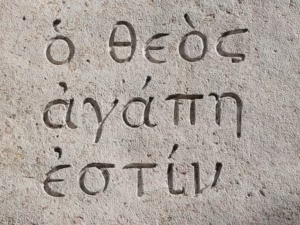
The Greek engraving above (which transliterates hó theós agápē éstin) is from the rear of “The Book of Love among People” (Il Libro delle Genti), by the Italian sculptor Vincenzo Bianchi. The text, which is carved in Greek, Latin, and Arabic, is from the epistle of John:
Whoever does not love does not know God, for God is love. (I John 4. 8 NRSV).
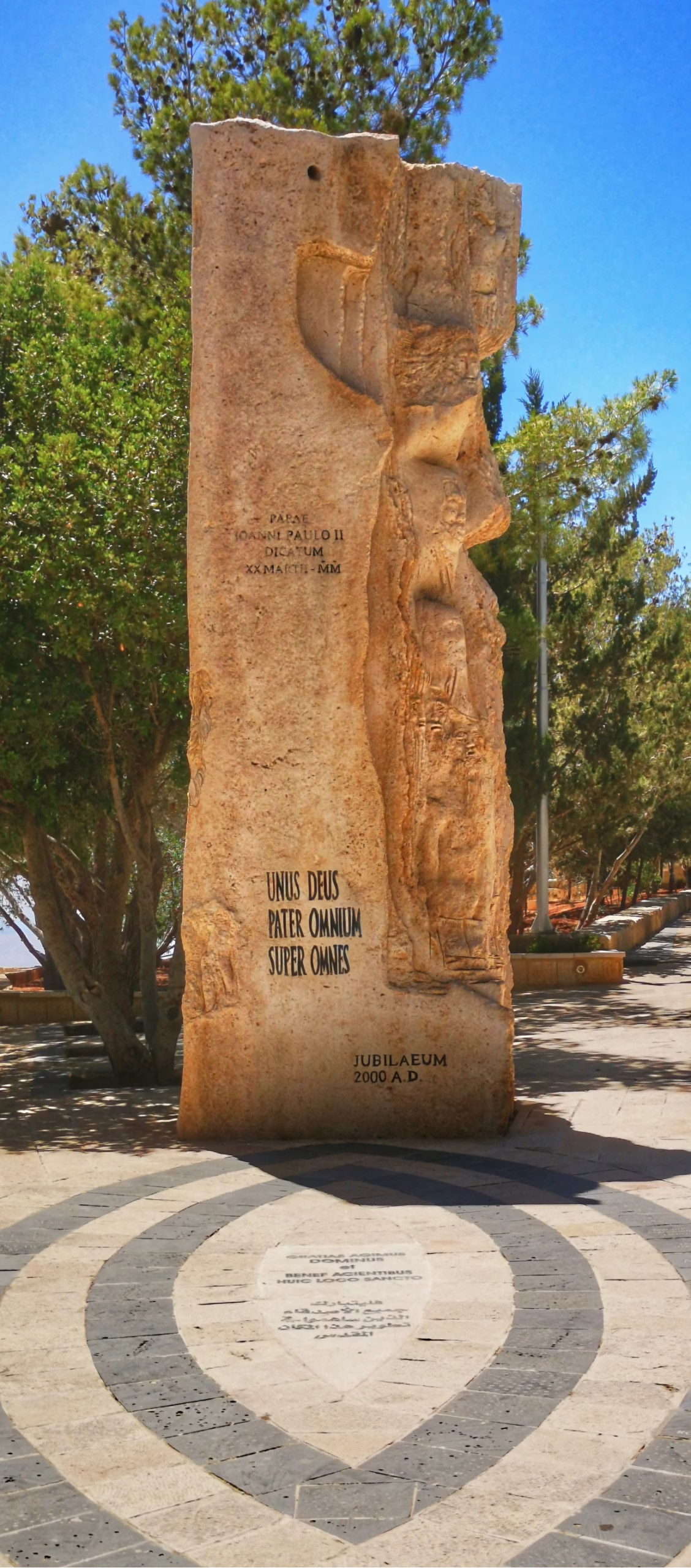
On the front (shown right), the Latin inscription reads, ‘Unus Deus Pater Omnium Super Omnes’, abbreviating Ephesians 4. 6 (Vulg.): ‘one God and Father of all, [who is] above all [and through all and in all].’ (NRSV). The 5.5-meter-high stele is on Mount Nebo, near the northern end of the Dead Sea in Jordan (formerly the land of Moab), which is believed to be the ridge from which Moses saw ‘the land of Gilead’ in Canaan, before he died (Deut. 34–4). The monument, which commemorates the Jubilee 2000 and the visit of Pope John Paul II, celebrates the close spiritual affinity of the Jewish Torah, the Muslim Koran, and the Christian Gospel.
Image right, “Stone monument of the three monotheistic religions” by John Romano D'Orazio (27 June 2018). CC BY-SA 4.0 https://commons. wikimedia.org/wiki/File:Stone_monument_of_the_three_monotheistic_religions.jpg
Meetings: September–November
- 16 September: A Philosophy of Love, with Jeremy Carrette. Jeremy Carrette is Head of the School of Divinity at the University of Edinburgh, and Professor of Philosophy, Religion and Culture. In 2023–24, he was instrumental in organising conferences to celebrate the anniversaries of Honest to God, and of Sea of Faith.
- 21 October: Local and Other Small Sea of Faith Groups, with group convenors/facilitators and members of groups exploring the use of face-to-face and online groups for support and conversation.
- 18 November: On Jewish music, with Hannah Kieve. Hannah Kieve is Head of Music at Alyth Synagogue and a PhD candidate at the University of Cambridge, bringing together practical and academic work in Jewish music, focusing on liturgy, migration, and cultural memory in the diaspora.
Meet us by Zoom

For further details about the speakers and introductions, and for Zoom links to the meetings and to be included in future mailings please email inconversation@sofn.uk.
Letters
Please send letters to our Letters Editor, Stephen Mitchell letters@sofn.uk
Dear Editor,
In June, our London local group tried something new: a “sacred text” reading of the first two chapters of Dickens’s Oliver Twist, through the theme of hope — inspired by your previous Sofia issue on the same theme.
Sacred text practice applies the approach taken by religious communities to sacred texts to a secular book. The approach started in a Harvard Divinity School course with Jane Austen, but became popular via the ‘Harry Potter and the Sacred Text’ podcast. I’m part of a group who are currently taking this approach with The Northern Lights by Philip Pullman. We meet via Zoom and are grateful for the use of the Network’s Zoom account.
Sacred text practice has three principles — trust that the text has something to give you, rigour in reading closely even when a passage seems slight, and reading in community. Rather than a whole book we take a chapter or two, read with a theme in mind, and finish with monastic techniques such as florilegia (gathering the sentences that caught your attention) and lectio divina (rigorous reading of a randomly selected passage).
Much of our reflection on ‘Hope’ and Oliver Twist can be related to articles in the past Sofia. In the editorial, Pope Benedict is taken to task for a hope pitched at eternal life while passing over the suffering of this world and the hope of an earth remade in justice. Dickens hands us precisely that suffering world: a nameless mother dead without rites, her child left to the mercies of a board of “wise and humane” gentlemen who calmly resolve to starve their charges by degrees. After that, it is hard to be satisfied with a hope that is only otherworldly.
Then Oliver stands and asks for more. Christiane van Duuren called her piece ‘Hope Against the Odds’ (Sofia 160); she might almost have been describing Oliver. We wondered whether some sort of ‘want’ or hunger is always the start of hope. We wondered whether hope was always good. Was it perhaps the brother of ‘anxiety’? Could it become meaningless like dismissing problems with ‘thoughts and prayers’? But on the other hand, perhaps we can live without faith, but not without hope — we had the arguments from Carroll and Norman in mind from Sofia (‘Hope Faith and Redemption 1’ and ‘Hope Faith and Redemption 2’).
Reflecting on what the text might be calling us to do, we had reflections on people’s hopes for the session itself and for the Network, as well as on what they had hoped for their own lives. To close, we each selected a character to ‘bless’. I chose the ‘sage, deep, philosophical’ men of the Board who delight in their own clever reasoning but end up administering a cruel inhumane system. My blessing was to hope that I could avoid being one of them!
Several members in the group would be interested in doing it again, perhaps others in the Network might be interested?
Edward Nickell, London Local Group
Sea of Faith Network AGM – Wednesday 30th September 2026, 19.00 – by Zoom
Sea of Faith members have a vital statutory role in shaping the work of the charity. We therefore encourage all members to participate in the AGM, so that we have a required electoral quorum. Sea of Faith Members will be sent details in due course, but subscribers and friends who are not yet members may join to support its work and help shape it. See sofn.uk/join-or-donate.
The network is dedicated to promoting gender and diversity inclusion and especially encourages SoF members from underrepresented social and religious groups to consider standing for elected positions. See sofn.uk/governance and sofn.uk/constitution (Part II).