
Lamorna Ash, Don’t forget we’re here forever: A New Generation’s Search for Religion (Bloomsbury Circus, 2026), pp. 352.
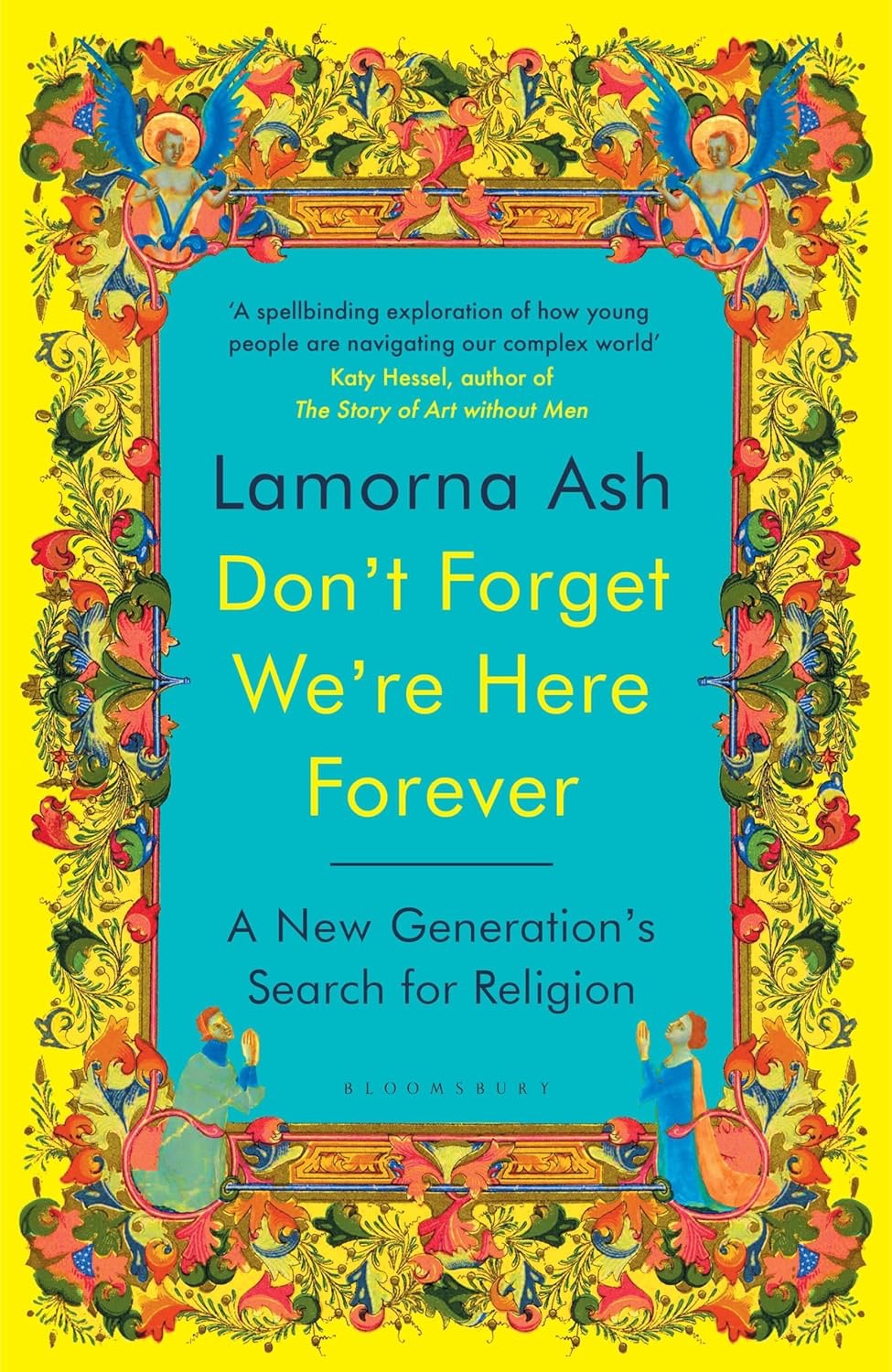
Lamorna Ash takes a year-long road trip around Christianity, gathering the stories of some sixty young adults who have converted. It paints a picture of Christianity in Britain today, not through polls and statistics, but through her conversations.
The ‘Quiet Revival’ report, in which a YouGov survey found Christianity on the rise among young people, made headlines in April 2025, just before publication of this book. The timing must have delighted the publishers! Some reviewers saw the book as answering the headline questions: who is converting, and why?
Ash herself rejects this: the book was written before the survey, and not with the aim of explaining generational change. She was sceptical of the survey’s claims and has been vindicated; YouGov have since retracted the data. There is no quiet revival.
But there are real stories to tell. Lamorna meets people from more than a dozen traditions, from Quakers and Pentecostals to Anabaptists and mystics. In telling their stories she reflects on her own struggle with Christianity, drawing on Jacob wrestling the angel. Like most of our generation (millennials) she grew up relatively ‘unchurched’ but with some cultural familiarity: a Church of England schooling and a grandmother who attended Anglican and Quaker services.
Given that Lamorna is progressive and queer, it’s surprising that her starting point was the conservative evangelical Christianity Explored and Alpha? courses. But these are the best-promoted introductions, so hers is a common route, sadly leading some into abusive theologies.
In this version of Christianity, the first I had been offered, it felt like there was harm stitched into the other side of its welcome.
I took guilty pleasure in the wild things Lamorna recounts of evangelical bible classes. She approaches them with impressive generosity and an open mind. But not so open that her brain falls out.
As a conservative evangelical venture, Christianity Explored imposes ‘unspoken limits on what can happen in the classes … we could never contest the text’s veracity, find contradictions or irresolvable ambiguity within it’.
Her course leader, Rico Tice, a leading opponent of same-sex marriage blessings who describes sin as a ‘far worse problem’ than climate change, tells Lamorna that he chooses to teach Mark because it’s the shortest gospel, betraying, she notes wryly, the limited faith pastors often have in those they seek to convert.
Her own take on Mark is that it is the strangest gospel, ending (originally) not with the resurrection but the empty tomb, inviting faith as an imaginative leap rather than a fixed answer. Not an insight she could have shared at Christianity Explored!
Lamorna comments that ‘the more time I spent at Christianity Explored, the more it felt like the outside world was not making it through the walls in any meaningful way.’ She concludes on this form of Christianity, ‘I think it would make my life smaller. I think it would make me a worse person.’
Is faith good for us? That is the main question, for her, not whether its metaphysical claims are true. She cites the term ‘flexible ontologies’ from the anthropologist T.M. Luhrmann, describing how believers speak as though God is straightforwardly real while acting otherwise.
Speaking to Laurence, an atheist Quaker, his atheism is noted but the focus is on his interest in social justice: ‘in political activism, you fight because you want to attain an equality that does not yet exist. It appealed to Laurence that Quaker meetings already ran on this principle. The goal was to sustain the conditions of equality within the space for an hour each week.’
At the start of her journey, Lamorna tells a friend, ‘I don’t think I have the capacity for faith.’ By the end she writes:
I choose to become a Christian with my scepticism about organised religion intact … I believe I come closest to knowing something of God in my interactions with other people … I believe that the God of the religion which is my heritage might have come down to Earth as a man 2,000 years ago to walk alongside us and help us with our terrible pain because I can’t think of a more beautiful story for how a god might behave. My belief is not founded on certainty, and I don’t want to persuade anyone else of it … I haven’t found any answers. I’ll go on looking.
I must write to her about the Network!
Edward Nickell is Secretary of the Sea of Faith Network, and a member of the London Local Group.