
Nicholas Spencer, Magisteria: The Entangled Histories of Science & Religion (One World, 2023). pp. 480
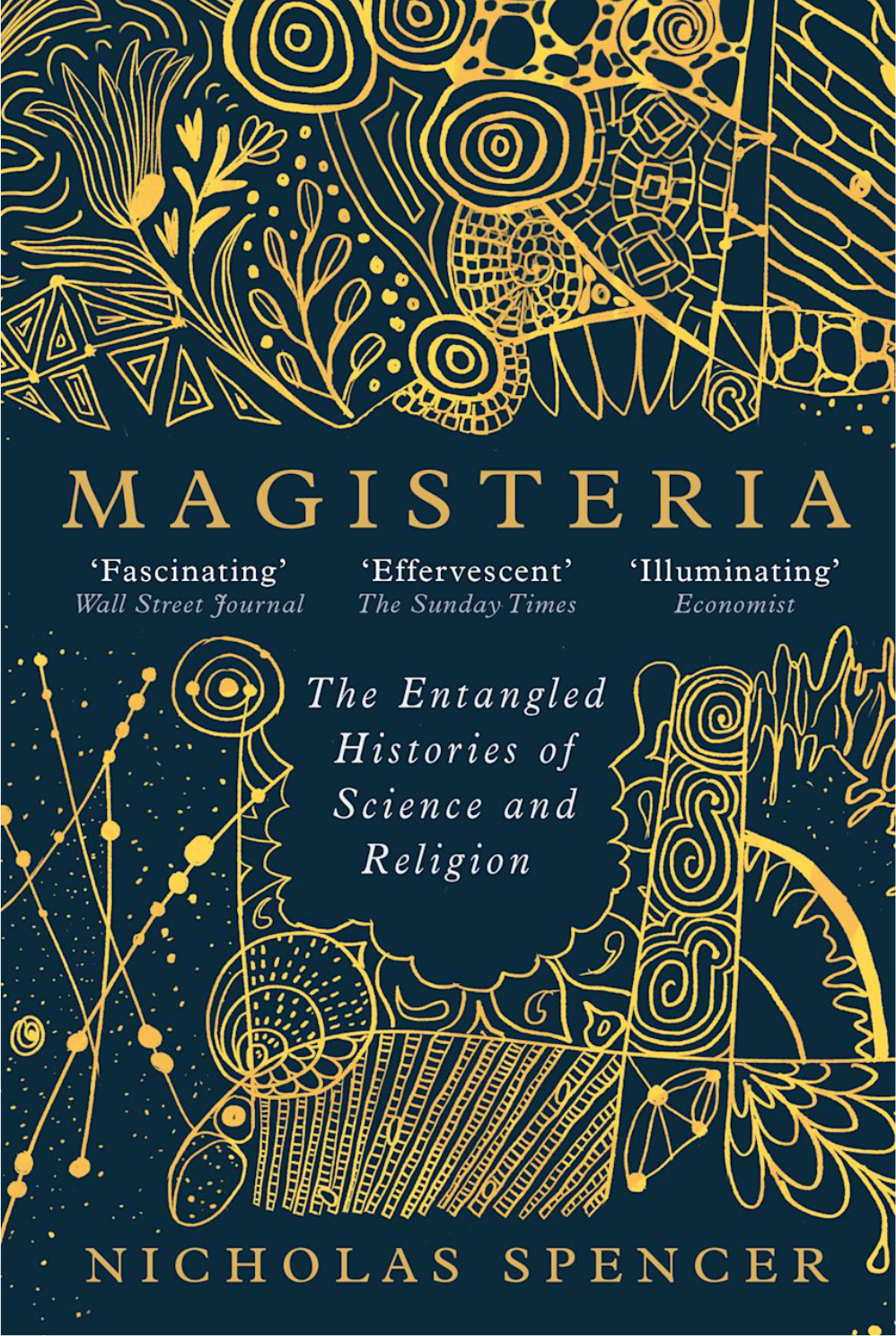
A common misconception about the relationship between science and religion is that these have always been in opposition and that science has basically won.
Nicholas Spencer points out that the relationship between the two ‘magisteria’ of science and religion has been more of a complex and inconclusive debate than a narrow argument. However, there are certain key flashpoints in history where scientists and theologians have squared up to each other, mainly over two issues: who has authority to proclaim what is true; and the sacredness of human life (how astronomy, geology or natural selection diminishes our central or special place in the universe). The main three of these flashpoints are the trial of Galileo, the Huxley v Wilberforce debate at Oxford in 1860, and the Scopes trial in Dayton, Tennessee, just over a century ago. In each case, the common perception of what took place is revealed as an over-simplification. While Galileo was defending heliocentrism, for example, the hypothesis was already about 100 years old and had caused no controversy previously. Indeed, there were hybrid hypotheses between helio- and geocentrism which many church fathers favoured. Galileo met trouble because the use of his telescope gave tangible evidence to the new hypothesis. He fell out with Pope Urban VIII because his holiness felt personally mocked in one of Galileo’s books, and, contemporaneous with the Thirty Years’ War, challenges to Catholic authority were perceived as having a Protestant aspect to them. Spencer points out that whether you were a Biblical literalist or more sympathetic to evidence-based descriptions of the cosmos had nothing to do with Protestantism or Catholicism; both contained literalists and rationalists. Indeed, the way each controversy is deepened and broadened to include each actor, their sympathies and objections, as well as contemporary perspectives, is hugely impressive. But it can be a little over-complicated. The book presents itself as an antidote to the over-simplification of the science versus religion narrative, but the story is then framed in a context of opposition. However, it is a most comprehensive study. Many examples of scientists are cited, such as James Clerk Maxwell, who held a deep conviction that the scientific method is ultimately limited in what it can achieve. While medieval scientific ‘dark ages’ are revealed as being more enlightened than is recognised (the work of the ‘physici’), periods of contention or enlightenment are shown to be less controversial or ground-breaking than we are generally led to believe.
The book is best read as a history. It aims to set the record straight and generally succeeds. It does not explicitly delineate the limits of science to explain how the two magisteria can stand alongside each other. Instead, it explains how this complex debate will endure, mainly in the field of artificial intelligence. All points of view are treated with respect and understanding. Spencer only runs out of sympathy with those who are unduly adamant. So materialist reductionists are accused of disciplinary overreach for trying to explain complex behaviour merely from biochemistry or the architecture of the brain, or for equating thought with computation. Just as maps can be topological, navigational, political, electoral, or thematic, etc., so human beings have many aspects, and trying to explain the whole from one point in one layer is plainly fruitless. Spencer concludes by stating that the overlap which he sees between science and religion is a feature of we human beings — we are embodied (physically bound) and embedded (integrated into a collective), whereas the models of neuroscience are characterised by isolation and insensitivity and therefore lose such matters as meaning, mortality, empathy and love.
More might have been said about the soul or spirit: meta-consciousness, not just the soul, may have merited more mention in the conclusion and vitalistic thinkers such as Goethe, Swedenborg, Mesmer or Steiner might have been included. The idea that consciousness cannot be explained merely by matter, energy or emergence is most pertinent to predicting the properties of machine intelligence, even if you do not ascribe to the presence of an ‘elan vital’. And Hindu cosmology deserves more mention; their emphasis on the unknown rather than the known has seen much less retreat from scientific discovery than the Judeo-Christian or Islamic traditions.
Where the book really succeeds is in dispelling commonly held beliefs, such as the idea that Columbus proved the Earth is round, even though its circumference had already been calculated in Hellenistic Egypt in the third century BCE. The basic message is that while science may have diminished the remit of religion, it has not diminished its relevance. Despite a few possible omissions, as a scholarly work and an engaging retelling of the story of science and religion, Magisteria is an outstanding achievement and a genuine education.
Robert Boucnick is an FE Teacher, a Sea of Faith member and a regular contributor to Sofia.