
A film exhorting us to serve one’s community with love — review by Ross McCrory, Arts Editor
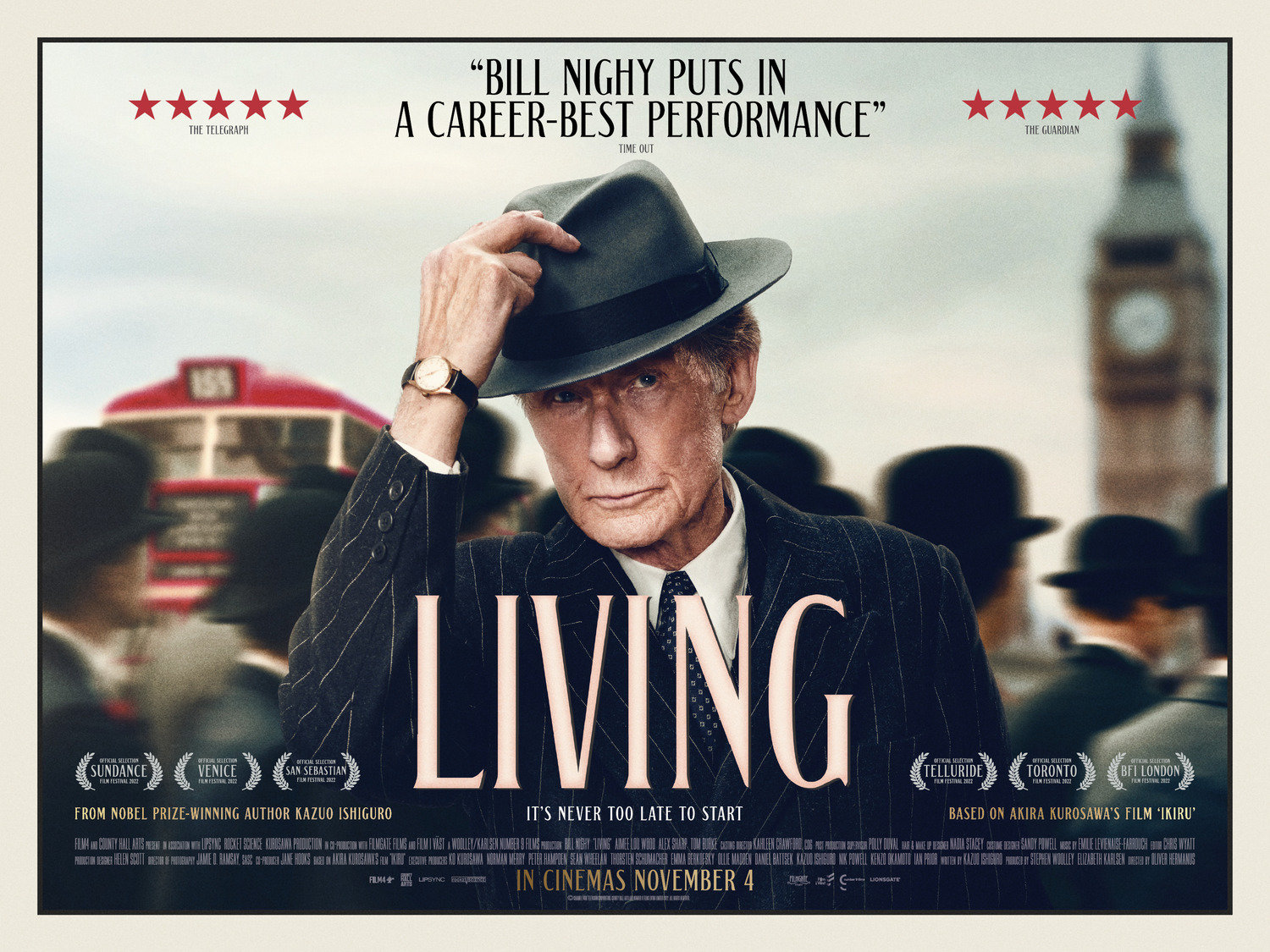
Living is a 2022 film, directed by Oliver Hermanus and written by Nobel Prize-winning author Kazuo Ishiguro. It was inspired by Akira Kurosawa’s 1952 film Ikiru, which was, itself, a retelling of Tolstoy’s The Death of Ivan Ilyich.
When Ishiguro won the Nobel Prize for literature in 2017, it was for a body of work which ‘uncovered the abyss beneath our illusory sense of connection with the world.’ (1) Given the theme of this issue of Sofia, an exploration of efforts towards true connection — or ‘love’, both in and for the world — will be the core of my analysis of Living. In what follows, I shall draw out a few relevant ideas, as a way of encouraging you to seek out and watch the film yourself, if you can. Unavoidably, I will cover much of the plot in what follows, so I warn you of that now. Fortunately, I do not believe that existing knowledge of the story will spoil your appreciation of the piece, artistically or philosophically.
The setting of the film provides an important context for the action and some explanation for the relationships that form the crux of the narrative. We find ourselves in 1950s London, and tropes about suburbia and the rituals of its commuters abound in the opening scenes. The popular memory of postwar ennui is intentionally foregrounded. This is the stifling, repressed world of hierarchy and social expectation, of people seen as anonymous cogs in a larger machine; as automatons ruled by the clock and governed by strict customs and mores.
This atmosphere being established, we meet Bill Nighy’s middle-management bureaucrat, Mr Williams, of the Public Works Department in London’s County Hall. As you might imagine, the Council’s processes are presented not just as labyrinthine but deliberately circuitous and purpose-built for inertia. Mr Williams’ own attitude is the apogee of this approach. Whenever new proposals cross his desk, he responds ‘we can keep it here for now, it won’t do any harm.’ As a colleague of my own recently recalled, from their time in a similar institution, the feeling amongst the workers is that stalling decision-making offers one an easy life: ‘the longest way round is the quickest way home.’
As the film progresses, we discover more about the emptiness and rigidity of Mr Williams’ life, at home as much as in the office, and some events in his past are alluded to, by way of explanation for his yearning for order and a lack of excitement. Nevertheless, in a particularly moving interaction with his son and daughter-in-law, we also realise that, in truth, he has a need to be needed and a desire to be in community. Sadly, a combination of personal and social circumstances have left him not knowing how to articulate or act upon these feelings. As E.M. Forster has it, would that he could ‘only connect.’ That is, connect more deeply with the world around him but also connect his head and his heart; his intellect and his emotions. (2)
The film’s first turning point away from this presentation of a safe, staid existence comes when Mr Williams receives some news which jolts him into asking the question: how do I live? By which he means, how can I really live and feel the worth of experiencing the world? He finds the first impetus for that new way of being, perhaps echoing classics of English literature, in an unexpected place. Somewhere deliberately away from London and the subtle oppression of his neighbours, his colleagues and the very landscape. (3) He goes to the seaside. Here, in what seems to be a world built only on frippery and frivolity, he finds emotional truth and the freedom to express himself. In apparently seedy bars, he finds real life growing in the forgotten cracks of 1950s society, like wildflowers breaking through a pavement. The implication is that there is vitality to be found in the margins, even though there is hardship, because there is a kind of liberation from expectations. Notwithstanding, the hardship itself breeds a necessarily reciprocal community lifestyle. Mr Williams realises that breaking some of the rules imposed on him by the system he inhabits need not be considered ‘wicked.’ In the right circumstances, subverting boundaries is the healthy thing to do. It can be an expression of love.
How do I live? … How can I really live and feel the worth of experiencing the world?
After this ‘pilgrimage’ to the sea, Mr Williams is further awakened to the benefits inherent in the formation of real connections. He begins to understand more of what it means to live truly in and amongst the world. This education comes at the hands of his colleague, Miss Harris. They eschew the gossip and assumptions about the nature of their association and form a fruitful platonic friendship. She reveals to him the value of depth, honesty and generosity in one’s relationships and helps him to gain a real ‘appetite for life.’ She reaffirms that it is possible to find wonder and joy, even in seemingly quotidian things. Essentially, Mr Williams might be said to have experienced a dark night of the soul, after which he realises, to borrow from Dylan Thomas, that he does not want to ‘go gentle’ towards his end. (4) He will not be a passive ‘zombie’ any more, as Miss Harris had been wont to call him. He will really live. In fact, eventually, it is Mr Williams who realises that there is ‘heaven in ordinary’ more readily than his younger colleague. (5)
Upon returning from these adventures and coming back to his desk, Mr Williams has a plan for embodying his desire to live and love more fully, by using his knowledge and power to help those on the margins. His old, internal barriers have been torn down, and nor will he allow the barriers placed in his way by his institution to hamper his progress. He uses his skills, connections and status to greater and more positive effect than perhaps he has ever done before. He works with passionate alacrity towards his new goal: to build a children’s playground in an abandoned bomb site.
This mission fills him with purpose, energy and urgency. He even uproots his colleagues, all of whom are as stuck and suffocated as he once was, by forcing them out of the office to view the site itself. This literal change of scene is also a symbolic moment of transition. The men have to walk through rubble, rain and dirty water to reach their target. They have to cross a threshold, and this is not easy. It takes time and effort. Nevertheless, Mr Williams sees the potential for new life on the other side of this threshold. In the course of working on his new project, he does, indeed, form real relationships with those he meets and generates a sense of camaraderie amongst all involved. Perhaps unlike even the reformed Ebeneezer Scrooge, Mr Williams’ actions are not simply paternalistic and nor do they idolise certain presentations of hardship. They are dialogic. He has the bravery to discard social norms and, instead, he acts from a place of equanimity and love. In fact, given the portrait of Mr Williams we are shown in the first third of the film, it might be just as significant that he acts at all. It is telling that simply doing ‘no harm’ is no longer good enough for him. He wants to stoop down from his position of apparent authority, get amongst the messiness of life and do something worthwhile.
In the right circumstances, subverting boundaries is the healthy thing to do. It can be an expression of love.
During these scenes of high activity, Ishiguro appears to preempt some typical criticism of those who do good works to ‘brighten the corner where [they] are’, to quote the popular American hymn. (6) Mr Williams himself recognises that one playground is just that: one playground. He knows that his work will always be incomplete, and he leaves room for it to fall into disrepair or be superseded. Nevertheless, he doesn’t allow that to deter him from his efforts or detract from the value that the playground can have, in the moment. He can envisage the impact of his project for the personal-social development of the local children. The playground will not stand for all eternity but, whilst it serves those it is built to serve, it will be a place of joy, creativity and real community. Therefore, whatever comes next, it still has value and can provide satisfaction for Mr Williams and the children for whom it is built.
I would suggest that this makes the bombsite playground an icon of progressive, liberal, free-religious community. It is intentionally provisional, and no-one working on it has any illusions of it being something everlasting. It is a grassroots movement, albeit one formed by the coming together of the right mix of people, at the right time. It works in and for a specific context, but that doesn’t prohibit it from having a ripple effect elsewhere or, via those who visit, an impact on the future. It is formed in the cracks and the forgotten places, outside the mainstream. It is focused on building real community and it is a crucible for childlike imagination and creativity. As such, there is a vitality and even a healthy wildness to it.
The film itself invites us to see playgrounds like this, as symbols of something beyond their literal purpose, but it is also true that building playgrounds for children was another trope of 1950s council work. Even at the time, there was a utopian element to the idea of these new recreational spaces — perhaps particularly when they were erected in bombsites — which contributed to certain, future-focused attitudes towards children and childhood. (7) The bombsite playground, then, definitely tells us something about what it means to express love in and for this world.
Later in the film, Mr Williams’ disciples, as it were, continue his mission. They each claim that, like him, they will not be beset by doubts, or by pressures from their superiors. They all commit to actively working towards their predecessor’s ideal. Love, after all, is a verb. It’s something you do. Sadly, although perhaps inevitably, Mr Williams’ colleagues do not maintain their commitment to a better world, as symbolised by the playground. In the ‘grind’ of their daily tasks, they soon descend into their old ways. Ironically, though, there is still a fight to take the credit for Mr Williams’ project when it is finished. Nevertheless, these reactions are understandable. Perhaps they even represent a typical pattern for spiritual and social justice movements, when the original leader is no longer there to hold the group together. The weight of a whole society is telling Public Works that there is no alternative to business as usual. Indeed, even if some of us have moved beyond putting the founders of our respective spiritual movements on pedestals, at the expense of future progress, I suspect we are not immune to the pressures Ishiguro presents either. In fact, the film is implicitly asking us to confront that possibility. Might we feel the same stultifying weight, for instance, in our liberal religious work, or our work to fight climate change? In these two arenas, and many others besides, there are plenty of forces telling us that the job is too big and our efforts too small, that things cannot change, that they do not really need to, or that we are foolish for thinking there is any great appetite for change anyway.
Fortunately, the film itself ends on a note of hope. Mr Wakeling, a more recent addition to the Public Works Department and through whose eyes we first see it, becomes frustrated that the energy Mr Williams inspired has dissipated and that the original group have dispersed. It is only Mr Wakeling who recognises the danger of their return to a listless approach to life and work. In response, he resolves that he will not allow Mr Williams’ vision to be lost. A visit to the original playground proves energising and we are left with a feeling of potential. The memory of the project and the happiness it generated, for Mr Williams as much as for the children, acts as a spur for Mr Wakeling’s own desire to do difficult, rewarding work. He will change himself and the world around him for the better. Just like a small playground in a bombsite, Mr Wakeling is only one sign of hope, but he is a sign nonetheless.
It is probably quite obvious now why the film is so entitled. The message is simple: one must find a purpose, get out there, and live! Live for oneself, and live for others; live for those around you now, for those in your past and for those far in the future. Live now, because this is the time we have. Mr Williams shows us that we have to live in spite of our limitations, beyond our fears and even beyond the sense that any positive change will be too little or too late. The central message is, quite literally, life-affirming.
In other hands, I admit, these messages would seem self-evident, even to the point of triteness. They would be platitudes and nothing more. However, the design of this film is so detailed — from the interspersal of particular pieces of music to the very deliberate choices of clothing and the well-conceived visions of each setting — and the acting is so deft, that the piece bears analysis and even repeat viewing. It is packed with rich and interesting symbolism.
To conclude, I draw the threads of this brief analysis together around the theme of this edition of Sofia. Mr Williams learns something about real, agapeic love and the building of an agapeic community. He gives of himself and crafts some genuine, deep and empathetic relationships. He realises that, if we can only learn to see this world differently, we can help to build that which has been called the Kingdom (kin-dom) of God or the Ideal Community. For Mr Williams, this aim is not abstract. It is not something one pursues instead of living fully now, or instead of being in the world. It is a result of living fully — here, now and today.
Ross McCrory is Sofia’s Arts Editor.
Image Credits and Notes
Image p. 9: Promotional Poster, Lionsgate (fair use)
1 ‘The Nobel Prize in Literature 2017’, https://www.no-belprize.org/prizes/literature/2017/summary/ [accessed 9 June 2026].
2 Edward Morgan Forster, Howards End (David Morgan, 1992), p. 195.
3 Brian C. Southam, ‘Jane Austen beside the Seaside: An Introduction’, Persuasions, 32 (2010), pp. 167–172.
4 Dylan Thomas, ‘Do Not Go Gentle into That Good Night’, https://www.poetryfoundation.org/poems/1146569/do-not-go-gentle-into-that-good-night [accessed 1 June 2026].
5 George Herbert, ‘Prayer (I)’, https://www.poetryfoundation.org/poems/44371/prayer-i [accessed 1 June 2026].
6 Ina Dudley Ogden, ‘Do not wait until some deed of greatness you may do’ (1913) https://hymnary.org/text/do_not_wait_until_some_deed_of_greatness [accessed 01 June 2026].
7 For an example of scholarship along these lines, see Jon Winder, Designed for Play: Children’s Play-grounds and the Politics of Urban Space, 1840–2010 (University of London Press, 2024).