
Contents
Editorial
- Where Then is My Hope?, Paul Overend
Articles
- Hope Against the Odds, Christiane van Duuren
- Ernst Bloch: Religion, Atheism, and Hope, Paul Overend
- Bartleby's Resistance, Andy Kemp
- Reflections on RE Part 2: Hope for the Future of Religion and Worldviews Education, Dave Francis and Denise Cush
Regulars
- Lived Religion: Katy Jennison, Pagan Sea of Faith Member
- Book Recommendations
- Review: Restoring Humanism to Religion by David Galston, David Boulton
- Review: Navigating Uncertainty by Ian Scoones, Digby Hartridge
- Anniversaries of Publications by the Sea of Faith Network, Teresa Wallace and David Boulton
- Network Matters: SoF Publications, Paul Overend
- Letters
Where Then is My Hope?
by Paul Overend | editor@sofn.uk
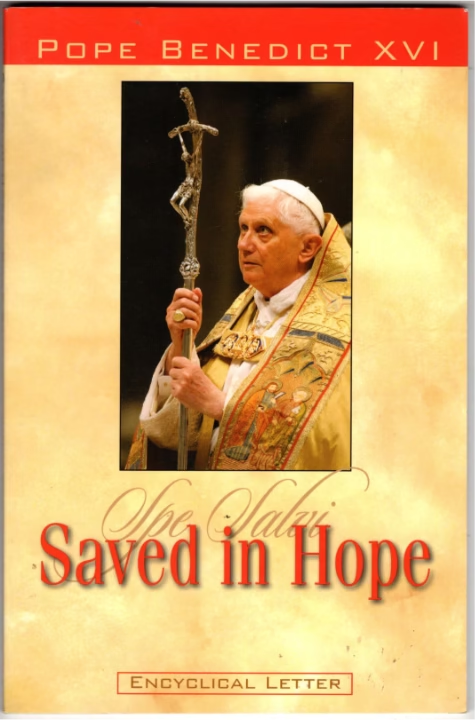
Hope was the theme of Pope Benedict XVI's encyclical Spe Salvi, translated as 'Saved in Hope'. The title cites Saint Paul, 'in hope we were saved' (Spe Salvi facti sumus, Rom. 8.24). Benedict contrasted the hope of salvation based on faith in Christ (§10–15) favourably with hope in progress based on Enlightenment principles of reason and freedom, while also characterising Marxism as an ideology of progress (§18–23). In what might be taken as a rebuke of Cupitt's early work, Benedict claims,
To protest against God in the name of justice is not helpful. A world without God is a world without hope (cf. Eph. 2.12). (§44)
Rarely has an encyclical had such an untimely birth: It was published on 30th November 2007, two months after the run on the British bank Northern Rock and the American global financial services firm Lehman Brothers filed for bankruptcy, and one month after the U.S. Congress approved a $700 billion bailout to stabilise the financial system, and the UK government was forced to inject £37 billion into RBS and Lloyds-HBOS to prevent their collapse. With the subsequent collapse of the stock market in 2008, these events led to political turmoil and electoral despair from which we have not yet recovered. When, in 2009, Vera Baird, the Solicitor General, said that she could see 'a few green shoots' of economic recovery — on the day that unemployment in the UK rose to 2,030,000 and Barclays announced further job cuts — she was widely accused of complacency and insensitivity.
In light of those events, the hope that Pope Benedict spoke of seemed almost immediately hollow. Over 30 years, our sense of hopelessness has been exacerbated by the powerlessness felt in the face of austerity budgets (in the UK from 2010), the COVID-19 lockdowns (2020-2021), the rise in aggressive diplomacy, militarism, religious nationalism, wars — and their global impacts on cost of living — political interference of vested interests, and advancing climate change. Many people experience either 'learned helplessness' or 'anger turned inwards' that are characteristic of depression. As Job complained, 'Where then is my hope?' (Job 17.15)
Reviewing this encyclical, theologian Jürgen Moltmann contrasted Spe Salvi with the Gaudium et Spes ('Joy and Hope', known as The Pastoral Constitution on the Church in the Modern World, 1965), one of the four key constitution documents of Vatican II. Moltmann notes that Vatican II's Gaudium et Spes, 'begins with the church's deep solidarity with "the entire human family."' But Pope Benedict had explored hope in Christian doctrine for the committed faithful, set apart from others who 'have no hope' (I Thess. 4.13, cited §2). Also, Benedict's focus was on blessedness in eternal life, but this 'Christian hope then becomes hard to differentiate from a Gnostic religion of salvation', Moltmann observes:
What is missing is the salvation of a groaning creation and the hope of a new earth where justice dwells.1
Unlike the conciliar constitution, and other social encyclicals, and documents of Catholic Social Thought over the last 135 years — since Pope Leo XIII's Rerum Novarum (On the Condition of Labour, 1891) — Benedict failed to address broader social and environmental issues, or the problems of under-regulated speculative capitalism. Indeed, he offered a simplistic, dismissive critique of Marxism, which does analyse these things.
The omissions of Benedict's encyclical give a material perspective from which we consider hope in this edition. The theme is introduced by Christiane van Duuren, who writes of her stay on a Palestinian farm to the southwest of Bethlehem, called The Tent of Nations, the tenacity and resilience of the Nassar family who own it, and the hope that sustains them.
'The Necessity of Hope' was a theme of the Sea of Faith conference in 2018, in the centenary year of WWI. Versions of the keynote papers can be read in Sofia 129. Two of the keynote speakers were co-editors of and contributors to Religion and Atheism: Beyond the Divide, published the previous year.2 The Rev'd Dr Tony Carroll drew upon Kant and later Kantian thinkers:
For Kant if we hope, we already assume the existence of God as a postulate of practical reason. […For] without belief in God there is no practical ground for hope in the face of the tragic nature of life.3
However, Prof Richard Norman remarked that:
For a humanist, a faith capable of sustaining hope can only be a faith in human beings, real human beings in whom we can place our trust.4
He drew upon Hegel, the progress of reason and growth of freedom, and the work of the young Hegelians who followed him. The presentations are worth revisiting.
Missing from this debate, however, was the work of Ernst Bloch, the atheist, theologian, and idiosyncratic Marxist philosopher, who Paul Overend introduces in this edition. Bloch was an honorary professor at Tübingen in the 1960s, when the 39-year-old professor Joseph Ratzinger joined the staff there in 1966, after Vatican II. (He became Pope Benedict in 2005, aged 78.) Ratzinger's colleagues Hans Küng and Jürgen Moltmann were greatly influenced by Bloch's work on hope, but Ratzinger's later criticisms of Marxism and liberation theology often have Bloch's work in his sights.
Also in this edition, Andy Kemp considers the character Bartleby in Herman Melville's short story 'Bartleby the Scrivener' as expounded by the Slovenian-born philosopher and cultural theorist Slavoj Žižek. Another idiosyncratic Marxist, he describes himself as a 'Christian Atheist'.
Dave Francis and Denise Cush continue a series of articles explaining current developments in Religion and Worldviews Education (RE), considering the opportunities offered by the Curriculum and Assessment Review of 2025.
2026 also marks the twenty-fifth anniversary of the Sea of Faith publication Time and Tide, and the thirtieth anniversary of a shorter booklet, A Reasonable Faith. Teresa Wallace, who was lead editor of the first, and David Boulton who wrote the second, reflect on their publications in this edition. 'Network Matters' reports on Sea of Faith Network publications, and on the progress of a new publication, due out in 2027, on the philosophy of Don Cupitt.
Sofia loves to receive readers' articles, book reviews, letters, and can now consider artistic pieces — e.g. poetry, prose, reviews — as we have an arts editor (see inside front page). Please do write, and help us to explore religion and worldviews as human creations.
Hope is a belief that what we do might matter, an understanding that the future is not yet written. It's informed, astute open-mindedness about what can happen and what role we may play in it. Hope looks forward, but it draws its energies from the past, from knowing histories, including our victories, and their complexities and imperfections. It means not being the perfect that is the enemy of the good, not snatching defeat from the jaws of victory, not assuming you know what will happen when the future is unwritten, and part of what happens is up to us.
Rebecca Solnit. From 'Protest and persist: why giving up hope is not an option', The Guardian, 13 Mar 2017.
Notes
1 Jürgen Moltmann, 'Horizons of hope: A critique of Spe salvi', trans. Sean Hayden & Gerald Liu, The Christian Century (May 2008) 125(10). Available at <https://www.christiancentury.org/article/2008-05/horizons-hope> [accessed 24 Feb 2026]
2 Anthony Caroll, Religion and Atheism: Beyond the Divide (Routledge, 2017).
3 Tony Carroll, 'Hope Faith and Redemption 1', Sofia, 129 (2018), p. 5.
4 Richard Norman, 'Hope Faith and Redemption 2', Sofia, 129 (2018), p. 9.
Letters
Please send letters to our Letters Editor, Stephen Mitchell letters@sofn.uk
David Rhodes wrote in to the previous edition (Sofia 159) to draw attention to the article 'The Violence of (White) Nonviolence' by Syed Mustafa Ali (Sofia, 158). I was very unhappy with that article, which decried non-violent responses and concluded that resistance should be 'by any means necessary'. In his letter, David Rhodes gave full support to 'the counter-violence of resistance by Hamas and its allies'.
We are called to be peace-makers. Within SOFN there will be differences of opinion as to how peace-making is best done (and some people may think that armed resistance has a role), but to unequivocally promote the right of one side to commit any form of violence they choose represents a loss of faith and an acceptance of evil. An atrocity is an atrocity, whoever carries it out, whoever it is done to.
James Priestman, Great Waldingfield, Sudbury