
Looking Back — Teresa Wallace
Time and Tide was published 25 years ago, in 2001. The editor, Teresa Wallace, reflects on her contribution to SoFN publications.
I am the daughter of a clergyman, and have a (retired) Archdeacon brother — both of whom were much more concerned with the welfare of their flocks than forcing certainties down our throats. As a child, my dear Dad used to read me the odd bible story. Being at the end of a family of seven (I was a bit of an afterthought), the one that resonated most was the tale of Zacchaeus, that man of small stature who, like me, was a tree-climber. His reason was perhaps a little more serious — he wanted to get a good look at Jesus.
As an adult, I attended church for quite a few years, so when The Sea of Faith Network came to my notice via a friend of mine — a psychiatrist — I thought, 'This is really interesting'. 'Exploring and Promoting Religious Faith as a Human Creation' sounded just up my street. For some time, I had become a little limp about the weekly ritual at my local church. Undertaking tasks such as reading the odd lesson, overseeing the annual jumble sale, and editing the church magazine had become a bit pedestrian. So when I approached the rector one day — he was a good friend — suggesting that we might get a group together to discuss what we meant by the word 'God', he looked a bit startled and said he couldn't think of anyone else in the congregation who would be interested. So I decided it was time to look elsewhere. At the first SoF conference I attended, some 30+ years ago, I was transfixed by how many ordained folk were there — and all looking so relaxed. It was great not to feel guilty about all my doubts, and to hear so many differing views on what religion can mean.
Back in 1988, when I had been a SoF member for some years, David Boulton suggested that I get together a group of Sofers who might be interested in writing about their experiences of the network. I gulped a bit, but thought that my work, many moons ago now, in magazine editing/proofreading, would stand me in good stead.
The proposed book's title was This is My Story, and eventually, fourteen members put their hats in the ring. The result was a glorious mix of views/experiences, all collected on floppy disks. Remember them? These subsequently had to be transferred to my brand-new computer, which my husband, Ian, had recently dumped on my desk, always at the cutting edge of new technologies. I groaned a bit and said what on earth was wrong with our electric typewriter?
Well, it was growing-up stuff that I had to embrace: getting to know the writers, asking them to put their oeuvres on disks, and then posting them back to me. Doesn't this sound archaic, compared with the myriad ways we are now able to communicate with each other?
They were all beautifully written pieces, so there was little editing needed, and I had a real thrill when I saw the finished product, with a lovely cover design found by David.
Three years later, it was decided to launch another book, Time and Tide: Sea of Faith beyond the Millennium, this time spreading the net a bit wider, with hugely interesting contributions from people from an interesting range of backgrounds: a former Catholic nun, a rabbi, the Deputy Secretary-General of Amnesty International, an Anglican Quaker, the Director of the British Humanists, a Bishop, a couple of poets, and a sprinkling of academics and ordained people — with an introduction by Don Cupitt. It was rather a different experience from This is My Story, in that I only knew a few of the participants, though I was particularly glad to include Richard Holloway, the Bishop of Edinburgh, whose views on religion are wonderfully open-minded. And David found another delightful design for the cover.
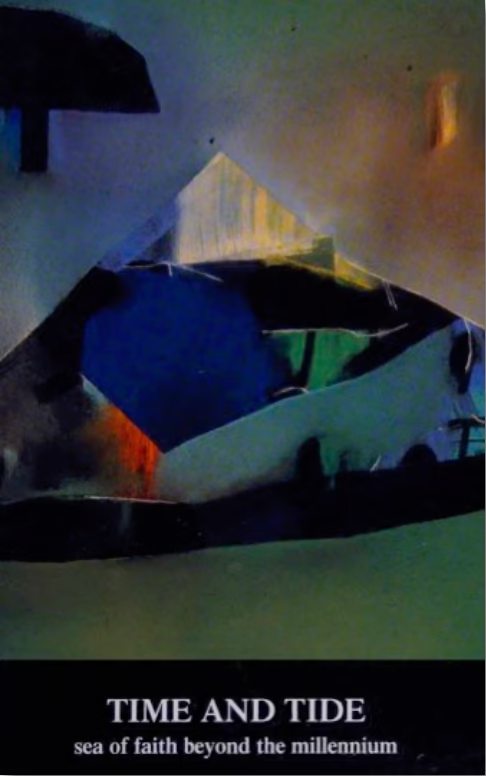
I was supported by my good friend Helen Fisher and her husband, Peter (both of whom sadly died recently), plus the Education and Development worker for the Sea of Faith, and a senior lecturer in Religious Studies at the University of Derby. In truth, it was a more challenging task to be at the helm of this second book, with a fair amount of disagreements to wrestle with. Our team was divided over the inclusion of one article; in despair, I sent a note to Don. He wrote a typically brief reply: 'Well, you're the Editor, Teresa', which gave me the confidence to put my foot down and reject the article. All good character-building stuff, I remember saying to myself…
Re-reading these books, I am struck by the variety of views the writers offer and entranced by their generosity in sharing their thoughts. Published in 1998 and 2001, they still feel remarkably fresh as they sit happily amongst all my books on religion, and looking back, I feel very blessed that I was responsible, to some degree, in getting them published.
Teresa Wallace
My Word! — David Boulton
A Reasonable Faith was published in 1996, 30 years ago. David Boulton reflects on his role as a writer and work on Network publications.
Our esteemed editor has asked me to write about the books and booklets I've written on religion understood as a human creation, both those specifically for SoF and those intended for a wider readership, including the Quakers. Since I've been banging on about non-realist, nontheist or humanist views of religion since the 1960s, there's a lot of ground to cover. Therefore, be thankful, dear reader, that I am limited to the stuff I've written on religion, leaving my books on jazz, nuclear disarmament, socialism, Ian Paisley, Patty Hearst, the Lockheed bribery scandal and the future of broadcasting to rest in peace.
It began in 1963 (famous as the year, according to Philip Larkin, when 'sexual intercourse began … between the end of the Lady Chatterley ban and the Beatles' first LP'). In the immediate wake of Bishop John Robinson's famous/infamous Honest to God, SCM Press published The Honest to God Debate, a collection of essays including one by me. Reading Honest to God, I wrote, 'was for me a moving experience because it described a path I have walked myself', a path which brought me to the point where 'I began to wonder whether it was useful or honest so to stretch the meaning of words as to change their nature altogether and finally render them unserviceable. "God" once meant something clear and definite. So did "heaven" and "prayer" and "worship". Was there any point in my continuing to use the same words but giving each of them a special, private meaning?'. A question which would be at the heart of the Sea of Faith enterprise more than two decades later.
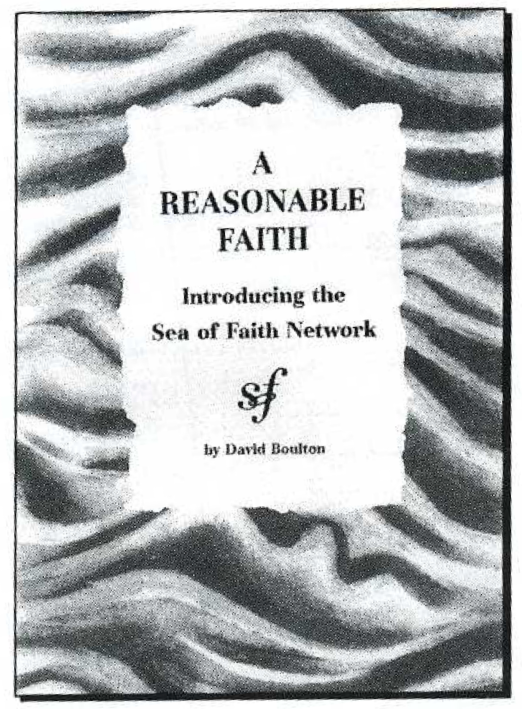
I wrote a lot over those two decades, but little about religion until the 1980s when I discovered Quakers, including nontheist ones, and the 1990s when I caught up with Don Cupitt, joined the Network and found myself editor of Sea of Faith Magazine. In 1996 the steering committee commissioned me to write a booklet explaining the Network's aims and I produced A Reasonable Faith, emphasising that 'our faith, our philosophy, our world view, must be reasonable and rational if it is to have any value. The alternative – an unreasonable, irrational faith – is not only pointless but immeasurably dangerous'. It sold well (at £2) and was reprinted in 1997 and again in 2000.
In 1997 I wrote a pamphlet for the Quaker Universalist Group, The Faith of a Quaker Humanist, envisaging a 'new radical Quakerism and visionary humanism that will value the rational over the irrational and the imagination over the literal. It will employ both head and heart. It will be suspicious of a lazy reliance on an unreflective intuition and will recognise that the mind must be exercised if we would understand ourselves and our world. Its preoccupation will be the demands of our own century, in the language of our own times, not the demands or thought-forms of the seventeenth or first centuries. Its adventure will be the creation and re-creation of human value, the application of mercy, pity, peace and love to the complexities of social and personal life'. I understand this pamphlet is still available.
1998 saw the publication of In Fox's Footsteps: A Journey through Three Centuries, written with my wife Anthea. Although based on George Fox's missionary journey through north-west England in 1652, it asked: 'After 350 years of scientific, political, religious, philosophical and psychological revolutions, what, if anything, remains relevant of the vision and insight which Fox and his revolutionary band broadcast far and wide in their provocative attempt to subvert the old order?' The birth of a 'profoundly religious humanism' was our answer.

'Religious humanism' was the core idea in The Trouble with God, first published by John Hunt Books in 2002 and re-issued in an enlarged edition in 2005. I explained in an Introduction that 'I am writing for those who, in poet Stevie Smith's words, cannot "bear much longer the dishonesty / Of clinging for comfort to beliefs we do not believe in", who will not "allow good to be hitched to a lie", for those who sense that there are other worlds, but know they are all this one. For those who live one life, and that it is many lives. For those who believe in God as they believe in Hamlet and Mr Pickwick and Mozart's Countess Almaviva, but are as sceptical of divine providence or intervention as they are of the influence of fairy godmothers and things that go bump in the night.' Don Cupitt described the book as 'entertaining, funny and serious'. Richard Holloway found it 'affectionate, learned and extremely funny'. Were they laughing at or with me?
More books followed: Real Like the Daisies or Real Like I Love You? Essays in Radical Quakerism (2002), a collection of essays and reviews; Gerrard Winstanley and the Republic of Heaven (1999), a comprehensive study of the 20 books and pamphlets by the seventeenth century leader of the True Levellers, whose radical liberation theology fed into Quakerism, socialism and modern religious humanism; and in 2008 the book I would most like to survive me, Who on Earth was Jesus? The Modern Quest for the Jesus of History.
No-one who has spent so much time sounding off with his own opinions can complain if some readers fight back. In 2015 a fellow Friend, Derek Guiton, wrote a book asking 'How can one write about these matters [religious humanism] without mentioning David Boulton? It would be like trying to write the history of ancient Egypt without reference to the pyramids.' Alas, this wasn't flattery. Guiton argued that the Society of Friends was 'poised at the edge of the abyss', and a principal cause of the crisis was my subversive advocacy of religion as a wholly human creation. I replied in 2016 with Through a Glass Darkly: a Defence of Quaker Nontheism, admitting that 'I sometimes found myself wondering why I was spending my diminishing energies arguing the toss about divine transcendence when the task of building the republic of heaven on earth was never more urgent.' I have continued to wonder ever since.
David Boulton