
These 'Network Matters' pages explore various aspects of the charitable work of the Sea of Faith (SoF) Network. In this edition, we focus on the Network's publications.
Publishing was at the heart of Don Cupitt's life's work, alongside the media appearances that brought him to public attention and established his reputation as a public intellectual. His engagement with philosophical questions of religion was formative for the SoF Network from its inception at its first conference in July 1988, onwards. But he wasn't alone in engaging with those questions: many network members have been, or still are, published authors and poets — such as Anne Ashworth, David Boulton, Hugh Dawes, Michael Elliott, Anthony Freeman, David Hart, Dinah Livingstone, Stephen Mitchell, Steve Regis, Graham Shaw, John McDonald Smith, Frank Walker, and Tony Windross (alphabetically listed) — with publications for a wide range of ecclesiastical, Quaker, and general readers. And, of course, academic members of the SoF Network have also published, including David Chapman, Denise Cush, Andrew Edgar, Dave Francis, and Trevor Greenfield.
Several members of the Network contributed to God and Reality: Essays on Non-Realism, edited and introduced by Colin Crowder. The rear cover explains that it was designed to 'bring together leading non-realist writers and some of their most influential critics' and to be 'a significant contribution to future development as a constructive theological dialogue'. The contributors were Jeff Astley, Don Cupitt, Anthony Freeman, Daphne Hampson, David Hart, Fergus Kerr, Stephen Mitchell, George Pattison, Peter Selby, Graham Shaw, Denys Turner and Graham Ward, with a guarded foreword by Rowan Williams.
Although Tony Windross' Thoughtful Guide to Faith was not published by the Network, it was based on leaflets he produced for the Network. These were published as 'Why Bother', in a format suitable for leaving at the back of churches.
Network publications
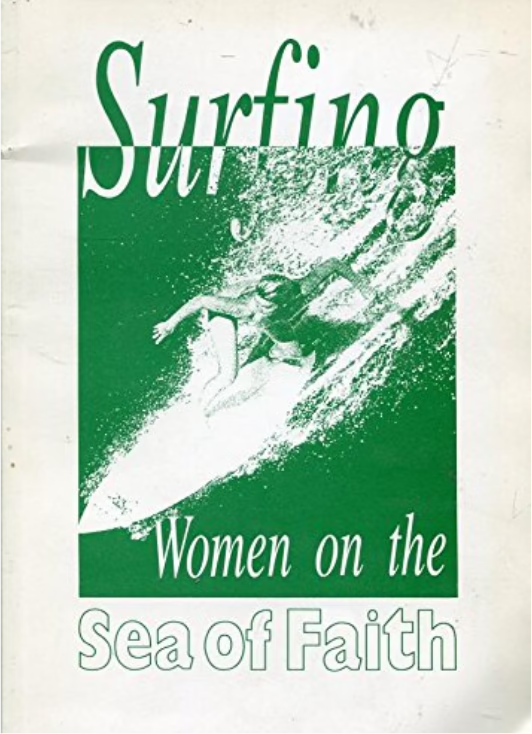
1995, Surfing: Women on the Sea of Faith, was edited by Maxine Green and Trudi Newton. In this collection of essays and poems, the book explained that 'women from the Sea of Faith Network describe their experiences of "exploring religious faith as a human creation"'. The contributors were Anne Ashworth, Anthea Boulton, Valerie Clarke, Jane Cole, Mel Crossleu, Maxine Green, Anne Horner, Aileen La Tourette, Penny Mawdsley, Trudy Newton, Barbara Ratcliffe, Ruth Robinson, and Wendy Worham. Ruth Robinson was the widow of Bishop John Robinson, of Honest to God fame.
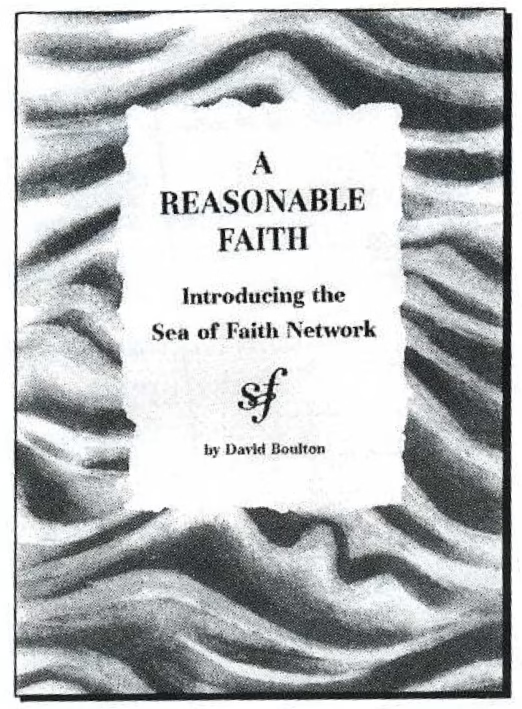
1996, A Reasonable Faith by David Boulton (Sofia, 160, p. 20–21). This year, 2026, marks the thirtieth anniversary of this booklet, produced by the Network, which remains available on the Sea of Faith website. As many readers will know, David was the editor of SOF, the magazine of the Sea of Faith (issues 11–21, 28–51), and a well published author. David lists some of his books on religion in an article in this edition, a couple of which were reviewed in the magazine. He also edited Godless for God's Sake: Nontheism in Contemporary Quakerism (2006), which was also reviewed in Sofia.
1997, Agenda for Faith by Stephen Mitchell. This production ran to a second edition (2011) with an added preface, when it was made available on the Network's website. Written not long after Anthony Freeman's book God in Us: A Case for Christian Humanism (1993) and in light of the furore that cost Freeman his job, Stephen considered whether the Church of England could adapt to changes in theology. The book was reviewed twice in Sea of Faith by Mike Jenkins and Elizabeth Wilkinson, and more information about the book and their responses to it can be found there. Stephen Mitchell's other publications include God in the Bath (2006) and Past Perfect (2018).


1998, This is My Story: voyages on the sea of faith, edited by Teresa Wallace (Sofia, 160, p. 19–20). This collection of articles was produced when Teresa was Convenor of the Sea of Faith's Publications Sub-Committee. It comprises personal stories by fourteen members of the Sea of Faith network about how and why they found themselves in the Sea of Faith and their understanding of religion. The contributors were Helen Alexander, Anne Ashworth, David Boulton, Jude Bullock, Derek Chorley, Alec Davison, John McDonald Smith, Penny Mawdsley, Duncan Park, David Patterson, John Pearson, Clive Richards, Janet Taylor, and Patti Whaley — from Catholic, Anglican, Methodist, Presbyterian, Brethren, Salvation Army, and Congregationalist churches, and from Quaker and humanist backgrounds. Their work bears witness to the warmth, wit and wisdom found in the network.
2000, Will The Real Jesus Please Stand Up: A Quest, Inquest, Conquest, Request for the Historical Jesus in the Words of Scholars, Would-be Scholars, Poets, Essayists, Journalists and Even Theologians, was edited by David Boulton. As the subtitle suggests, it was a miscellany of lightly edited extracts from writings about Jesus. SoF published it to coincide with the visit to Britain by Robert Funk, founder of the Jesus Seminar in the USA. This led to closer links between the Network and the Seminar, with Don Cupitt and David Boulton making several visits to the States.

2001, Time and Tide, edited by Teresa Wallace, with Peter Fisher, Helen Fisher, Michael Elliott, and David Hart (Sofia 160, pp. 19–20). This year, 2026, marks the twenty-fifth anniversary of this Sea of Faith publication. It was a collection of commissioned essays and thought-provoking poems produced at the turn of the 21st century by Don Cupitt, Karen Armstrong, Paul Davies, Richard Holloway, Lloyd Geering, Dan Cohn-Sherbok, Robert Ashby, and Sea of Faith members, Anne Ashworth, Pamela Donohue, Michael Elliott, Philip Knight, Stephen Mitchell, Graham Shaw, and Patti Whaley. At the time, Michael Elliott was the Education and Development Worker for the Sea of Faith Network.
Where contributors to the earlier This is My Story were 'asked not to talk about how we "found Don"',12 this publication engaged, to some greater or lesser extent, with Don Cupitt's and similar theological and philosophical work. That the book had an impact can be seen in the range of reviews, summarised in the SoF magazine.13 We have an article in this publication by Teresa Wallace reflecting on that work on its silver anniversary of publication.
2009, This Life on Earth, edited by Dinah Livingstone. This is an anthology of 16 poems and 23 prose pieces on the theme 'This Life on Earth'. There are 38 contributors to this book, 19 women and 19 men, who offer a variety of responses to the theme — from personal stories to more general ecological, reverential, and other reflections on life on our vulnerable planet. Anthony Freeman offered a personal response in the form of reflections on the book and on the theme of the environment, published by way of a review in Sofia. The volume editor, Dinah, was also editor of Sofia (issues 68–154) at the time of publication. She is a renowned poet and translator, with numerous publications including ten poetry collections.


2015, From Monk to Modernity: The Challenge of Modern Thinking, by Dominic Kirkham. This was a 'personal odyssey' reflecting on how he met the challenge of modern thinking and journeyed from the religious life. A second edition of the same title was published by Wipf & Stock in 2018 (with a different cover). Dave Francis wrote a review of the book in Sofia. Dominic also published Our Shadowed World: Reflections on Civilization, Conflict and Belief (2019) and Horror and Hope: The Conflicted Legacy of Christianity (2021).
2027, A Philosophy of Life
Over the past 16 months, Paul Overend and Stephen Mitchell have commissioned and edited articles for a new book, now in production under the Iff label of Collective Ink, the publishers. The book is titled A Philosophy of Life: The Spirituality of Don Cupitt. The process has been both a steep learning experience and deeply rewarding.
The publication was planned from the time of Cupitt's death in 2025 to celebrate Don's contribution to the network and to encourage further engagement with his work. It aims to serve as a bridge between the general readership Cupitt sought to reach and teach and academic readers, thereby stimulating discussion to advance the study of Cupitt's philosophy. The book explores Cupitt's philosophy in terms of ethics, spirituality, and religion. Cupitt's approach to philosophy developed from an ancient Greek and Roman tradition, in which philosophy was concerned with a way of life and ethics sought to imagine and articulate the "good life". Cupitt's work advances this philosophical wisdom tradition, but does so within a contemporary understanding of language and culture. Cupitt's approach dissolves the divide between "philosophy" and "religion" within a democratic theological-philosophy of "Life". He develops both personal and social ethics of the good life in terms of expressive solar ethics and critical humanitarian ethics. The book traces Cupitt's spirituality through themes of asceticism, critical thinking, mysticism, and self-fashioning.
Those who have contributed chapters include the bestselling Secular Buddhist pioneer Stephen Batchelor (whose work reflects Cupitt's in several ways), a number of academics — David Biernot, Christo Lombaard, Linda Woodhead, and Don Cupitt's Chinese translators, Zhicheng Wang and Caihong Zhu — and some Sea of Faith Network members — Andy Kemp, Philip Knight, and the editors, Stephen Mitchell, and me. There is also a moving personal reflection by David Boulton, reprinted with the permission of the editor of Fourth R, the Westar magazine, which serves as a perfect foreword.
While contributors and editors have generously donated their time and expertise, the publication has been made possible by a generous anonymous donation. The profits from sales are therefore available to the Sea of Faith Network to advance its charitable educational work. We thank all supporters of the network for their financial support, which enables its charitable work to continue. We hope this publication will lead to future books and other educational materials, continuing to advance our educational work for both formal learning in schools and universities, and informal learning among people of all ages.
Paul Overend
Notes
More information on the book is available on the A Philosophy of Life webpage, where The Preface gives the intended purpose of the book.