
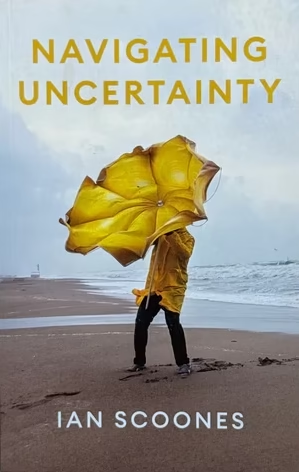
Ian Scoones, Navigating Uncertainty: radical rethinking for a turbulent world (Polity, 2024).
I was strangely cheered by Ian Scoones's book. Oversimplifying, he argues that marginal farmers and small-scale entrepreneurs in Third World countries might cope better than us sophisticates in a major catastrophe — chaos theory predicts it! In countries without effective administration, he says, people on the ground are suspicious of the generalised prescriptions of government and of international organisations (sold as "development plans" but originally evolved for advanced economies) and make use of their advice and extension services with extreme discretion, alongside many tried-and-tested traditional sources and networks. Can we learn from Zimbabwean peasant farmers, Kenyan petty merchants and Eritrean cattle herders, who have always faced uncertainty, dealt with unexpected setbacks, wars, epidemics, droughts and other natural disasters, and gained resilience and flexibility? Can we learn, we who rely on insurance schemes, risk management and predictive models that break down immediately in the face of any real reckoning? The 2008 monetary crisis, the Covid pandemic, and the manifestations of global warming provide examples.
Scoones cited studies showing that, for instance, western firefighters in California found all contingency plans useless and resorted to old stratagems remembered by the older hands. How do you understand complex, non-linear systems? What skills and systems remain appropriate in conditions of great uncertainty? In Britain, we're at particular risk because we're reliant on badly conceived programmes, rigid algorithms, untested mystical AI, and, above all, we're wedded to top-down control. And our excessive short-termism leads us to knee-jerk reactions and inconsistent thinking. Scoones analyses our broken financial structure and technology (what's safe and for whom?) and advocates building responses from below. He decries solutionism, box-ticking, conscience-salving — and snowballing corruption. He's at his best with exhaustive case studies from Africa and Asia, where he reflects on local empowerment, long-established links and loyalties, flexibility of planning, diversification, and, crucially, the role of women. He acknowledges that the necessary changes in mindset will be difficult.
And in the coming apocalypse? Here, Scoones begins to generalise and tends to resort to vague sloganeering and jargon, "polyphonic narration", "the logic of care", resistance to the "cheerleaders of despair", "transformations within spaces of change". He's right, but you need to see for yourself what it can tell us about our own plight.