
Q. You kindly shared in Sofia 121 that you were a Wiccan, Katy. How does your faith tradition and your personal practice shape your outlook and influence the pattern of your daily life?
A decade or so ago, when I was the Secretary of the Oxford Council of Faiths, we had several meetings which we called 'speed-dating': the idea is that each person pairs with someone of a different faith, and each of you gets five minutes to describe to the other what your faith means to you. Not what your faith teaches, or what you believe, but what it means for you personally and for how you live your life. And the lovely thing about this format is how quickly you discover how much common ground you share with people of different faiths.
I think my answer to the same question today would be that my Paganism gives me the tools to make sense of my life, of the world around me, and of my relationships to the different parts of that world. Seeing everything on this Earth as, in its own way, sacred has propelled me into activism with the Green Party. The components of the Wiccan rituals that I use (see below) help me find a way through the problems and challenges of everyday life. And the discussions which I have with my fellow Pagans (mostly on Zoom, since my stroke) perpetually introduce me to new concepts, frequently raise questions I hadn't thought of, and keep my thinking sharp. My sense of myself as a spiritual creature feels at home here; it keeps my feet on the ground while allowing my imagination to soar above the clouds.
Q. Are there particular practices in your religious tradition that are particularly important to you?
My regular ritual practice at each full moon is what keeps me especially grounded. (The full moon is traditional, but the ritual could be done at any time.) As I'm what's called a 'solitary practitioner', I generally perform this alone. What I do would be immediately recognisable to other Wiccans and to most non-Wiccan Pagans, but every solitary Pagan will do things their own way, with a form of words, or simply an emphasis or an interpretation, which is uniquely our own.
There are several parts to the ritual, and the preparation for it involves setting up the ritual space, a process that also serves to prepare me psychologically (attuning me, or getting me in an 'appropriate mood'). Depending on where I'm doing the ritual, this may entail moving some furniture and setting out any equipment (candles, incense, etc.). It will probably also mean putting on different clothes or at least accessories. Often I work indoors, but if the weather and the season are encouraging, I'll be outside — but I'm too old now to feel a ritual is enhanced by getting soaked or frozen. And when I was in a hospital ward, I did it entirely by visualisation. (You'll notice I use the term 'work': you will see why as I proceed.)
I work within a circle, which serves both to exclude and to include: it makes an imagined (magical) boundary between my working space and the mundane world, and it creates an enclosure for magical work, the work of transformation. The ritual proper begins in stillness, consciously centring myself in time and space, upon the earth, beneath the sun and the moon, between my past and my future. This is followed by the blessing of materials representing the four elements: salted water for earth and water, incense for fire and air. These are used to consecrate the space. I draw the circle, and facing the four directions in turn, I welcome into my circle the powers of Air in the East, Fire in the South, Water in the West and Earth in the North.
Q. You've enabled us to imagine that ritual space. Can you unpack the significance or meaning of these elements?
What these powers mean is crucial to understanding the purpose of this part of the ritual. Each of the four elements and its associated compass direction represents several more linked aspects of human experience, including the seasons, particular human attributes or faculties, and particular stages of life.
When I'm calling in and welcoming the power of the East and the element of Air, I'm deliberately awakening my power of thought, of reasoning and analysis. Visualising the air, the wind, blows my drowsy mind awake; the season is Spring, the springtime of ideas, and the dawn, the early morning of my life, for the stage of life is childhood, the energy and excitement of early youth, and the memories and lessons of my own childhood.
The element of Fire in the South impels me to call up and activate my intuition and imagination, the ability to create and to make connections (synthesis, the counterpart to Air's analysis). The element of Fire is the crucible or the furnace powering my creativity; the season is summer, with the power of the midday Sun at its height; the stage of life is young adulthood, with its ambition and its desire to forge its own path, and also its need for the fire of romantic and sexual connection; and I remember my own youth and early adulthood.
The element of Water in the West brings me to focus on the emotions: love, empathy, and compassion, but also anger, pain, and grief. The lesson of Water is to allow the emotions to flow and to find their proper levels; neither to suppress any of them nor let any one of them exclude the rest. The season is autumn, the winding-down of the year; and the stage of life is the mature adult, appraising what has been achieved and what remains to do, what must now be left behind and what might take its place.
Finally, the element of Earth, in the North: we come to stability and stillness, and to physical sensation, my affinity with the ground beneath my feet and the material world around me, and my own body with all its wonder and delight, aches and incapacities. My attention is now on tuning in to whatever my body is telling me, and appreciating it as my current home and my instrument. The season is Winter, and (as you will have worked out by now) the time of old age: accepting the need to draw oneself in, to retreat, but also (at any age) to be aware of the need for rest and silence, to acknowledge that one is ageing, and to know that death is a part of the wheel of life.
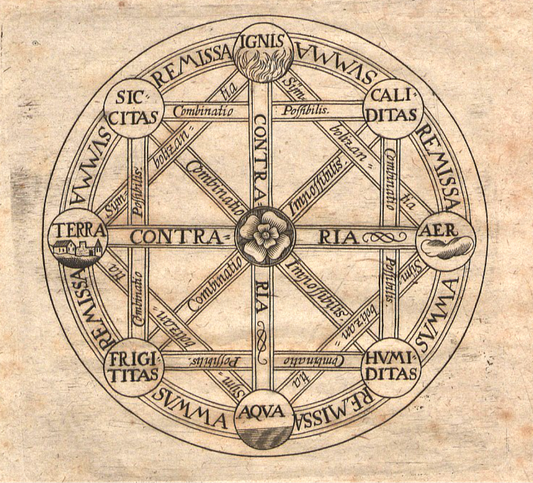
The ritual up to this point has brought all my faculties into play and honed them to a high level of alertness. I haven't yet got onto any Deities or any other ritual constituents: I've only scratched the surface, here, of the innumerable interlocking factors which correspond to the four elements.
Q. Thank you. Please continue with the rest of this ritual and its meaning for you.
The next stage is to call upon and to welcome the Divine, the Deities with whom I'm working: these may vary depending on the circumstances, but will usually, though not always, be one female and one male. My position on Deities (and on any other supernatural beings) will be familiar to Sofia readers, and can be summed up as 'a Deity can be true and real without being literally factual'. So I will call them in, and then I will school myself simply to listen, with all my senses awake. Listening: that is the heart of this stage.
After that, there might be a magical work of some kind, which entails consciously and deliberately bending my mind and will towards a particular end, while at the same time letting go of any personal attachment to the outcome. That might lead me to an understanding of what real-life action I might take, on the principle that we ourselves are the agents of the Divine, the only way the Divine can act in the world. And this, of course, is why my ritual rarely includes anything resembling petitionary prayer, other than occasionally "Help!"
Sometimes, magical work is accompanied by chanting, singing, and/or dancing to concentrate further and empower the purpose for which the magic is performed. And I'm intentionally not avoiding the M-word: it covers what most of us have experienced in ritual, although different faiths use different words: a crescendo of mental energy directed towards achieving a transformation.
The rest of the ritual includes consecrating and consuming food and wine (or equivalent), as we toast our spiritual ancestors, our teachers, and our community, spread over time and space. Eating and drinking also, importantly, brings me back down to a normal state of mind, down from the rarefied atmosphere and out of the heightened psychological state I have been working in.
It merely remains for me to tidy everything away, and to write down what I did and what words I used, and to record any insights or revelations before I forget them. These are grist to the mill of personal transformation: a person's magical work is what gradually brings this about.
Q. Thank you for sharing yourself, your experience, and understanding with our readers, Katy.
Image on p.15: The frontplate of Gottfried Wilhelm Leibniz's Dissertatio de Arte Combinatoria (1690), by Deutsche Fotothek. PD. A Leibniz representation of the universe, involving the four elements of Empedocles and Aristotle.