
Until a few years ago, for me and I'm sure for many others, 'Bartleby' was just the name of old Joe Grundy's not entirely cooperative grey pony, in BBC Radio 4's long-running agri-soap, 'The Archers'. That is, until I encountered the various and prolific writings of Slavoj Žižek, the Slovenian Marxist philosopher and cultural theorist, who describes himself as a 'Christian Atheist'.
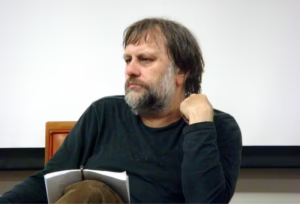
Žižek considers his book The Parallax View to be his 'magnum opus'. A parallax can be defined as 'the apparent displacement of an object caused by a change in observational position'. In the book, Žižek makes two major political points. The first concerns a split between the economy and politics. He insists that although the economy is the real arena of struggle, and politics is simply a shadow of that struggle, the battle must nevertheless be fought in politics. The second concerns the nature and effectiveness of political resistance, and this is where 'Bartleby' comes in.
Žižek contends that politico-economic systems 'contain' – in both senses of the word (to encompass or include and to limit or constrict) – their own contradictions, and that most negations of capitalism and neo-liberalism are already 'factored in'. Reactive or 'knee-jerk' oppositional resistance plays into the hands of oppressive systems and reinforces their power over society. In other words, those who simply 'resist', who campaign against, who frame their opposition in the negative or 'just say no', 'stop', have already been 'gamed' by the system they oppose. Their drive and energy merely strengthen the all-encompassing, all-dominating forces of oppression and control.
This is how Žižek introduces his argument:
'The deadlock of "resistance" brings us back to the topic of parallax: all is needed is a slight shift in our perspective, and all the activity of "resistance," of bombarding those in power with impossible "subversive" (ecological, feminist, anti-racist, anti-globalist…) demands, looks like an internal process of feeding the machine of power, providing the material to keep it in motion…'
True resistance, then, is not to meet the oppressor head-on, but to take a step sideways — working on a different alignment, using different parameters, with different values.
Žižek's model for this — explored in The Parallax View — is the character of Bartleby in Herman Melville's short story 'Bartleby the Scrivener: a story of Wall Street' (1853). Melville's two novels, Moby Dick (1851) and Pierre: or The Ambiguities (1852), had been poorly received when first published. Resorting to short story writing for magazine publications, his first successful attempt was 'Bartleby the Scrivener'.
The Story of Bartleby the Scrivener
Bartleby, a gaunt, expressionless young man, is engaged as a copyist by an accommodating employer in a legal practice on Wall Street, having previously worked in the Dead-letter Office of the postal service. He works hard at his copying, but whenever he is asked to do other work, to take on additional tasks or collaborate with his colleagues, he responds: 'I would prefer not to'. He doesn't refuse, he doesn't argue, he doesn't go on strike, he doesn't walk out, but he states his preference not to engage with the system beyond his immediate task. His remarkably tolerant employer and his exasperated colleagues are at a loss to know how to react or persuade him otherwise. His 'preferring' expression is unconsciously catching and is repeated by those around him.
The story is pushed to ludicrous extremes. The more he is prevailed upon to co-operate, the more distant and disengaged Bartleby becomes. He stares at the walls and out of the viewless windows. As his position in the firm becomes threatened, he takes to sleeping in the office; he never leaves. The boss decides the only way to free himself of Bartleby is to move his business out of the office block, but then he is confronted by the other occupants of the building, as Bartleby has become their burden in turn. The boss even offers Bartleby a place in his own home. Bartleby, as ever, 'would prefer not to'. Eventually, Bartleby is arrested, imprisoned and hospitalised. The sad denouement arrives when the boss finds Bartleby dead in the prison exercise yard, as he 'preferred not to' eat.
Bartleby inspires Žižek to explain Melville's intention in the story thus:
Bartleby's "I would prefer not to" is to be taken literally: it says "I would prefer not to," NOT "I don't prefer (or care) to" – so we are back at Kant's distinction between negative and infinite judgement. In his refusal of the Master's order, Bartleby does not negate the predicate; rather, he affirms a non-predicate: he does not say that he doesn't want to do it; he says that he prefers (wants) not to do it. This is how we pass from the politics of "resistance" or "protestation" which parasitises upon what it negates, to a politics which opens up a new space outside the hegemonic position AND its negation.
Žižek goes on to argue that, unlike some other commentators, we should not see Bartleby's 'I would prefer not to' as just the first stage of resistance: a step that needs to be taken before launching a rebuilding of society that aims to replace what has gone before. It is the whole thing, its entire foundation: a shift that disengages us from the power system AND the shadow-play of confrontation that it fosters.
Bartleby as Jesus?
One is put in mind of other examples of non-violent resistance: of Gandhi, the Suffragettes, and hunger strikers for any number of causes. But is this the same thing? Is Bartleby a protestor, a man resisting the system, in this case, the rapidly expanding engine of Western capitalism that was 1850s Wall Street? Or, is Bartleby something else, a person refusing to rebel or even engage, refusing to resist on Wall Street's terms?
Indeed, should we view Bartleby as a kind of 'Christ' figure? It is possible to detect in the gospel accounts the impression that Jesus, within the parameters of his own time, was engaged in both kinds of resistance. The cleansing of the temple certainly feels like direct action, aimed at the temple-cult central to first-century Judaism. Jesus resists: 'just stop this; it's oppressing you, it's killing the poor…' The arc of the passion narrative in the synoptic gospels implies this incident is the catalyst of the case the priests took to Pilate, alongside any Messianic claims made about Jesus. In other words, the authorities had already factored in this direct resistance; crucifixion was inevitable and final.
If we follow the line of the synoptic writers, Jesus' words and actions appear to unveil or hint at the Kingdom of Heaven. This 'Kingdom' – present, emerging and to come – is depicted as an 'alternative economy', set up in parallel to Imperial Rome rather than defeating or eclipsing it: 'render unto Caesar…' etc. The Kingdom of Heaven is not a political manifesto in a worldly sense. Rather, the 'heavenly realm on earth is like this…' and Jesus would either follow up with a parable, in which the hearer found themselves judged by their own conventional reactions, or, with an expression of extreme counter-intuitiveness if one's main motive is self-preservation or self-promotion. Mostly, Jesus is not taking on the might of Rome, but presenting a way for people to support each other in having as little to do with imperial power as possible. Many parables and direct teachings appear to urge responses that break the cycle of violence and oppression: 'turn the other cheek', 'go the extra mile', even 'love your enemies'. Rather, they aim at creating a context for liberation in which different rules apply. The religious response appears to be one of 'preferring not to' engage, rather than one of zealous resistance.
It is a very hard line to hold to. One senses this in the earlier writings of St Paul, a Roman citizen as well as a religious Jew, dealing with the practicalities of early churches straddling the worlds of 'Kingdom' and Empire. Three centuries later, Constantine collapsed the church into the Empire; the world became the church, and the church became the world. The church's various incarnations and denominations down the centuries have struggled to escape the world's clutches; its opposition often collapsing into complicity.
Selling Spirituality
In our own times, so much of organised religion – and not just Christianity – has been captured by neoliberal, capitalist methodology. There is a strong sense that the church is 'selling spirituality', competing with all the alternative 'spiritualities' now aimed at the wellness- or wholeness-seeking individual, many of which are also heavily monetised and market-driven. The leadership of several denominations in the UK, as in the US and elsewhere, has succumbed to 'vision and strategy' speak and to finance-led growth targets; fresh church plants are run like commercial start-up enterprises. Unfortunately, neoliberal capitalism has anticipated this; it negates the negation implied or claimed by this kind of market-compliant approach. It does not represent competition for 'the system', as it reinforces the system's tendency towards choice, consumption, and gaining advantage, and the exploitation of both workers and natural resources.
Churches and other groupings could do things differently. They might create settings where people who 'would prefer not to' be part of all that could gather to do things very differently, where alternative 'economies' based on simplicity, minimal consumption, revaluing, reducing, reusing, and recycling are given spiritual recognition. The 'freedoms' sold to us by neoliberal capitalism are so often just new layers of insecurity and anxiety for us all to bear. To be freed from these heavy burdens in exchange for much lighter ones (c.f., Jesus) would be a true liberation. Neither Bartleby nor the church-as-kingdom are about establishing a new 'symbolic order'. Rather, they are about drastically changing lives by decoupling them from systemic control and oppression. What would happen if we all 'would prefer not to' at the same time?
Žižek's last line on the subject is this: 'Bartleby couldn't even hurt a fly – that's what makes his presence so unbearable'.
Photo credit: 'Slavoj Zizek in Liverpool', by Andy Miah, Flickr, CC BY-SA 2.0.