
Contents
Articles
- Time for a New Reformation, David Boulton, Stephen Mitchell
- Subject, Object, Abject, Alison Webster
- Religion, Passion and Whatever Turns You On, Ian Stubbs
- Anger and Spirituality, Alan Norton-Taylor
- Holy Cows, Lost Sheep and Tally-Ho!, Trevor Greenfield
- Shaikh Appeal
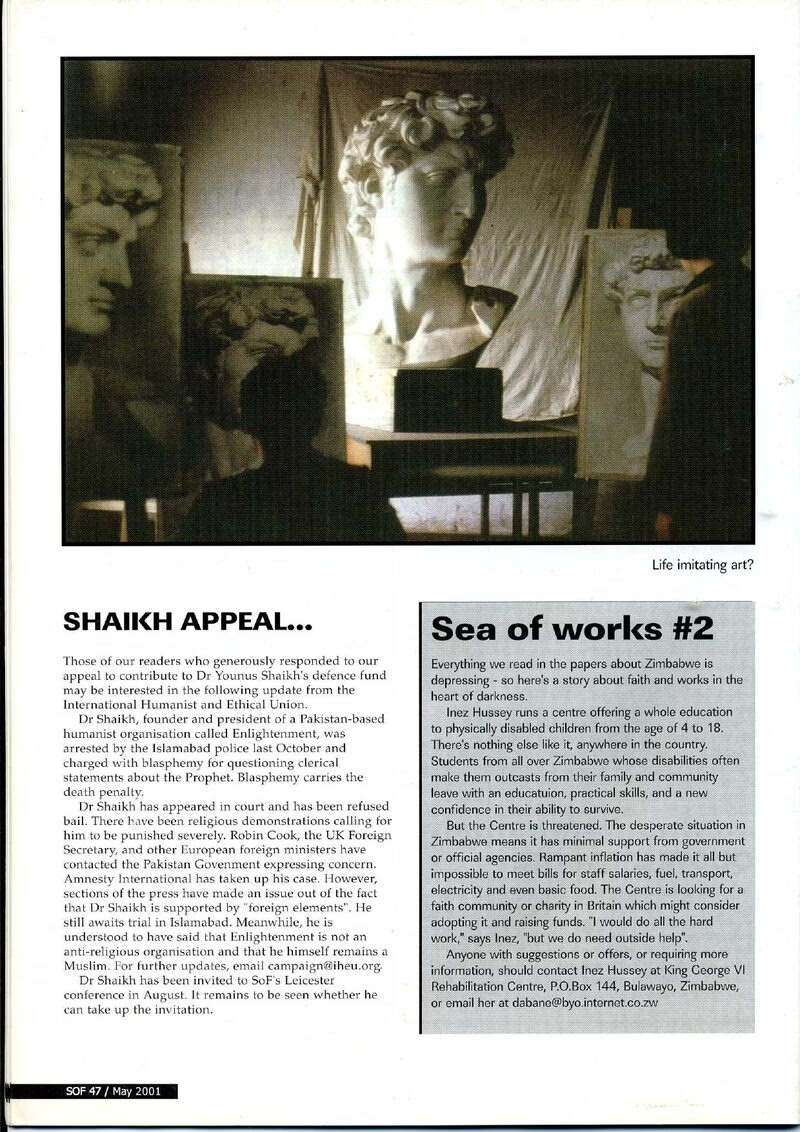
- Life Imitating Art? Sea of Works #2
Reviews
- Seduced by Candy: Chocolat (the book), Lucy Walters
- Seduced by Candy: Chocolat (the film), Tim Woodcock
Regulars and Occasionals
- SoF in the Churches: A Change of Name, Ronald Pearse
- Postscripts: Hattersley, Son of God and the Countenance Divine, Seafarer
Editorial
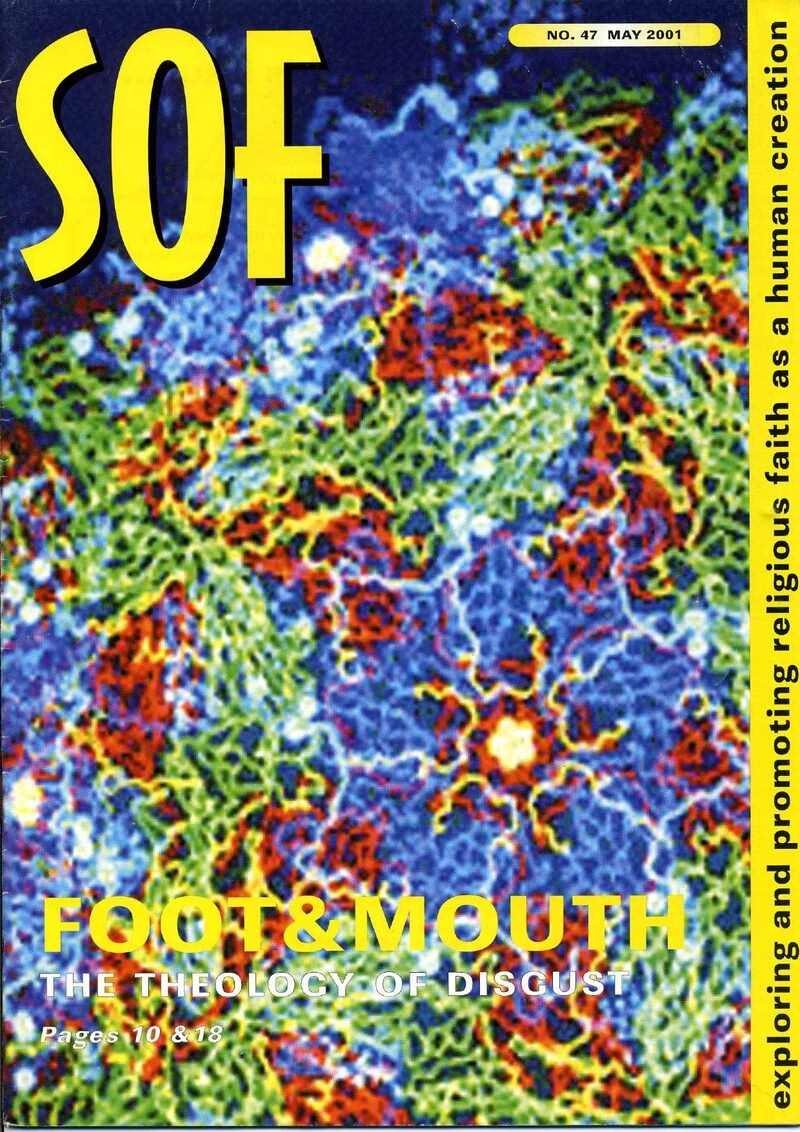
Trevor Greenfield on the aftermath of foot-and-mouth SEDUCED BY CANDY Lucy Walters reads Chocolat the book, and Tim Woodcock sees the movie 3 GLOBAL VILLAGE Editorial 20 POSTBAG You're telling us! 23 POSTSCRIPTS Seafarer gets the last word - as usual v Front Cover picture: A magnified photograph t of the ‘Foot and Mouth’ virus ~ J I chanced upon the following on the Internet, it having originated, I'm told, in a Christian publication called Quadrant. "If Earth's human population was envisaged as a village of 100 persons they would be: 57 Asians, 21 Europeans, 14 from the Americas and 8 Africans 52 women and 48 men 30 white and 70 of other colour 30 Christians and 70 of other faiths and none 1 would be near death 1 would be newly born 80 would live in substandard housing 70 would be unable to read 50 would be malnourished 6 persons would own almost six tenthsof the village's wealth 1 would have college/university education 1 would own a computer.
What a village! What a world! For all the talk by all the religions over all the centuries about justice, compassion and the one family of humankind, that's how unjust, pitiless and disfunctional is the world in which we live.
It is because the problem is so vast, the misery so great, the injustice so collossal that we do nothing or next to nothing. "What difference can I possibly make?" we ask.
But suppose we lived in a village just like that.
A village where we rubbed shoulders every day with those 80 who live in substandard housing, knew the names of those 70 illiterates, worked alongside those 50 malnourished, shared the hardships of those 96 who own much less than half the land?
I think we'd be much less likely to sit back, wring our hands, and wish someone would do something about it. I think we'd be up in arms.
We'd make big trouble. We'd run our parish councillors out of town if they didn't do something about it, fast. We'd make our churches centres for revolt and subversion, cells for plotting ways of turning the village upside down...
What would Jesus do if he dropped into our village? Any Jesus - the historical one, the biblical one, the mythical one, the black Christ of the dispossessed, the Christ-woman of radical feminism, the hippy one who (dis)graced our front cover in March? Who would he be seen with? With so much to do, would he find time to come to church?
The massive disparities which make life one long hell on earth for millions of women, men and children challenge us to think through the questions of what kinds of faith, religious or otherwise, might begin to make a difference, begin to make a fairer world here and now. What price religions of "self-fulfillment" and anguish over the destination of our own precious soul?
Religion is what we make it; and if we don't aim to make it work for a better, fairer global village, we deserve to see that village go to the hell of our own making. 3 SOF 47 / May 2001 editorial Hobsons Farm, Dent, Cumbria LA10 5RF sofpublications TIME AND TIDE A new collection of essays about Sea of Faith by Karen Armstrong, Robert Ashby, Rabbi Dan Cohn-Sherbok, Don Cupitt, Paul Davies, Lloyd Geering, Richard Holloway, Stephen Mitchell, Graham Shaw, Patti Whaley and others. Edited by Teresa Wallace, Helen Fisher, Peter Fisher, Michael Elliott and David Hart. Published by John Hunt Publishing in association with SoF (UK). £7 plus £1 p&p from the Network Secretary, 15 Burton Street, Loughborough LE11 2DT. bic are TE 3 " essential reading both for questioning members of traditional faith communities sea of fai yond the millennium é ; . ie ee and for those who have no connection with organised religion but who refuse to abandon the search for human values to live by." sofconference “2001 - a faith odyssey” 14th SoF annual conference and AGM Friday-Sunday August 3-5 2001 Leicester University Do you sometimes feel isolated as the only one in your church, meeting or other group who sees religious faith as a human creation and wants to explore what that means for you? You'll find lots of like-minded people at the Leicester conference - a rich and happy fellowship of people like you, working out together what faith means in the 21st century, and what demands it makes on us.
Nonrealism is a force of great revelation, the most significant response possible to the postmodern human condition. However, to lead a religious life endowed with these insights seems to pose two problems.
Firstly, is it possible to remain a member of a religious group which believes primarily in realist doctrines?
Although I can remain friendly with evangelical, literalist Christians, I find true dialogue uncomfortable because of their rigid acceptance of notions such as heaven and hell, or divine intervention in prayer. There is a strong temptation not to offend, and I suspect that most SoF members find difficulty in proselytising. Should the Sea of Faith act like a spiritual yeast, fermenting the inertness of all categories of belief, or will it be forced, by its own radical nature, into a sectarian corner?
The second problem is action in the world. Realist religious belief has often been associated with certitude and vehemence, often violently imposing its own particular form of meaning. Nevertheless, the conviction with which realist believers have asserted their values has often radically transformed the lives of individuals and societies - think of Methodism, or the Salvation Army. Is there not a danger that the Sea of Faith might become an oasis for quietism, a meditation on the cloud of unknowingness? Living and responding to others in this world of signs will require a great spiritual discipline.
— Tony Knight, Beverley, East Yorkshire
TONY KNIGHT 5 Elmsall Drive, Beverley, East Yorkshire HU17 7HL tony@knight.karoo.co.uk Merchants of death I don't recall any whisper of protest about the UK being Number 2 in the international league of arms sellers. Is this a blind spot in our consciousness? Do thousands of crippled women and children mean nothing to our intellectual musings?
— David Fraser, Rugby
DAVID FRASER Newton Cottage, Newton, Rugby CV23 0ED Letters to Auntie The BBC continues to run down its religious and ethical programme making (and like ITV etc. putting any they SOF 47 / May 2001 Send your letters to:
Patti Whaley Letters Editor SOF 145 Petherton Road London N5 2RS email 101335.3561 @compuserve.com do on at midnight). I think the SoF should make representations to the BBC in protest at this. I am sure that if we could write in as individuals but stating our SoF membership, plus writing in collectively via the Steering Committee, then the BBC at least would have to realise that many people object, not to increasing secularism, but to an ever-increasing attitude of expediency.
I am not demanding more "religious" broadcasting as such and certainly not exclusively Christian. Indeed I find it ironic that the lessening of exclusively Christian TV or radio has not meant a broadening out to cover more faiths; rather it has meant the deletion of any reference to any sort of ideal systems. When broadcasters say that people are not religious any more I feel they are misreading the situation. The religious impulse is embedded in everyone but is often expressed today through football, gardening or a sentimentalism of "the family".
SoF is well placed to remind broadcasters that a lot of us appreciate well-made, thoughtful programmes on these matters.
— Jane Baker, Fishponds, Bristol
JANE BAKER 17 Gorse Hill, Fishponds, Bristol BX16 4EG Cultural contraceptive of the West?
For those able to avoid the mental paralysis of orthodoxy, a simple question needs to be answered: what was the real reason for the replacement of the myths of paganism by those of Christianity 2000 years ago? Christian, humanist and SoF literature may be searched in vain for a plausible answer.
It is easy to understand how the two most important Christian festivals, Christmas and Easter, were transformations of existing pagan ceremonies. It is also easy to understand how the Latin cross, "the new symbol of eternal life", was derived from the male ithyphallus.
What is not so clear is what the circumstances were that prompted the replacement of the pagan by the Christian myths and symbolism. The worship of fertility and the stimulation of human sexuality characteristic of much of earlier pagan society, necessary to maintain an adequate level of population in the difficult conditions of the time, had become too successful and therefore redundant. This is consistent with the fact that Rome had great difficulty in finding sufficient food for its population at the beginning of the Christian era, it being necessary, for instance, to import grain from the North African littoral. The pagan fertility practices were no longer appropriate and had to be actively discouraged.
Support for this theory is found not only in the absence of any trace of sexuality in the new god (in contrast to earlier pagan gods) but also in the detachment of the calendar months from the lunar months. By that detachment the moon, always regarded as feminine and therefore symbolic of human fertility, was made subordinate to the sun, symbolic of the fertility of the fields. This was consistent with the proscription of any suggestion that religious practices should concern themselves, as hitherto, with the encouragement of human sexuality and fertility. This revolutionary discouragement, and indeed suppression of practices associated with the stimulation of sexual desire, has been a characteristic of Christianity down the ages and is, of course, still with us today.
— Bernard W Soole, New Malden, Surrey
BERNARD W SOOLE 19 Woodside Road, New Malden, Surrey KT3 3AW bwsoole@globalnet.co.uk cleverness is valued above all, leaving quieter, harder-toacquire qualities like humility and compassion way behind in the running. Ben Okri's Astonishing the Gods suggests invisibility as the highest form of spiritual development: perhaps balancing that with the necessity for "promotion" would be a useful exercise in reconciling opposites.
Finally I have to say that I found the cover of SOF 46 not only repellent, but also pointless, having little in common with David Bryant's thoughtful article.
— Janet Taylor, Skipton
JANET TAYLOR Barn Garth, Litton, Skipton BD23 5QJ Origin of speciesism You appeal for funds, but I cannot fully support the SOF while you continue to concentrate on the human superstructure of religion and ignore its foundation in the spirituality of nature. To me this is speciesism - close to racism.
— David Strachan, Hessle
DAVID STRACHAN 2 West Hill, Hessle HU13 OER SoF dogma I hope that Sylvia Batley's fear of a split in the SoF network ("Hostile to mysticism", SOF 46, March 2001) will be unfulfilled, but I share her, and Rosemary Arthur's, discomfort.
There is a danger that SoF creates its own dogma - in particular that there is nothing in our experience which is not humanly created. When we explore the innerness of our own selves we discover something mysterious and sacred which we cannot claim to have made, something which many would describe as "God in us".
That does not mean we subscribe to a crude supernaturalism.
— None
Why does SoF feel the need to state categorically, for instance, that there is no afterlife? Why not just say "We don't know"? , Or are we so keen on our intellectual powers that we have to provide an explanation for everything? I sometimes get the impression from the magazine that Error of judgement I'm rather worried about the cover chosen for SOF 46. I feel that it is lacking in taste and shows little consideration for the many seekers for whom the various myths, Christian or otherwise, are necessary as a part of their spiritual growth.
We outgrow our myths but, while they are meaningful to us, it may cause pain to have them rubbished. A gentle listening and understanding may be a better way of leading a person towards new pastures.
— Norman Richardson, Ashwell, Rutland
NORMAN RICHARDSON 17 Water Lane, Ashwell, Rutland LE15 7LS [We received four letters (including one cancelled subscription) expressing concern about our cover picture of Jesus as a 1960s hippy. It was intended to draw attention to David Bryant's article on Jesus’ use of humour (though David was not consulted about it). The line between images which may shock us into different ways of thinking and those which simply provoke distaste is notoriously difficult to draw to everyone's satisfaction, and to those who feel I made an error of judgement on this occasion I apologise. - David Boulton] Freeman's Christian humanism Anthony Freeman's article ("Christian Humanism: a Gospel to Proclaim", SOF 45, Jan 2001) is one of the first I have read that attempts to get to grips with the problems that arise in the SoF agenda.
The idea that "all deities reside in the human breast", that God and religion are creations of the human imagination, will seem to one camp to diminish unacceptably both God and religion, and to others obvious and therefore not so much to diminish religion as to set it in its proper place as a work of the imagination.
A Christian Humanist or SoF viewpoint could be seen as somewhere in the middle, and could hopefully sort out some of the confusion. Although both of the - above camps reach very different conclusions, they SOF 47 / May 2001 come to them for the same reasons, which seem to be embedded in our cultural make-up, in the way we value the human imagination (or not) and the way we embody and view those qualities we call the mind /body or the physical/spiritual. Freeman's use of emergence seems to be going some way towards dealing with some of these issues.
As an artist Iam frequently asked (in reference to my work) if lam "some sort of a Christian". I never really know what to say. The things we create can sometimes run before us. I suppose I am hoping that it might be possible to re-present Christian imagery and drag it away from the grip of the church.
— Christopher J Clack
CHRISTOPHER J CLACK chris@clackmeade.fsnet.co.uk Lose the adjectives Reading Robert Ashby's article ("Humanism without Adjectives", SOF 45, January 2001) rang bells of other quotes, such as: "Man come of age” and "religionless Christianity”.
Surely, this is what both Robert Ashby and Dietrich Bonhoeffer had in mind: It is the mature adult man and woman who learns to articulate a "religionless Christianity", i.e. a Christian language without an endless body of adjectives like divine, eternal, supernatural, immortal etc. attached to nouns like God, Eternity, Heaven, Immortality and so on. As long as we hold on to the nouns, we will be coining and attaching adjectives to them. So, the nouns must go too!
— Rosemary Weddell, Manchester
Your rewrite of the ten hypotheses in the March magazine was brilliant. Wholly inclusive: nothing any realist or nonrealist or polyrealist like me could object to, but at the same time very meaningful! Well done!
— Frederic Lamond
FREDERIC LAMOND lamond@net4you.co.at ---or not The review of Doctorow's City of God (SOF 46) and the revised ten hypotheses have been helpful in clarifying my mind.Your ten hypotheses seem to me to be too wordy and complex - a sort of Westminster Confession for agnostics, and about as much help. I don't see any need for us to cluster around words.
But E L Doctorow wants to reinvent God and so do I.
I don't see why we can't retain the bathwater and reinterpret the myths we've already got.
— John Macdonald Smith, Evesham
JOHN MACDONALD SMITH The Old Shop, 38 Main Road, Norton, Evesham WR11 4TL macsmith@bushinternet.com Powerful Thanks for the magazine. In particular, I found your 10 Hypotheses very powerful.
— Tony Benn, London