
Contents
Articles
- The Simpsons, Jesus and SoF
- Down by the River, Tim Woodcock
- @ of Faith: The SoF Email List
- Only Human: Our Ten Hypotheses Revisited, David Boulton
- The Tale of Snail, Clare Jane Hewitt
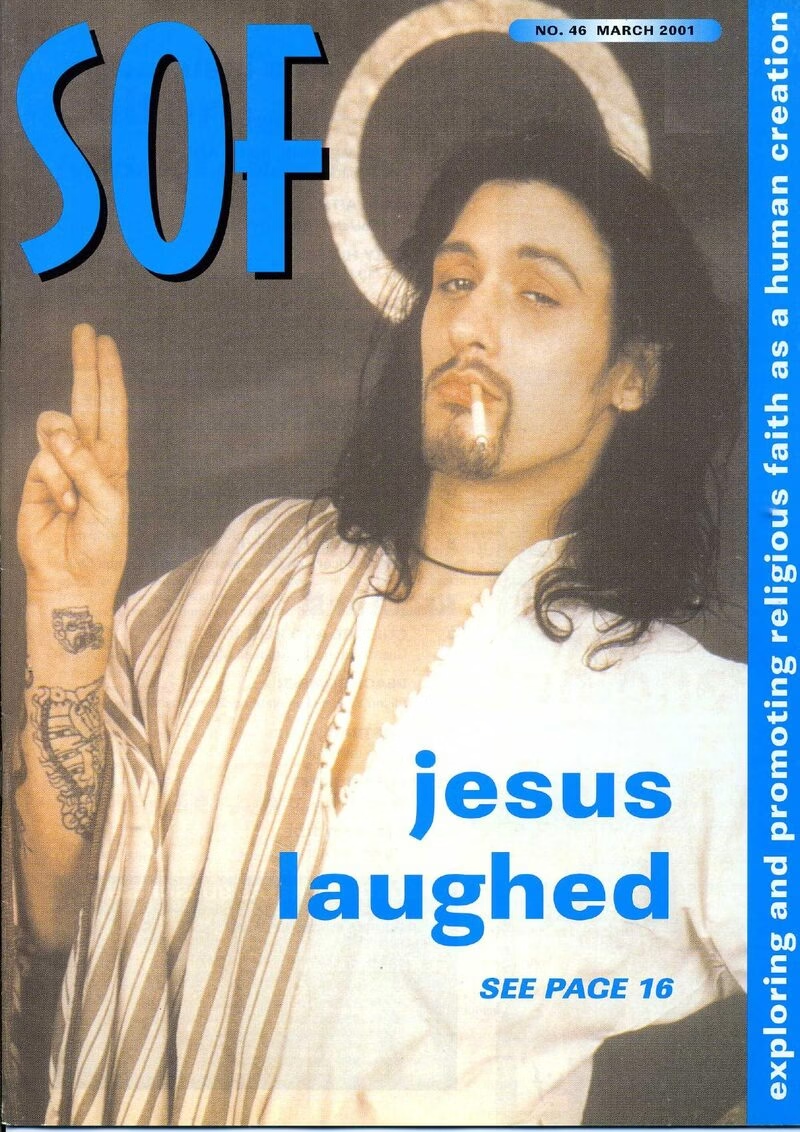
- Jesus Laughed, David Bryant
- Give Peace a Bank, Frank Boulton
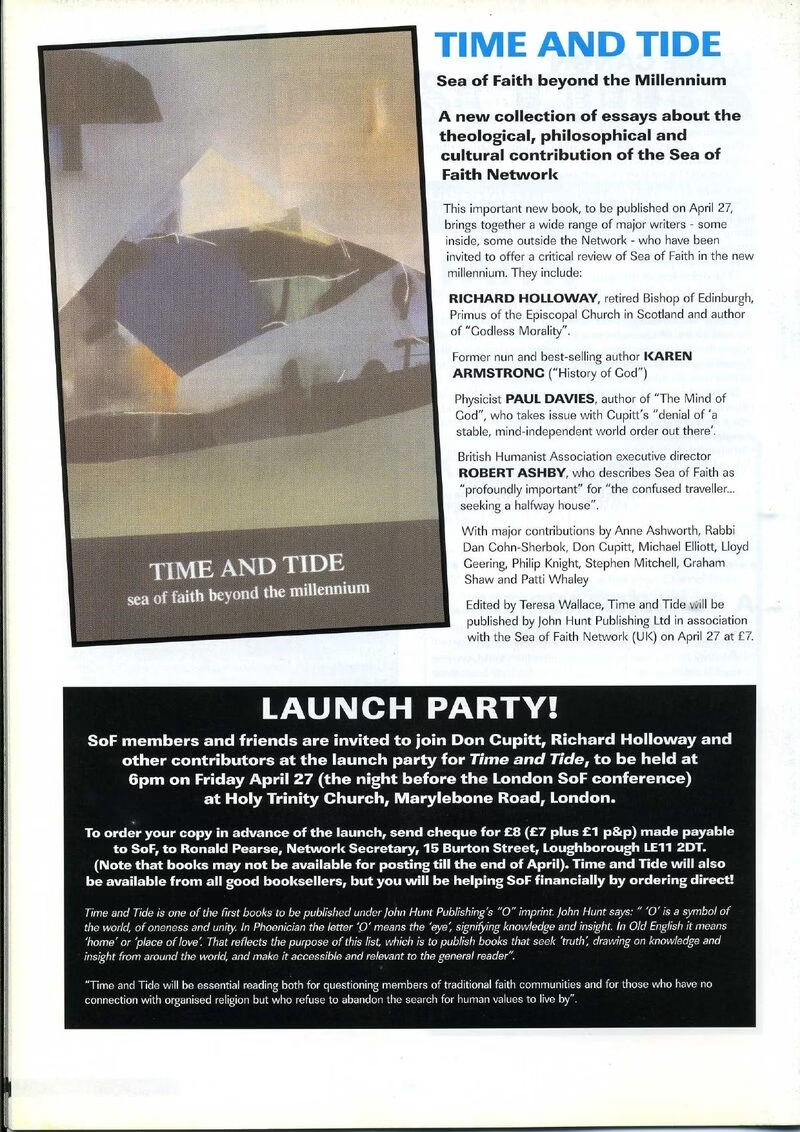
- Time and Tide: Sea of Faith Beyond the Millennium
Reviews
- A Hallowed Secularism, David Boulton
Regulars and Occasionals
- Beachcomber: Ritual and Remembrance, Alison Webster
- Postscripts: Sleaze of Faith, Seafarer
Editorial
We hope to be able to announce similar arrangements in our next issue for magazine subscribers in Australia and New Zealand. culture and religion (without a wet T-shirt) GUEST EDITORIAL BY STEPHEN MITCHELL My granddad was a violin teacher and organist of Macclesfield parish church. When the first world war came, many of his pupils joined up, some never to return. So he changed his profession and became an engineer. His advice to his son, my father, was not to become a music teacher.
I used to be a music teacher and now my daughters are about to further their musical education. What advice do I give them?
Take your cue from Vanessa Mae, I could say.
Give techno-synth interpretations of Bach dancing in wet T-shirts. You will have no trouble making a living. But heed the warning of Bond. “Their bare midriffs and pouting poses may have catapulted the all-woman string quartet Bond to chart success with their debut album, but the music establishment has shown less enthusiasm for the ‘classical Spice Girls’ than the paying public. Music industry leaders have banned them from the classical charts after one week, declaring that Bond’s brand of music owes more to Boyzone than Beethoven” (Guardian, October 16 2000).
Away from Classic FM, the Nigel Kennedys and Charlotte Churches, another world strives for public attention. The Royal Opera House Covent Garden has received £75.5m of lottery money and is subsidised to the tune of £20m. Yet very, very few people go to the opera. Only 5% of the population ever attend the theatre, ballet or opera and only 2% of young people. A tiny proportion of that 5% ever go to an opera. It makes the Dome seems like a good deal.
If, as we say, religious faith is a human creation, then religious faith is part of human culture. The world of faith is like the world of culture, like the world of today’s classical music.
That raises some interesting questions.
For example, church-going statistics may not be impressive. But then what percentage of the population do we expect to attend church as compared to, say, the opera? Is worship a highbrow activity, high art? Is there a popular religious culture? Is there a Vanessa Mae of the religious world?
The world of faith is like the world of culture.
Religious believers say their faith has shaped their lives. In it they live and move and have their editorial Hobsons Farm, Dent, Cumbria LA10 5RF being. Culture is about cultivation and growth. It too is that in which we put down roots and grow.
Religion has its roots in a word meaning to bind. Faith binds its adherents together. So too culture. Faith determines how people behave and respond. So too culture. Faith, like culture, looks to spread itself around. The gospel has its evangelists, culture its colonisers.
Then there is the culture/Culture divide: culture which was all about cultivation and agriculture, the common everyday work of growing and providing for life, has become Culture, the rather refined selfconscious expression of a cultivated society. Talk of highbrow and lowbrow smacks of class consciousness.
The highbrow was seen and heard and patronised in the stately homes of the aristocracy. The lower classes had their own forms of entertainment and culture. Now we are more likely to talk about high art |¥ and popular culture. But even that does not seem appropriate as today’s mass consumerist culture pervades everywhere. And with this divide can go an elitism.
All this has its parallels in religion.
There is a common, unreflected, unconscious inheritance of faithand « : there is v a ; theological ey reflection.
For some, theology should be confined to those who can take it. The ordinary person in the pew with their “simple faith”, we are sometimes told, should not be Is there a Vanessa Mae of the religious world? Doubt it. disturbed by the academic theorizing of the clergy.
In Common Culture (OUP 1990), Paul Willis comments on the 3 SOF 46 / March 2001 URGES statistics quoted earlier: “The institutions and practices, genres and terms of high art are currently categories of exclusion more than inclusion. They have no real connection with most young people or their lives...” Isn’t that true of the institutions and practices, genres and terms of high faith? How much religion is exclusive rather than inclusive, having no real connection with most young people’s lives?
For those of us promoting religious faith as a human creation there is a more challenging question. Has culture taken over from religious faith?
Is there no adventure, no ambition, no courage, no politics, no spirituality?
And he ends his book: “We have seen how culture has assumed a new political importance. But it has grown immodest and overweening. It is time, while acknowledging its significance, to put it back in its place.” How are those who have not abandoned their faith to meet the cultural challenges? They may look to parallels in the world of art. Couldn’t this be the church of today - archaic, quaint, thinly attended, and not done as well as it used to be? Is all experiment over? Is there no adventure, no ambition, no courage, no politics, no spirituality?
This is the beginning of a lecture to the Royal Institute (Guardian, March 25 2000) by Richard Eyre describing theatre as “often regarded in Britain as the cricket of the performing arts”. He continues: “And the audience has changed. No theatre now can count on a ‘theatre-going constituency’. These have vanished in the same way congregations Many who have abandoned religion say that they go for walks, listen to music, read books, go to the theatre, light candles. Their cultural pursuits more than fill the void left by religion. Why worry if faith disappears?
Doesn’t culture do a better job?
In The Idea of Culture (Blackwell 2000), Terry Eagleton has this warning: “Religion, which forges a relation between one’s most intimate experience and the most fundamental questions of existence... served this purpose supremely well in its day... Culture, fragile creature that it is, is far less robustly equipped to perform these functions; and when too much is asked of it - when it is asked to become a substitute for God, metaphysics or revolutionary politics - it may well start to betray pathological symptoms.” One symptom is the equating of culture with the arts.
To be cultured is to know about the arts. The civilised person is the one who patronises the arts. But if culture is reduced to this narrow view, human creativity is equally restricted.
Another symptom is the loss of moral and political impetus. The civilised and cultured person is detached from the world, standing aloof from its messiness. To be committed is to be uncultivated. Eagleton makes this point about Matthew Arnold, who as the writer of Dover Beach has some significance for Sea of Faith: “Matthew Arnold may have believed in culture as social improvement, but he refused to take sides over the slavery question in the American civil war. Culture is thus an antidote to politics, tempering that fanatical tunnel vision in its appeal to equipoise, to keeping the mind serenely untainted by whatever is tendentious, unbalanced, sectarian.” Eagleton argues for a more modest view of culture: “The primary problems which we confront in the new millennium - war, famine, poverty, disease, debt, drugs, environmental pollution, the displacement of peoples - are not especially ‘cultural’ at all. They are not primarily questions of value, symbolism, language, tradition, belonging or identity, least of all the arts.
Cultural theorists qua cultural theorists have very little to contribute to their resolution.” SOF 46 / March 2001 have vanished from churches.” Eyre is keen to tackle the charge of elitism: “All the performing arts provoke accusations of elitism: they are dedicated to creating work that can be performed by only a very few, very gifted and very skilful people to an audience limited by the number of people who can sit in a concert hall, a theatre or an opera house at any one time. The use of elitism as a pejorative is only justified if the work seeks to obscure rather than illuminate, and if the performers are reluctant to communicate... “The power to engender real access to the theatre can only be achieved in three ways. First, through education: by putting drama in the core curriculum, by funding theatre visits, by supporting more extensive work by educational departments and by nourishing the much debilitated theatre-in-education initiatives.
Second, through touring: by extending the frequency and reach of touring to large- and small-scale venues.
Third, and most important, through the box office: by funding theatres on a permanent or part-time basis, to lower ticket prices to match those of cinemas.” He ends with this wonderful piece: “We have to make theatre which exploits its irreproducible elements, which proclaims the virtues of its liveness and its uniqueness, which combines the elements of time, space, light, speech, music, and storytelling, which ravishes the eyes and enchants the soul, and has the desire and ability to enlarge the imagination as much as to entertain.” We live in an age in which economies have become bulimic, sex has become public wallpaper, and giants stalk the globe - corporations, political leaders, showbiz icons. We need to be reminded of our humanity.
Seeing faith as a human creation has enabled some SoFers to find a way of revitalising faith for today in the face of philosophical challenges. Surely we are equally well-placed to meet the challenge of today’s culture.
Stephen Mitchell is an Anglican priest and chair of the Sea of Faith (UK) steering committee.
The piece by Philip Knight ("One small cheer for capitalism!", SOF 44, November 2000), must be one of the most astonishing pieces of writing in the magazine in recent times! The statement that "Capitalism...is the only effective system of social and economic polity by which any of us have any hope of ever realising the justice which Jesus suggested we seek" denies history and the human experience of millions. Today capitalism is the means whereby the poor get poorer, and the wealthy get wealthier. Ask the poor who live in the ghettos of the UK, the USA, and any European country, let alone the huge number of the dispossessed in India, Bangladesh, Palestine, and the varied countries of Africa.
Globalization itself is destructive and quite insensitive to the varied needs of individual countries where the economic struggle devalues local community initiatives.
Because it is based on the philosophy of competition, capitalism spawns militarism in its wake. For an open and compassionate society we need a mode of government based on the philosophy of co-operation.
This was fleetingly seen in 1968 socialism with a human face. I believe this is a viable alternative to capitalism.
— Ronald Beasley, Edinburgh
RONALD BEASLEY 37 Warrender Park Terrace, Edinburgh EH9 1EB Origins of religion No one seems to be aware of the most important study of religion to date viz.; The Elementary Forms of the Religious Life by Emile Durkheim (1915). It is an anthropological study of religion in its original state of totemism. It is a reasonable presumption that all subsequent forms of religion stem from that base.
Durkheim set out to identify the essential nature of religion by a process of elimination. He took all the common characteristics of religion as we know them, and asked the question: do they exist in totemic religion? In turn he eliminated a single God, a saviour figure, heaven and hell, sin, salvation and the Book. The distinction between faith and works turned out to be irrelevant. So what was left?
He found that the religious impulse had a single base in that all things, animate and inanimate, were moved Send your letters to:
Patti Whaley Letters Editor SOF 145 Petherton Road London N5 2RS email 101335.3561 @compuserve.com by indwelling spirits, good and bad. They were the ultimate reality. The "real" world we know is a mode of their expression. The totem is the animal that is sacred to a given clan. To kill that animal is taboo. But since life is sacred, all hunters have to go through a cleansing ritual after each hunt. This secures them forgiveness by the spirits of their prey.
Thus sacrality is the quintessential source of the religious impulse. It has always been so. It still is.
When the Greeks, most especially the Athenians, in the sixth century BC, abandoned the Homeric Gods and Heroes to seek a new religious dispensation, they had to find something that manifested faith and belonging and stood the test of reason. It was a time of extraordinary invention philosophy, science, mathematics, music, all the arts, especially the theatre, culminating in the invention of democracy and citizenship.
The Athenian citizens turned Athens into their own totem. For Athens, they would live and, if need be, die.
And they were as good as their word. At Marathon and Salamis they led all Hellas in the defeat of the Persian invasion of Greece. Incredibly, in face of the gréatest power in the world, they were triumphant. That triumph lasted for nearly two hundred years, until Alexander the Great (followed by Rome) overtook them.
Some 20,000-30,000 Athenian citizens, and their allies, changed the course of world history. They did it in the name of sacrality: Athens and their worship and citizenship thereof.
The question for us is: What sacred objects do we have? What do we put before all else? The alarming answer is that in a consumer society we have no answer.
If we don't find one we shall face the modern equivalent of the fate of Greece and Rome, both destroyed by their own imperial hubris.
— Peter Cadogan, London
PETER CADOGAN 3 Hinchinbrook House, Greville Rd, London NW6 5UP petercadogan@aol.com Hostile to mysticism I was very heartened by Rosemary Arthur's letter ("God and the nonrealist", SOF 45, January 2001) and I share to some extent the fears she expresses in her last paragraph.
When I joined SoF some years ago, having become disillusioned with the Church's very literal presentation * SOF 46 / March 2001 of the Christian faith, there was not then the hostility which there seems to be now to any idea of a mystical dimension to human life.
I believe there is a real danger now that the network will split in two.
— Silvia Batley, Leintwardine, Herefordshire
SILVIA BATLEY 5 Watling St, Leintwardine, Herefordshire SY7 OLW Who needs rituals?
Several contributors to SoF keep insisting that we need myths and rituals. This calls to mind the common remark, "I need a drink" which, if taken literally, is generally of doubtful accuracy.
Undeniably, many do want myths and rituals. Like many others, however, I do not share this appetite. Yet it is implied that my spiritual health depends on satisfying this "need".
Everyone ought to think the way I think is an unacceptable assumption, while argument, depending heavily on what the terms mean to the proponent, leaves those who reason otherwise entirely unpersuaded.
— Charles Ward, Wendover, Buckinghamshire
CHARLES I WARD 16 Clay Lane, Wendover, Bucks HP22 6NS regarding projects for building the Kingdom of Heaven on earth, an Oakshottian disinclination to fix what ain't broke.
I'm in unity with the anti-authoritarian, anarchistic spirit of Friends, I share their burning social concerns.
But before translating those concerns into political programmes, I'm inclined to seek the Kingdom first in tending my own moral garden, like Alisdair MacIntyre, cultivating the virtues. I try to follow a rule of life - the Quaker Testimonies: simplicity, truth and peace will do - not in the self-interested expectation that it will earn me "salvation" or "liberation", nor even for the enlightened self-interest of benefiting my fellow creatures (though that's a spin-off to hope for), but just because, from the viewpoint of silence, that seems to be my dharma, the most natural thing to do.
— Alan James, Ashbourne, Derbyshire
ALAN JAMES The Limes, Belle Vue Rd, Ashbourne, Derbyshire DE6 1AT Sound of silence No, I'm not a humanist. Thanks to SOF 45 (January 2001) for making clear to me why I'm not.
God's been dead for years now, but did you miss what happened to the "Enlightenment Project" last century?
World-wide civilization gave us imperialism. Evolving a stronger, purer humanity gave us Nazism. Building a classless, sharing society gave us Communism. Freedom and enterprise gave us rampant global capitalism. If religious faith is a human creation, so surely are ethical systems and political plans, even such worthy statements as the Universal Declaration of Human Rights, and they all share the tragic destiny of the best-laid schemes of men (I cannot speak for mice) to end up pear-shaped.
So I'm just a Quaker, adjective-free. Like the Quaker poet Basil Bunting, in meeting for worship I "watch fells dwindle, think / The sun's fires sink". Reflecting on our place in the vastness of the universe, in the scales of geological and cosmic time, I try to brush aside my "self’, the bundles of social constructs, the murky bucketfuls of depth psychology, the chunks of brain-cells and DNA, and centre down on the Silence at the heart of it all.
I'm no sort of a Christian, because Christians - as Anthony Freeman shows so well - deify a particular historic human. But then George Fox didn't have much to say about the historical Jesus, he preached the "inward Christ", Freeman's "emergent God". And I can come out from the Silence with things in a clearer perspective, enjoying "the drunkenness of things being various" (MacNeice), the messy complexity, the ephemerality, even the tragedy, of our existence.
This isn't quietism, though the Quietists (17th century Catholics and 18th century Quakers) can well shrug off the scorn heaped on them by chattering postmodern Noisists. It isn't conservatism, beyond some Burkean scepticism
— Alan James, Ashbourne, Derbyshire
Problems of humanism I write in warm reception of your recent and again stimulating edition, but in particular to recognize the problems regarding humanism.
Continental philosophy once seemed to put the human at the centre, but in fact this was short lived, if it was ever. |. true. The real turning point of modernity is in Nietzsche's recognition that the subject only exists when God is taken to be objective, which he undermines. Since Nietzsche, the subject has been further displaced through desire (Deleuze, Guattari), philosophical method (Derrida), cultural difference (Foucault), ethical alterity (Levinas), and psychology (Freud, Lacan, Kristeva) and others. With this displacement of the centrality of the subject, postmodern philosophy has developed in an anti-humanist direction, nor does it seem desirable to reinvent the humanistic myth as the substitute for theology. :
I suggest that enlightened Christian thinkers should perhaps rather be arguing for an anti-humanist spirituality founded in the relation with alterity. This is the encounter with what lies beyond the limits of our knowledge, the Other' of and exceeding cultural difference, yet resisting the cultural constructs of all religions. The poetry of the late R.S. Thomas comes to mind as an authentic voice of such spirituality.
It seems that here, rather than in either a humanistic myth or some doctrinal one (both still literally understood), we may discover a fruitful and ethical ground between orthodox believers and orthodox unbelievers, and those others like myself who live somewhere between faith and doubt in an all together less orthodox way.
— Paul Overend, Cardiff
Rev PAUL OVEREND Anglican University Chaplain and PhD student, Cardiff Overend@Cardiff.ac.uk Best yet Thanks for the special "religious humanism" issue - a terrific issue, one of the best so far, and that's saying something!
MARGARET CHISMAN The Bungalow, Nr. The Station, Tring, Herts HP23 5QX MoT aS JANUARY 2001 ~ That infamous cover Codswallop "Life is Cod" the front cover of SOF magazine screamed as I opened it at the weekend.
Certainly far from the most preposterous proposition I've encountered there in many years of reading.
After all, overfishing is rife and the death of Cod seems to be imminent all around Several attempts have been made to provide new liturgies and rite-ofpassage material for those who don’t feel comfortable with traditional religious language, but none better than SEASONS OF LIFE, an anthology of poetry and prose from Chaucer to Larkin, Donne to Wendy Cope. “How but in custom and in ceremony / Are innocence and beauty born?” asks Yeats, so compiler Nigel Collins and coeditors Jim Herrick and John Pearce have selected poems and prose passages to cover funerals, weddings and naming ceremonies. “Poetry, at its best, tries to be more honest than religion” suggests poet Tony - Great Britain. A nonrealist concept of Cod is urgently needed if the great British tradition of fish and chips is to survive much of the 21st century.
And the early Christian symbol for Christ was a fish...
Harrison in a preface. A treasuretrove for those who conduct both humanist and non-traditional religious ceremonies, the book will also move and delight those in search of food for private reflection.
— Phil Brighton
It’s published by the Rationalist Press Association at £9.99 PHIL BRIGHTON phil@sunflowers66.freeserve.co.uk [Editor's note: Phil posted this message on the SoF email list, provoking such ripostes as "Is a cod-piece a religious garment?”, "Is the wrath of Cod all codswallop?” - and, of course, the inevitable “piece of Cod which passeth all understanding”. ] Readers are invited to send their brief reviews and recommendations for this feature.
— David Rush, Birmingham