
Contents
Articles
- Creed or Hypotheses?, Duncan Park
- A Star Is Born, Del Stewart
- Poetic Rites, Richard Holloway
- Wicca's World, Frederic Lamond
Reviews
- Taking Leave of Our Senses, David Boulton
- Dreams, Demons and Desire
- Songs of the Earth, Jeni Parsons
- Murder in Paradise, Ian Stubbs
- Licht and Shade, Chris Athorne
Regulars and Occasionals
- Bridget Jones Meets Her Alpha Betters, Alison Webster
- Postscripts: Divine Comedy, Seafarer
Editorial
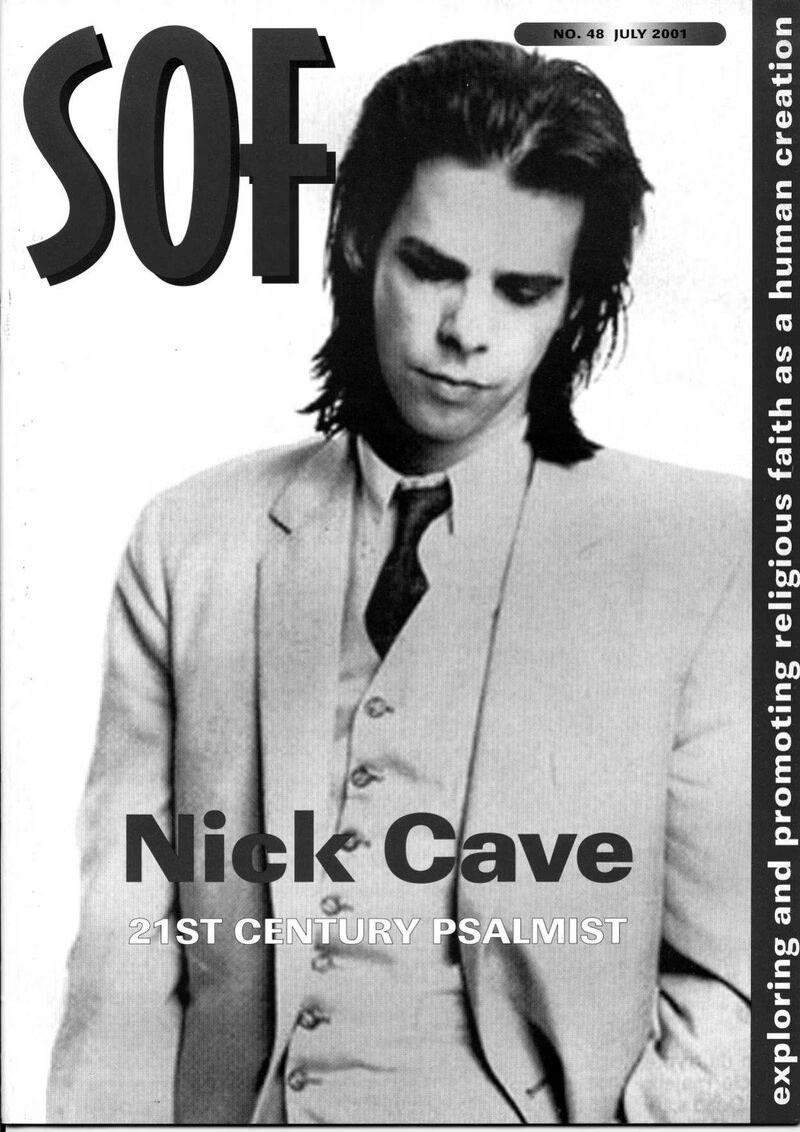
Duncan Park sounds a war-cry against the "10 hypos" 8 A STAR IS BORN Del Stewart on radical religion and spirituality in Canada 12 POETIC RITES Richard Holloway's contribution to the SoF London conference on "Human Rites" 18 WICCA'S WORLD Frederic Lamond says you don't need Jesus to enjoy a religious experience REVIEWS 10 SONGS OF INNOCENCE AND EXPERIENCE David Boulton on the lyrics of Paul McCartney and Nick Cave 17 DREAMS, DEMONS AND DESIRE Wendy Perriam's new collection of short stories 19 SONGS OF THE EARTH Jeni Parsons reflects on Dinah Livingstone's new book 20 MURDER IN PARADISE Ian Stubbs joins English passengers on a trip to a Paradise lost 21 LICHT AND SHADE Christ Athorne on the Enlightenment and the making of modernity REGULARS 3 BAD TIDINGS FROM ZION Editorial 16 BRIDCET JONES MEETS HER ALPHA BETTERS ...while beachcombing Alison Webster listens in 22 POSTBAG ...the other holocaust...anger...action...new realism 23 POSTSCRIPTS Seafarer on resurrections ISSN 1460-5244 © SOF, 2001 C5 i•m a) Hobsons Farm, Dent, Cumbria LA10 r'l tidings from zion In Sea of Faith we have always placed the highest value on the stories, from all religious traditions, in which humanity's most imperishable values have been expressed. Fewer and fewer literate people now suppose, when they read the old, old stories, that they are dealing with factual reports of "what really happened". We value the creation myths, not because they are good history or science but because they are great poetry. We draw inspiration from the Resurrection story, not because we suppose a crucified hero really came back from the dead, but because it assures us that there are hopes which can never be killed off, and values which will endure despite the best endeavours of those who would nail them to a cross and bury the body in a tomb sealed by an immovable stone.
But precisely because they are so potent, myths and stories can explode in our faces. Over the past few weeks we have seen, night after night on our TV screens and morning after morning in our newspapers, the devastating outworkings of one of the Bible's most powerful stories: the origin-myth of the "Children of Israel" as a "chosen people", awarded by divine fiat a "Promised Land".
In the name of that myth, the modern state of Israel, with the help of its allies (mostly Christian nations which had inherited the same mythology), drove into the desert wilderness more than a million refugees, much as their legendary Joshua was said to have driven the ancient Canaanites from the same lands. The myth was held to legitimise the illegal occupation of Palestinian land and the planting of Jewish settlements in the most fertile hills and valleys of the conquered territories. The myth sent in Sharon's tanks and US-supplied fighter planes to put down resistance to this squalid tyranny. The myth powered the bulldozers which last month razed to the ground the homes, hospitals and olive groves of the Gaza strip. And the myth (with a bit of help from the Jewish and Christian-fundamentalist vote) continues to provide the justification for America's annual payments of $3billion to sustain Israel's army and keep the Philistines - sorry, Palestinians - out of a Promised Land from which an arbitrary Jehovah long ago banished them in one of his recurrent fits of partisan smiting.
It's a grim and grizly reminder that religious story, myth and midrash can have its downside when appropriated for evil ends. Those of us who claim a continuing positive value for our religious cultural heritage - as SoF does - need to do so critically, with discernment, and with a clear understanding of the power relations entangled in even the best of our stories.
One gleam of hope in this whole wretched business, however, is the courageous stand being taken by those Jews and Israelis who recognise their identity myths for what they are and refuse to prostitute them. Rabbis for Human Rights and the Peace Now movement, sometimes at real risk to life and limb, are insisting that the Israeli government's racism, apartheid, and ethnic cleansing are affronts to Jewish history and Jewish religious values. Recently Michael Kustow put the following proposal "from an appalled Diaspora Jew": vacate the settlements, leave them to the Arabs, and urge the Bush regime to transfer their annual $3billion from Israel to its Palestinian neighbours. Fat chance, of course... But good evidence that one or two other Biblical myths - those about repentance, restitution and beating swords into ploughshares - still have currency in helping us frame our response to those who quote scripture for their own devilish ends. "Precisely because they are so potent, myths and stories can explode in our faces" SOF 48 / July 2001 sofconferences "2001 - a faith odyssey" 14th SoF annual conference & ACM Friday-Sunday August 3-5 2001 Leicester University STOP PRESS!
Patti Whaley, Letters Editor SOF 145 Petherton Road London N5 2RS email 101335.3561@compuserve.com postbag The other holocaust In her article on the first National Holocaust Memorial Day ("Ritual and Remembrance", SOF 46, Mar 2001), Alison Webster writes about the ritual she experienced in Worcester, without any reference to the present conflict in Israel/Palestine.
On April 1 I attended "Deir Yassin Remembered" at the Peacock Theatre in London. We remembered the massacre of 254 Palestinians on April 9 1948 by commandos of the Irgun and the Stern Gang. The evening was introduced by Alexei Sayle, a Jewish stand-up comic.
There were laments and poems, ending with an act of commemoration, shared by a rabbi, a sheikh and a Catholic priest.
Deir Yassin marked the beginning of the depopulation of over 400 Palestinian villages and the exile of more than 700,000 Palestinians. Deir Yassin no longer exists: the area stands in clear sight of Yad Vashem, the Holocaust Memorial in Jerusalem. Two symbols of tragedy confront each other and speak eloquently of atrocity and victimhood. They ask not only how the abused turn into abusers, but also how the abused can achieve justice without turning themselves into abusers.
The message of Yad Vashem, "never to forget man's inhumanity to man", is timeless and needs to be remembered by fanatic religious Israelis who have distorted all the secular ideals of the early Zionists. And they are supported by the Christian right in America, who see Israel as the fulfilment of Biblical prophecy. No wonder the Palestinians believe that they are suffering for Western Christendom's guilt for all the crimes committed against the Jews, culminating in the horrors of the Holocaust.
— Tony Crowe, Whitstable, Kent
TONY CROWE 9 Park Avenue, Whitstable, Kent CT5 2DD Angry with whom?
Alan Naylor-Smith ("Anger and Spirituality", SOF 47, May 2001) states that faced with the inevitable suffering of our lives we have a right to our anger. What can that mean?
Job has some justification for his anger, for Yahweh has capriciously singled him out for unwarranted punishment.
And perhaps a skilfully channelled anger has a place in righting the human injustices in our global village. But take away a personified creator God, as I'm assuming all SoFties do, then to whom or what can one rightfully complain about old age, disease and death? What metaphysics underlie such a complaint - special status in some divine plan that merits us a better deal than all other animals?
— Varaghosa
As the author himself suggests we humans are but trumped-up apes. We are perhaps more reflective than what came before us, but are still inextricably a part of nature that is sublimely indifferent to our fates. There is no God up there, so shaking your fist at an empty sky tells of confusion.
VARAGHOSA ds@clearmindfsnet.co.uk Where's the action?
I am a newcomer to the Sea of Faith. My route lay through 22 years of agnosticism, 3 years of Methodism, 35 years of humanism, and 14 years of Quakerism. Sailing along contentedly now, the only thing I miss in SoF is opportunities for action. Back in 1965 there was a startling article in the Rationalist Press which made me alter course.
Imagine a new sign at the side of the road, it said. Instead of "Men at Work", there would be "Humanists at Help".
The very awkwardness of the phrase made it, as intended, unforgettable. As a result, I turned to voluntary work in my spare time, and greatly enriched my life.
It surprised me to find, in the May issue, hardly any mention of action. It would be pleasant to be able to say, in response to anyone one is helping, "I'm doing this because of the Sea of Faith", rather than "...because I'm a Christian/Muslim/Hindu/ Buddhist/or Other." A discussion would be bound to follow, instead of the puzzled silence that, in my experience, greets a declaration of religious belief. People generally respect unbelievers doing good, but smirk at religious do-gooders.
— David Curtis, Weston-super-Mare, Somerset
DAVID CURTIS 7 St Jude's Terrace, Weston-super-Mare, Somerset BS22 8HB munstonehouse864@hotmail.corn [We plan to resume our "Sea of Works" feature in the next issue. But our back page in May did suggest two opportunities for action by SOF readers. - Ed.] New realism?
As an occasional reader of SOF I have become acquainted with the term "non-realist". While the definition is straightforward, I feel that the term itself sounds misleading.
— Dr Rob Walker, London