
‘Reimagining Humanism: Religious Humanisms as Frameworks for Building a Common Life in a Fractured World’ — a conference report by Martin Spence
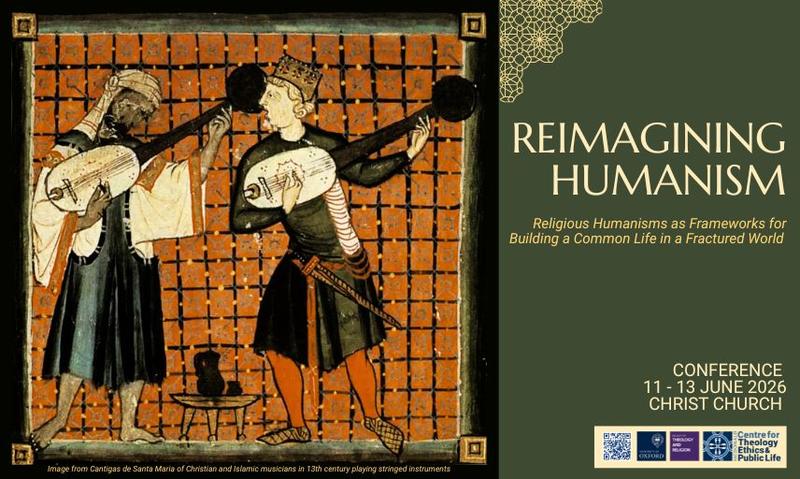
I learned of this conference on “religious humanisms” from a friend who knew of the humanist bee in my bonnet. Intrigued, I signed up. I’m glad I did.
The McDonald Centre in Oxford, which organised the event, describes itself as bringing together academics, the church, policymakers and civil society “to build more just, generous and democratic forms of common life and address the existential questions facing humanity today”. All of which is broadly congenial to most SoF members, I think.
Humanism: a contested concept
What intrigued me about this conference was its ambition to explore “religious humanisms” in the plural: not humanism but humanisms. This put me on my guard, because I have argued — in Sofia, among other places — that the term ‘humanism’ has a singular historical meaning, which has become confused by repeated attempts to hijack and redefine it. For instance, in the nineteenth century, Comte’s disciples seized upon ‘humanism’ as a label for the bizarre positivist religion he had just invented. And in the twentieth century, the ethical movement adopted the term when it rebranded itself as the overtly anti-religious British Humanist Association (recently rebranded again as Humanists UK). But the original meaning of humanism has nothing to do with hostility to religion. On the contrary, it was emphatically Christian. The origin of humanism lies in the Renaissance, in the scholarly interest in ‘human studies’ or ‘humanities’, especially history and philology, which took hold in western Europe from the fifteenth century. Given my commitment to this singular notion of humanism, a conference predicated on the existence of many different religious humanisms struck me as a challenge.
There were several intriguing papers, but I will focus on just two, which I hope will give a flavour of the event.
Islamic Humanism
Ufuk Topkara emphasised the diversity of Islam. A key term was ‘entanglement’: throughout its history, Islam has been entangled with the other cultures and religions it has encountered, learning from them, resisting them, and contributing to them. Consequently, there is an enormous range of belief and practice within Islam today. Topkara, brought up in Germany, freely admitted his ignorance of Islam in Indonesia and south-east Asia, where most of the world’s Muslims live.
The main theme of his talk addressed the entanglement of Islam with Judaism, as he sought to frame an Islamic response to the Jewish philosopher Hermann Cohen. In The Religion of Reason, published in the early twentieth century, Cohen observed that we find ourselves in the world alongside others, and that it is open to us simply to live alongside them as Nebenmensch or neighbours. But, he argued, we only truly realise our humanity if we reach beyond this, transforming passive Nebenmensch into active Mitmensch, fellow humans to whom we are committed in compassion and love. For Cohen, all other human beings have the potential to become beloved Mitmensch. Topkara’s response to this was to endorse Cohen’s ambition to move beyond mere co-existence towards active community and compassion. But he balked at the word ‘love’. Topkara explained that, for him as a Muslim, ‘love’ refers not to a universal bond with all humanity, but to an intensely private bond with family and the closest of friends. Here was a fascinating distinction between a Jewish thinker and a Muslim thinker in their different approaches to the human condition and their different senses of the boundary between intimacy and community.
African Christian Humanism
On a very different topic, Chammah Kaunda provided a fascinating analysis of the roots of present-day African Pentecostalism. He argued that it draws on the avowedly humanist ideology of mid-twentieth-century African independence, as represented by figures such as Kenneth Kaunda in Zambia and Julius Nyerere in Tanzania. For them, the concept of ubuntu was central: a philosophical and moral concept of ‘relational being’, of finding oneself through living and sharing with others. In the early decades of independence, this notion was repeatedly invoked and became embedded in popular consciousness. But it did so as a determinedly secular concept, neither transcendent nor other-worldly, rooting human meaning in worldly human being.
Renaissance humanism was just one Christian approach to the human condition
Kaunda argued that Pentecostalism has built on this secular communitarian ethos while giving it a radically Christian twist. It has accepted that human meaning is grounded in human being — while insisting that human being is exemplified by Jesus Christ. It has accepted that we only find ourselves through living and sharing with others — while insisting that ‘others’ means other members of the church, and that true life and sharing in the church entail commitment, baptism in the spirit, and speaking in tongues.
Humanisms in Plural
Overall, I came away feeling tempted to revise my position on the meaning of ‘humanism’. I remain clear that the scholarly Christian humanism of the Renaissance was real and has left an extraordinary cultural legacy. But this is perfectly compatible with recognising that Renaissance humanism was just one Christian approach to the human condition, and that Christianity has historically entertained other quite different approaches. In fact, we might interpret Christianity’s doctrinal and theological arguments precisely as arguments about the human condition, about humanity’s status and meaning. And if this is true of Christianity, why should it not be true of other religious traditions? And if it is true of these other traditions, and if we wish to find a single term to encompass these many entangled approaches to the human condition, then perhaps we should indeed refer to them as ‘humanisms’ — in the plural.
Martin Spence is Chair of the Sea of Faith Steering Group.