
Contents
Articles
- Albert Schweitzer's "Reverence for Life", Ara Barsam
- Compassionate Mindfulness, Andrew Skilton
- Humane Killing and Humane Living, Andrew Tyler
- Veganism and Ahimsa, Priscilla Archer
- Andrew Linzey's Letter to Anglican Bishops on Hunting (One Year On), Andrew Linzey
- The Future of Liberal Anglicanism: The Case Continued — The Issue of Homosexuality in the Church from a Heterosexual Perspective, Nigel Leaves
Reviews
- Unitarian Perspectives on Contemporary Social Issues, Michael Elliott
- Sea of Faith (SCM Classics reissue), Paul Overend
- The Psychology of Mature Spirituality: Integrity, Wisdom, Transcendence, Paul Overend
- Fundamentalism, Alan Goss
Poetry
- The Nothing That Is, Jill Harris
- Song for Dying, William Imray
Regulars and Occasionals
- Radical Theology Series Part 7: America and the Death of God, Trevor Greenfield

Editorial
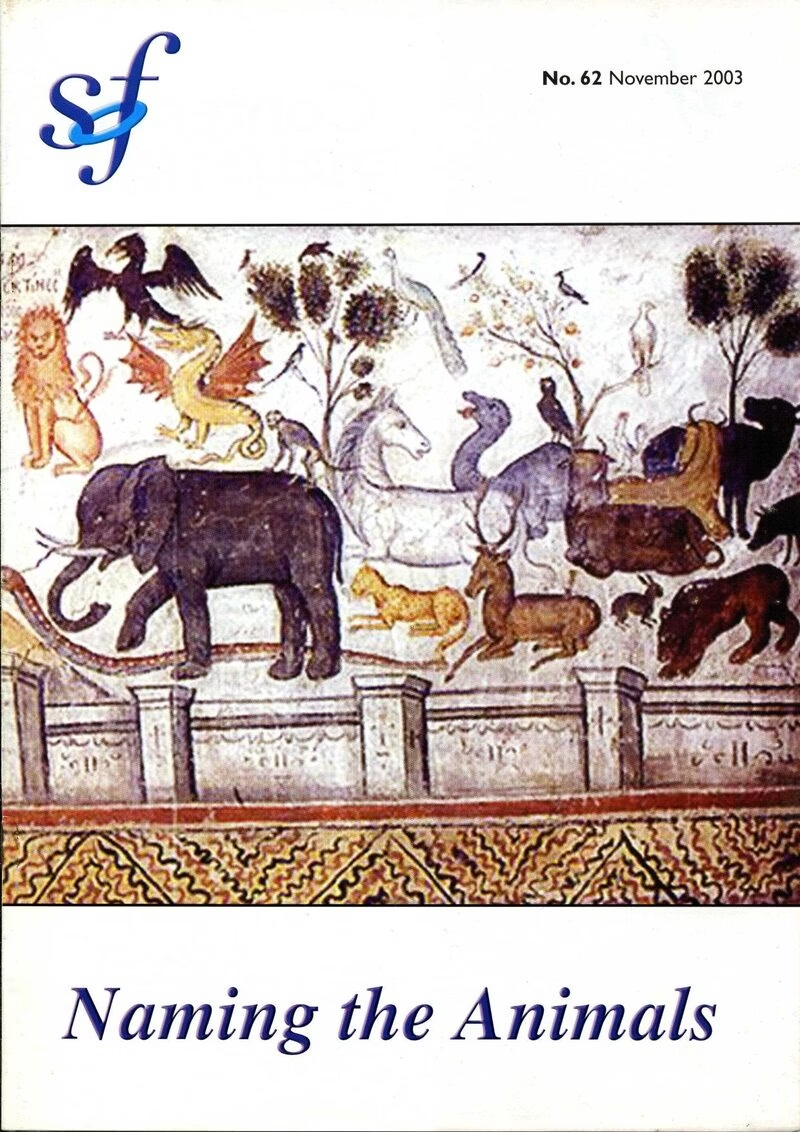
Naming the Animals A themed issue of SOF on animals may come as something of a surprise (I hope)! Yet the various religious traditions of our world have conceived of and treated animals very differently, and some contemporary spiritualities in the West are reconsidering how people relate to the environment and the animal world. This SOF edition attempts to explore briefly some religious attitudes to animals and to provoke readers to reflect critically on them.
There is no one way of viewing animals among the religious and philosophical systems of the world. In many religions the gods (and in Hinduism their vehicles) have been depicted as animals, or humans with animal heads, such as the falcon-headed god Horus or the elephantheaded god Ganesha. While such imagery has not always resulted in caring attitudes towards animals, amongst the most valued of animals for Hindus is the cow. The Sacred Cow Kamadhenu is revered as a gift of the gods, and the milk, curds, ghee, urine and dung of cows are used in Puja, worship (the dung purifies unclean places). Cows are consequently protected within Hindu society and, according to Mohandas K. Gandhi, ‘cow protection is the gift of Hinduism to the world’, because ‘it epitomise[s] the interrelation of living things, and human dependence on animals’.
In addition to various religious depictions of gods and holy animals there are also various religious and philosophical systems that inform religious practices. In Hinduism and Jainism, there developed a principle of ahimsa, ‘nonviolence’. The Bhagavad Gita reads, ‘He (or she) is dearest to God who has no enemies among the living beings, who is nonviolent to all creatures’. In Jainism ahimsa finds development within karmic theory to the extent that a monk filters flies from his drinking water and sweeps insects from his path to protect them. In each system of thinking, animals are viewed differently and it would need a close examination of each religious and philosophical system, as locally interpreted, to understand animals’ position within them.
In the West, Hebraic and Hellenistic thinking combined to provide the context in which we have come to consider the ethical position of animals. We may have forgotten the religious and philosophical basis of such attitudes, but our moral attitudes towards animals result from those traditions of thinking which do not give animals an intrinsic worth comparable to that given to humans. Yet it is out of the West that the animal rights movements have been born, perhaps from reflection on such an evaluation of animals and in reaction to it. The difficulties that opposing groups in the West have in understanding each other come from the different ways in which they conceive of the issue: the lack of a common language, of a common religious or philosophical approach, of common moral criteria. The farmer, the geneticist, the politician and the activist speak in different genres, have different idioms to communicate different ideas, and so fail to hear each other. How do arguments of economic necessity, medical potential, political expediency and compassion relate to each other?
Of course, animals are excluded from presenting themselves within these genres of discourse. They cansiot be heard in any such debates, and turkeys are given no vote against the celebrations of Christmas. If the animal’s harm is to be considered within these debates about humans’ use of animals at all, the ethicist and animal rights activist must bear witness to the unheard phrase that is presented by their cry of pain, their self-harm, or by their hidden suffering: they must find a witness for the silent phrases of the dead—of the fur coat and the leather sofa.
While the issue of the moral Horus attitudes towards animals continues to be recognised as one of legal importance in the West affecting the living conditions of and transportation of some species and the means of killing them, opponents of animal rights characterise its proponents as extending human rights in a loose and overly liberal way; as being tender-hearted, but soft-headed and economically unrealistic. This stereotyping divides the head and the heart, reason and emotion, and it therefore fails to recognise the important moral arguments that are at stake. Proponents of animal protection offer a criticism of both religious and philosophical traditions in the West, which have together provided our framework of meaning and value, a framework that has informed our spirituality, and/or lifestyle. Taken seriously, these challenges to the Western religious and philosophical traditions invite a reassessment of values. . sof 62 November 2003 It is sometimes thought that Western attitudes towards animals stem from Hellenistic and Hebraic ideas of dominion: ‘O Zeus, Father Zeus, yours is the dominion of the heavens, and you oversee the works of man both wicked and just, even the wantonness of the beasts; and righteousness is your concern’ (Archilochos, fr.87); ‘...and ‘Once the mind has been stretched by a new idea, it will never again return to its original size. animals - overlooks the mental abilities and behavioural intelligence of different species, such as the difference between the intelligent behaviour of a whale or dolphin and the less intelligent behaviour of a goldfish or tadpole, or between a chimpanzee or ape and that of a rat. Not all species notice the loss of a sibling or offspring, for example, but some species do. Peter Singer’s utilitarian principle of ‘equal consideration of interests’ challenges this, calling us to consider harm to each species individually, relative to the animals’ possible interests. He argues that to consider human interests and exclude an equal consideration of animal interests is simply an let them have dominion over the fish of the sea, and over the fowl] of the air, and over the cattle and over all the earth’ (Genesis 1.26, AV). However, this concept of dominion is largely misunderstood as domination, which is interpreted as legitimising the utilisation of animals. It is not always complemented by other religious ideas which contextualise the idea of dominion, such as the arena of a god’s sphere of influence or human participation in that sphere through stewardship.
In fact, what is really at stake is the way we think conceptually, separating things into religious and philosophical categories of good and bad, right and wrong, sacred and profane, sheep and goats.
In Hebraic thinking, creatures were fitted into categories: fish or fowl, cloven-hoofed or cud-chewing.
Some animals did not fit neatly within those boundaries, such as pigs, which being cloven-hoofed yet cud-chewing creatures were considered to be impure, unclean, and unfit for human consumption. Moreover, animals were representative not only of a kind, but also of a type of purity, the most pure of which was a first-born male unblemished lamb. The sacrificial system of temple worship used that representative purity as an economy of guilt and forgiveness, with pure animals serving as a commodity of humanity’s indebtedness to God, meriting divine forgiveness.
In philosophical thinking, however, what mattered was either reason, or the possession of a soul. The former is found in Aristotle’s distinction between rational animals, namely humans, and “brute beasts”. Reason was conceived as the opposite of passion, lust, instinct, etc. (which were the experience of both gods and mortals in Greek and Roman mythologies). Indeed, the use of reason was to master these experiences in humans. With hindsight, perhaps we can see that this represents an historical Western attitude to the human body, which was regarded as needing to be tamed, whether by asceticism or athleticism. Human society needs the restraints of reason over desire, but not the projection of human “weaknesses” onto animals. Be that as it may, this was a distinction accepted by the religious writer Thomas Aquinas, and the separation of man and ‘brute beast’ continues in the West beyond Christianity: it is a distinction used by the post-Christian philosopher Ludwig Feuerbach, for example. Jeremy Bentham questioned this basis of division between animals and beasts by suggesting that ‘the question is not, can they reason?, nor can they talk? but, can they suffer?’ This basic categorical distinction - Human/ “Other” sof 62 November 2003 example of ‘speciesism’. The interests of animals includes the distress caused by loss of natural habitat (for animals in cages, zoos and tanks), for example. However, this approach still assumes that we can relate to individual animals in terms of categories, as representatives of their species. Yet it has been this ordering of the world, which was done not simply to understand it but to facilitate the breeding of animals for human use - for food, sport and leisure - that led to the harm of the individual creature being a matter of indifference. The breeding of cows for milk production means genetic defects have weakened some breeds, so that a quarter of all British cows are lame. The sight of crippled, hobbling cows is so common that we fail to see this suffering as a problem and a result of our priorities, as our concerns have been focused on the breed for its perpetuation and production, not on the cows that develop this ‘genetic weakness’.
Today, we now recognise that racism is a matter of viewing a person as a representative of a race and stereotyping them with what we deem to be characteristics of that race. We now recognise that sexism is a way of viewing particular females as representative stereotypes of a gender. In both cases the issue is one of fitting the particular person into a stereotyped category. Could it not be that neglect of the harm to an individual animal is a result of a concern for categories? That this concern reveals a problem in our inherited structure of thinking?
Consider an analogy: the suffering of pain and of loss for a black slave was a matter of indifference to many slavetraders; indeed hundreds died of diseases on long voyages. This indifference was a result of seeing the person as a representative of a black category, understood to be a more ‘primitive’ or ‘backward’ people, not as an individual with the ability to suffer. Such categorising served economic interests by enabling “them” to be taken as a commodity for white owners’ use. The categories of perceiving were not objective: they were blind to the other people, prior to any moral judgements that were dependent on those evaluative categories. What is important in this analogy is that while some “owners” made conditions endurable for their slaves, this did not overthrow the structures of thinking that gave moral justification to slavery for a long time. So, making conditions better for productive animals does not in itself change the way we think of animals, or the way we economically utilise them or their bodies as commodities or as manufacturing machines for milk, eggs and wool.
Comparisons between the use of animals and human slavery, or the slaughter of animals and the holocaust of Jews, are not simply emotive rhetorical flourishes to manipulate the tender-hearted and softheaded. Attitudes are the result of the way we think, and when we begin to think differently then others’ indifference to animals is a matter of horror. J. M. Coetzee conveys this horror well in The Lives of Animals, by using such an analogy: ‘It is as if I were to visit friends, and to make some polite remark about the lamp in their living room, and they were to say, “Yes, it’s nice isn’t it?
Polish-Jewish skin it’s made of, we find it’s the best, the skins of young Polish Jewish Virgins.” And then I go to the bathroom and the soapwrapper says, “Treblinka — 100% human seratate”.’ Bearing witness for the silent phrases of the fur coat and leather sofa, Coetzee disturbs the genres of our debates. His analogies point to an ‘Every great movement must experience three states: ridicule, discussion, adoption.’ behaviour, lifestyle and/or spirituality. An appreciation of other religious and philosophical systems can help in our self-reflective critical task and in our moral self-examination, for we can become more clearly aware of the difference between the moral traditions and assumptions of the West and those of Eastern religions or other spiritual traditions. Through this awareness, we learn to recognise when a particular tradition may define social values in ways that are without justice, are no longer appropriate and are morally unacceptable.
This will prompt us to self-examination, but although new ideas and new lifestyles are related, redefining who we are and rethinking how we live by a new framework of meaning or spiritual paradigm is always harder than simply rethinking and re-evaluating ideas. It can involve painful recognition and difficult choices.
Archilochos fragment, tr. by and unpresentable horror that unsettles and disturbs us: an event that provokes a response. This is provocatively written, but is not merely to stir the readers’ emotions in order to shock them out of the unreflective habits of religion and thought. Once we have learned to return to the roots of religion, think radically and differently, to think outside a given religious and philosophical box, we do find a different moral value system that informs our attitudes and reactions, our lifestyle and/or spirituality.
Personally, I find my response fits well with a statement by Justice Oliver Wendell Holmes, Jr. (1841-1935, ‘The Great Dissenter’ of the US Supreme Court of Justice): ‘Once the mind has been stretched by a new idea, it will never again return to its original size.’ After realising that God existed as a idea within cultural story it was not possible for me to relate to God in worship in the innocent way I once did: my spirituality and life had to change to reflect this. But likewise, after realising the harm my way of life was causing other beings, I cannot innocently eat, wear or use corpses for pleasure.
John Stuart Mill once claimed that ‘[e]very great movement must experience three states: ridicule, discussion, adoption.’ The Sea of Faith has shared this experience with those who campaign for animal rights, though exploring religion as a human creation has become widespread in British university departments of Religious Studies. Yet considering religious ideas as reflections of cultures and value systems involves us in re-evaluating inherited religious ideas within more recent intellectual frameworks. The idea of heaven and hell (for example) had to be reconsidered after the Copernican revolution in cosmology, as this revolution in thinking put in question former attitudes to a morality of punishment and reward. Such an exploration of religion, culture and value is an important task, for it enables us to become more aware of inherited values that inform and define our attitudes, cited in Max Horkheimer and Theodor W. Adorno, Dialectic of the Enlightenment, 1944, (tr.
John Cumming), London, Allen Lane & Penguin, 1972 (p.9).
J. M. Coetzee, ‘The Poets and the Animals’, The Lives of Animals, (Princeton University Press, 1999) London, Profile Books, 2000 (p.121). (Winner of the 1999 Booker Prize.) Ludwig Feuerbach, The Essence of Christianity (1841, tr.
George Eliot, intro. by Karl Barth), London, Harper Torchbooks, 1957 (p.1) Mohandas K. Gandhi, cited and explained in entry on ‘Go’ (Sanskrit, ‘cow’) in ] Bowker (ed.) The Oxford Dictionary of World Religions, Oxford, OUP, 1997 (p.377) Peter Singer, Practical Ethics (Second Edition), Cambridge University Press, 1993 (cf. Ch.3) World Vegan Day is 1st November ( (each year) ol "Veganism may be defined as a way of living which seeks to exclude, as far as possible and practical, all forms of exploitation of, and cruelty to, the animal kingdom for food, clothing, or any other purpose. In dietary terms it refers to the practice of dispensing with all animal produce - including flesh, fish, fowl, eggs, (non-human) animal milks, and their derivatives, with the taking of honey being left to individual conscience." ( THE VEGAN; Winter 1985 ) 5 Sof 62 November 2003 Albert Schweitzer’s “Reverence for Life” Ara Paul Barsam explains Schweitzer’s ethical mysticism.
Oliver Essame Letters’ Editor SOF Gospel Hill Cottage, Chapel Lane, Whitfield, Brackley NN13 5TF e-mail to oliver@essame.clara.net While I appreciate Don Cupitt's article on “Redefining the Church's Role” (New Reformation of the Churches, SOF 60), and agreeing with the thrust of his argument, his remark ‘..and religion now rarely inspires any major artistic achievement’ is altogether too sweeping.
The evidence is that religions are producing remarkable art at the present time. One has only to think of the works of Graham Sutherland, Henry Moore, and (especially in South Wales) the sculptor Frank Roper. As a member of the Llandaff Diocesan Advisory Committee I can testify to the superb quality of stained glass being placed in our parishes churches.
It is in the field of religious architecture that we can see that, not only in Christianity, but also in the other world religions, there are some truly wonderful buildings being erected. In the United Kingdom we can see mosques and temples of excellent quality and artistic standard.
It may be that Cupitt is so anxious to establish his point about the decline of religions that he cannot see that religion still has the power to attract and inspire, not only masses of ordinary people, but also huge artistic achievement around the world." David S Lee 2 Old Vicarage Close Llanishen Cardiff CF154 5UZ These are reflections on the article by Dorothea Solle, How We Speak of God (SOF60).
— David S Lee, Llanishen, Cardiff
In social animals and history the main interest of those on top is to remain there. There is a will to live, survive and reproduce. There is a hierarchy and a drive for money and power within this hierarchy. This is a reflection on common attitudes to God as omnipotent, in charge and in power. This God is interventionist.
There is one means of restraining power, which is to share it. Organised democracy is a step towards this. Sharing is equivalent to love. This human co-operation working towards agreed aims is equivalent to the intentionalist rather than the interventionist God.
However, there must be leadership and specialisation.
There is a diversity of ability within a group, which needs to be reflected in various roles to avoid loss of efficiency of the group or species. This is not to take away respect and reverence for life.
God who lives in our actions can be fruitfully regarded as a person, a friend. It is up to us to make an effort to facilitate God working through us. This is not a God of power but is a God of empowering. S/he can also be considered as a process permeating or infusing everything and a creative urge. There is something of God in every living being. There is diversity but also an inter-relating of individuals or parts of a whole.
There are hopes of growing closer, sustained by faith.
Mature love is a mutual relationship.
David Strachan 2 West Hill, Hessle, HU13 OER sof 62 November 2003 The resolution at the end of the Summer Conference was to the effect that radicals such as SoF members influence social and political issues.
— David Strachan, Hessle
The workshop run by Anthea and David Boulton explored dreams that enable changes for the better to come about in society.
Here I should like to put forward such a dream of my own. It is for a change in values for the sake of the greater psychological health of our citizenry, now and in the future. It expresses my conviction that the care of infants and young children should be ranked as one of the most important roles a person can fill. Today it is generally despised, as people suppose it is something anyone can do. For mothers, paid employment is officially given preference over the job of mothering; and other carers, generally with minimal training, are miserably paid. My dream is that we spend time, thought and money to change all that.
Neuroscientists show that after a birth, brain tissue and nerve pathways and chemicals affecting the brain are created in response to what infants actually experience. The consequences may not be easily modifiable. Psychological researchers, too, have found that the experience we have as infants and young children vitally affects our later quality of life. It has been estimated to have more effect than our genes in influencing the kind of people we later become. For example, the capacity to put oneself in the shoes of others, a key element in the acquisition of morality, may well be related to how empathetically one has been treated in infancy.
Some efforts have of course been made to improve childcare. Hitting has been (more or less) outlawed; fathers as well as mothers may get leave from work for the care of infants or young children; there is prominence as never before for cases of child abuse. Traumatised children are routinely removed from abusive parents and there is the expectation that helpful members of the public can mother them, though many children are so disturbed that time and again new volunteer parents have to admit defeat and, damagingly, the children are repeatedly moved on. The pain of this causes them to end up with little or no capacity to make effective human attachments. Much greater support and training are essential for the children and all the adults concerned. By not providing it we are creating people whose fate is to be homeless, addicted to drugs or alcohol, lawbreakers or, perhaps, potential terrorists.
My dream is that our country will wake up to the importance of providing the best infant and child-care for all, and that attitudes change so that money, research and training are assigned for the purpose. I would hope to persuade Sea of Faith members to take a stand on this as a political issue, in order to give ordinary devoted parents a greater chance of developing in their offspring emotional intelligence, such as later should lead to their greater selffulfilment and the overall benefit of society. Appeals by informed people are also required to right the wrongs now inadvertently being done to the unfortunate victims of parental abuse. For this, too, I turn to the Sea of Faith.
Isobel Hunter-Brown isobel.hunterbrown@btopenworld.com “Traditional” faith, which says that Jesus is the only path to salvation, cannot be reconciled with the vision of peace on earth.
— Isobel Hunter-Brown
To put it bluntly, if you go round saying ‘we are right and every body else is wrong’ then peace on earth is impossible. Theists believe their faith is the only true one, and to me it follows therefore that only the atheist can be faithful to Jesus’ vision.
— Peter Lumsden, London