
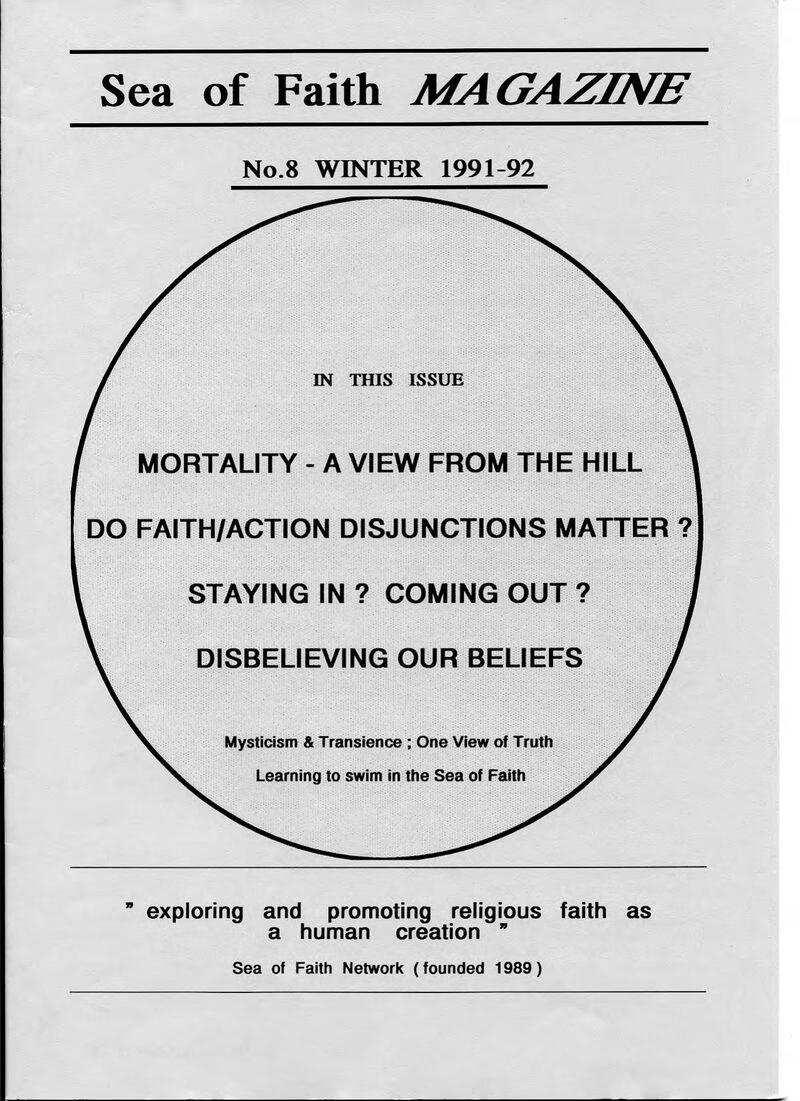
Contents
Articles
- Disbelieving Our Beliefs, Andrew Anderson
- Coming Out, Norah Gutteridge
- One View of Truth, Harold Steel
- Learning to Swim in the Sea of Faith, Rosemarie Wedell
Poetry
- View From A Yacht At Sea Off Dover Beach, Roger Barnes
Obituaries
Regulars and Occasionals
- A Cynic in the Network: Do Faith/Action Disjunctions Matter?, Stephen Warnes
- Don Cupitt's Notebook: Mysticism and Transience, Don Cupitt
Today less than two percent of that original wilderness remains. A similar story can be told for much of the rest of the planet and destruction continues unchecked. In whatever perspective one chooses to view it, human beings are clearly overwhelming the earth." (4) In the world described by Edwin Mickleburgh what we believe has become irrelevant. What matters is the value we place on life ; not just our lives but the life of the earth itself. There is nothing more inimical to the church's attempt to increase its numbers than the lack of interest shown by the existing membership in the pollution and destruction of their maker's handiwork, and the terrestrial future of the lords of creation they believe themselves to be. 1.The_Arcticnrail, Pierre Berton, Viking 1988 2. Theklaked_Ape, Desmond Morris, Cape 1967 3. Oxford Englisittaictionary, OUP 1989 4. Beyond the Frozen Sea, Edwin Mickleburgh, Bodley Head 1987 SOF Magazine 8, Winter 1991-92 5 LETTERS RECALLING PETER MUNZ from John Challenor (Cardiff) Don Cupitt on the New Zealand connection (SOFMAG #7) makes me want to add the name of Peter Munz. While at the University of Wellington, he wrote Eielatianship_and_Solitude (Eyre & Spottiswoode, 1964) which impressed me greatly at the time, and still does. It is a naturalistic account of religion and philosophy, in the widest terms of space and time, which locates the origins of the religious 'supernatural' and the philosophical 'supernatural' (metaphysics) in our mythology and in our experience. It is a sort of Sea of Faith project before the time.
I'm encouraged to mention the book by finding it recommended by Daniel Liechty in his Ifteology_in Po_siliheralTerspeative. He notes sadly that Munz's book was largely ignored. Perhaps the title is unhelpful. Munz writes in fact about absolute love and absolute detachment, as two ethical ideals each offering a way of overcoming evil and attaining freedom.
On quite another subject - divorce, and judging not.
Do you know the one about the Rabbi (told by Lionel Blue) ? The Rabbi hears out the woman's story of why she had to divorce, and tells her "You are quite right". Having heard next the husband's account, he tells him "You are quite right". A by-stander in the synagogue calls out, "Rabbi, he can't be right, if the wife was right I" The Rabbi tells the by-stander "You are quite right".
— John Challenor, Cardiff
ON HIDING LAMPS UNDER BUSHELS from Michael Stewart (Farnham) John Coombes (SOFMAG #7) sums up the dilemma facing those of us who profess membership of church communities whether or not to stay in, and if we stay in whether or not to conceal our dissent from much of what is going on. And as far as I can judge, his standpoint on these questions is very similar to my own. What I find totally unacceptable - in his current practice, and also in my own - is the contented embracing of a self-centred quietism, on the ground that open declaration of our radical views "could give offence and lead to isolation" and "Life seems too short for that". Did that deter Jesus of Nazareth ? And how, believing what John does, can he say he no longer has a message to preach ? If one really believes the world today desperately needs the new radical gospel, one must surely have what one participant at SOF IV has called "an evangelistic zeal for this radical faith".
And yet of course in a way John is right. What, in the vast majority of cases, can it serve for the individual to 'come out' and say "I do not believe in your God, but I wish to continue attending your services provided that I am free to interpret the words as I choose" ? The usual reaction will be one of rejection or, at best, incomprehension. What the situation calls for is, as John himself says, the development of a 'ginger group' - made up initially of SOF members - within the wider body of the Christian church, to help nudge, prod, shock and finally, it is to be hoped, transform it so that it can at last proclaim the Good News in words that will speak to 20th (and 21st) century men and women of all sorts and conditions throughout the world. But how are we to get from one to the other, from individual insight to collective action.
Some years back those who felt uneasy about certain aspects of the annual Remembrance Day ceremonies were invited to 'come out' by wearing white poppies instead of the traditional red ones. One does not see so many white poppies now on Remembrance Day, even among committed pacifists, but by this simple act of individual and collective witness those concerned had made their point and made it possible to gauge the measure of general support for their views.
Is it possible to imagine something similar for bringing to the attention of the different denominations the extent of adherence to the kind of vision SOF represents, and at the same time allowing those of us who wish to remain church members to do so with integrity ? It is of course difficult to see how this could be done without reaching agreement, in sufficiently broad yet positive terms, on just what it is that constitutes the Christian kerygma. And we know that the task of drafting a statement that will satisfy all of us, or even the majority, is no easy matter, and is indeed held by some to be undesirable as imposing the straitjacket of formalism on what should be a living, open growth.
However, even if no credal statement can have more than transient and relative validity, what is at stake is 6 SOF Magazine 8, Winter 1991-92 surely of such importance as to make the attempt to find at least a broadly acceptable formulation worthwhile. Such a formulation might well be based on one or other of the definitions or statements of intent which have already been put forward and found widely if not universally acceptable among us, but would also convey the heart of the distinctive - I hesitate to use the word "unique" ! - Christian message without which humanism can so easily become in Lloyd Geering's words, "flat, mundane and altogether uninspiring".
— Michael Stewart, Farnham
BE HONEST from Adrian Worsfold (Clowne) I was very disappointed reading the article by John Coombes, not as such in his decision to stay in his church but to remain completely quiet about his views whilst staying in. I think that this is representative of the viewpoint of a number of people in Sea of Faith ; that the music is enjoyed, that the humanism of Jesus appeals in some continuing way, but that absolutely nothing will be done to move on any of the theological baggage presented. Why not ?
My own view was to leave. In fact, to a great extent, I was thrown out first. It is not as though I am inexperienced or even unsympathetic regarding The Question. But there are a number of issues involved here.
Those who stay in, whilst strongly disagreeing with the supernaturalism, look like entryists of the Trotskyist mould in the Labour Party. In my view the Labour Party is quite right to root them out because they are not properly democratic, as defined by the party.
They have their own agenda and seek to overturn the party in its structure and being. Of course the difference is that SOF does not hold a position on this issue, unlike the decision making Trotskyism the body of first allegiance - it is simply a matter for individuals and their conscience.
So some individuals choose to be entryist. Alright, but then they counteract their own entryism by saying and doing nothing at all. This seems absurd, like living a double life. It is, in my view, deceptive and extreme (at least the Trotskyist in the Labour Party tells you what she believes even if she doesn't tell who she represents). The result of this barmy, even incomprehensible, position is that nothing is done and the fundies carry on their march unimpeded. And will this same silence be practised when only highly sectarianised churches exist ?
Also, I do not understand what good work the churches now do. The greatest moral strides recently, if only to get people thinking, have been made through the media in secular responses to human needs around the world. The churches are full of excess baggage and self-contradiction, an authoritarian language leading to a confusion of messages and attitudes I do not want to be associated with, either openly or in self-sustained silence.
For me, now, the only position is to take account of the political influence of a church in wider society. I think they are pretty irrelevant now and can be left to go their sectarian ways (and I include my old denomination, Unitarianism, only apparently liberal in its self-definition). Of course, if the churches had some wider effect on society I would have to be in opposition to them. Then I might join simply to swerve one the other way, or I might be part of a secular opposition which has, in Western Europe at least, helped to cripple and fossilise dominant and socially influential churches - a very necessary historical process for healthy liberal democracy.
Of course I still retain an interest in ideas of symbolism and means to find a sense of self direction, and it was indeed the fact that I did openly express my views that led to my fate. So people who speak out must expect social isolation, loss of training, loss of posts. But then the churches are what they are ! So at one time I was prepared to develop my ideas of symbolism and believing inside a church.
Now, sufficiently happy that I have discovered enough that the churches cannot be reformed, my argument has adapted to one of watching them kill themselves.
That's their problem. Yes, it deprives me of a place to go. That I understand. It's a loss. I could develop a theology of crucifixion on this ! Some urge may change my mind, of course. Where I must be consistent, however, and especially in the matter of religion which claims honesty as a key tenet, is that inside such an institution one does not cover up. Let it show itself as two faced, and don't let it affect individuals who do not want to be like that into doing the same.
— Adrian Worsfold, Clowne
SPEAKING UP from Keith Whyte (Wokingham) Much as I appreciated the article by John Coombes, I am sorry that he no longer feels able to preach. He says he no longer has a message, but I am sure he is wrong. In any case, let me add my voice to those who must already have asked him to reconsider his decision. If those who feel as we do are not prepared to take an active part in the churches we belong to, giving voice to our insights and understandings whenever we have the opportunity, we will be abandoning organised Christianity to the dead ends of sentimentality, superstition and naive unthinking fundamentalism.
SOF Magazine 8, Winter 1991-92 7 One of the benefits of the SOF Network is in giving us the strength to continue despite the fact that in our own local churches we may feel dreadfully alone, with many if not all of the sermons no longer having any meaning. As John Coombes says, SOF can be a ginger group within the Church helping to shape its future, as well as a support group for those of us who are disillusioned by the way the churches seem to be going.
So, if any readers of this magazine have experiences to relate or advice to give on how to include 'non-realist' theology in public worship, please let the rest of us know. A starting point for those who are able to influence the content of sermons might be the current interest in the theory of evolution shown by a new biography of Darwin, Steve Jones' Reith Lectures and Richard Dawkins' Royal Institution Christmas Lectures. The Church has never really been able to come to terms with the implications of evolution.
Perhaps we can help it to do so.
— Keith Whyte, Wokingham