
Contents
Articles
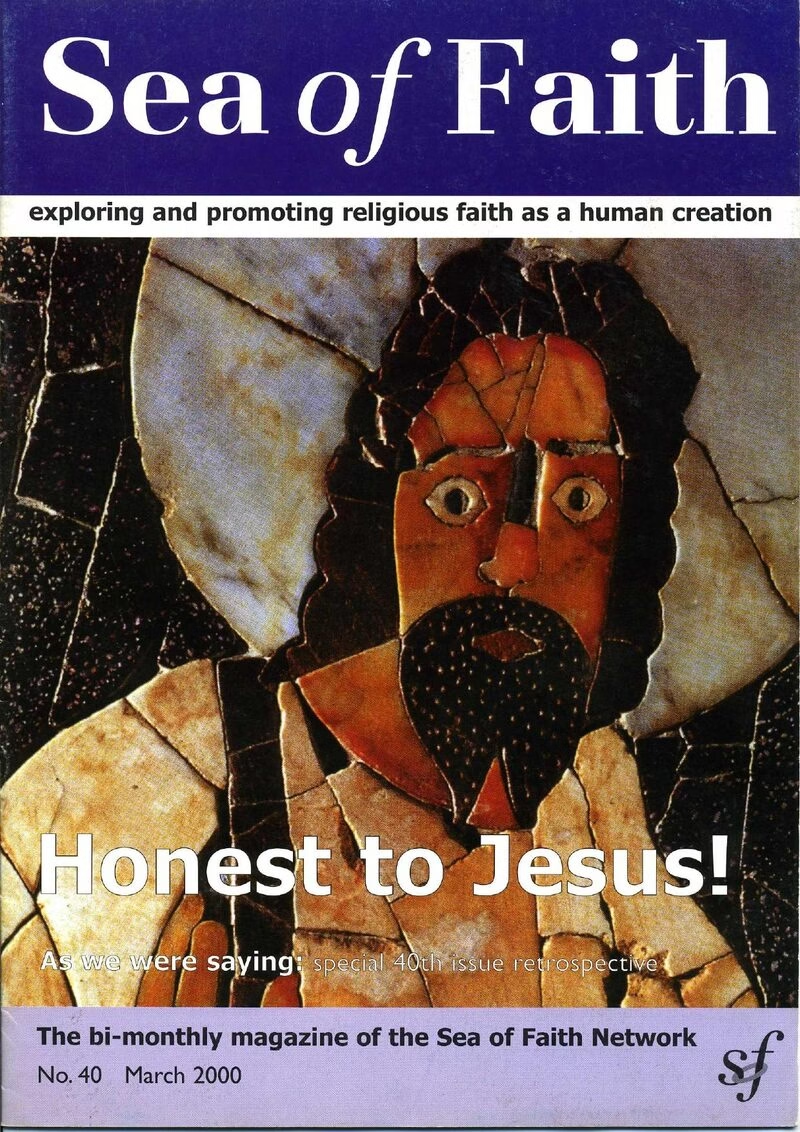
- Honest to Jesus!, Robert W Funk
- As We Were Saying... (Retrospective: Issues 1–10, 1990–1992), Ronald Pearse, C. B. Spurgin, Stephen Mitchell, Mark Stubbs, Clive Richards, Don Cupitt, John Mann, John Florance, Angela Barkshire, Aileen La Tourette, Adrian Worsfold, Penny Mawdsley, Norah Gutteridge, Rosemarie Wedell, Anthony Freeman, Clare Short
- Cupitt's Hat Trick: Don Completes His Hat Trick, David Boulton
- Cupitt's Hat Trick: Rethinking Kingdom Come, Don Cupitt, David Boulton
Reviews
- Jesus Untouched — or Touched Up?, David Boulton
- Cupitt's Hat Trick: What's It All About?, Eileen Thomson
Regulars and Occasionals

Editorial
EDITORIAL Sea of Faith The quarterly magazine of the Sea of Faith Network Hobsons Farm, Dent, Cumbria LAIO 5RF Editor: David Boulton Lhe Quest for the Hestorical e is “the fullest representation of H human possibility... Whether we are male or female, old or young,” he “speaks most urgently for us and to us... He can be transcendent or ironic... When we are wholly human, and know ourselves, we become most like...” Like whom? Jesus? Wrong! Like Hamlet. So Harold Bloom argues in his marvellous, rambling (750-page), idiosyncratic, over-the-top magnum opus Shakespeare: the Invention of the Human. “The phenomenon of Hamlet,” he argues, “the prince without the play, is unsurpassed in the West’s imaginative literature”. Hamlet “vies with... the Jesus of Mark as a charismatic of charismatics”.
He has “a mind so powerful that the most contrary attitudes, values and judgments can co-exist within it coherently... Hamlet incarnates the value of personality”. The result is that not one of us within western culture is quite the same as he or she would be had there been no Hamlet. We are all to some degree Hamlet-shaped, whether we know it not - even whether or not we've seen or read the play.
These remarks are made, of course, about the real Hamlet - who else? But who was the real Hamlet? A melodrama about Hamlet was performed in London in the 1580s, when Shakespeare was still an apprentice. It is generally attributed to a second-rate playwright named Thomas Kyd. Kyd’s work seems to have been derived from a book called Histoire Tragiques by Francois de Belleforest, published in French a few years earlier, and in English as The Hystorie of Hamblet in 1608. Belleforest’s book in turn was derived from a twelfth century WhoP We are all to some degree Hamlet-shaped, whether we know it or not. chronicler called Saxo Grammaticus, whose history of Denmark tells of Amleth, son of the heroic Horwendil and the beautiful princess Gerutha.
Amleth’s father is murdered by his jealous brother Fengon, who incestuously marries Gerutha. Amleth plots revenge, feins madness and stabs a friend of Fengon (lurking behind an arras - how’s that for Shakespearean authenticity?) before killing Fengon with the usurper’s own sword. But there is an unShakespearean happy ending. Amleth flees to England, where the king sends him to meet the queen of the Scots, the sexy-but-deadly Hermuthruda. She falls in love with him. They marry, defeat the king of England in battle, and return to Denmark where Amleth is proclaimed king, ruling with Gerutha and Hermuthruda as his two queens. This Hamlet gets it all: a ripping adventure, a crown, and two beautiful women to boot.
Sleuths on the quest for the historical Hamlet have, however, probed further back than Saxo. They have found hints of an Amlet in references to the lost Icelandic sagas of the 10th-century poet Snaebjorn, and one school of thought links our hero with the Swedish king Onela mentioned in Beowulf. Another claims that the historical Hamlet was the Irish king Amhlaidhe, slayer of king Niall Glundubh. Another locates him in ancient Persia. Then there was Shakespeare’s own baby son who died in infancy. He too was named Hamlet.
So will the real Hamlet please stand up!
Historical Hamlet scholarship is quite absorbing. It tells us a lot about the context of the Hamlet stories, and about how stories were made, adapted, transmitted. It reminds us that the distinctions we tend to make between “objective” historical reporting of “fact” and the stuff of myth and legend - between documentary and poetic “truth” - are modern, and would have meant nothing to pre-moderns. But it tells us nothing whatever about the “real” Hamlet. When we speak, write, think of Hamlet, when we acknowledge that in an important sense he has shaped the western world and helped create our modern sense of what it is to be human, it is the Hamlet of Shakespeare’s story, not any Amleth or Amhlaidhe or Hamblet of history we are discussing.
What would we make of some earnest scholar who told us, on the basis of his textual analysis of the Celtic, Icelandic and Danish sagas, that Shakespeare had got Hamlet wrong? That there is no evidence for his having met his father’s ghost, nor for his having known Yorrick, nor for his sexually harrassing Ophelia with provocative talk of “country matters”, nor for his ever having given a passing thought to the existential claims of action and self-knowledge? What kind of reception would we give our textual detective if he presumed to rewrite Shakespeare’s Hamlet, giving us footnote-attested Persian war-lords, Irish feuds, a Danish princess-wife and a Scottish queen on the side, all in the interests of “the truth” and “the real”?
The real Hamlet, the only real Hamlet, is the Hamlet of the greatest play in western culture, the protagonist of a story fashioned by the genius of the English language at its zenith in Elizabethan times, and the unfathomable genius of Shakespeare himself. It is this Hamlet who is “the fullest representation of human possibility”, this Hamlet who will live as long as human culture survives.
Which says what about other historical quests? The quest for the historical Jesus, for example...
That quest too is utterly absorbing. It is, after all, an investigation into the origins of a religious culture which, whether for good or ill or both, profoundly influenced human behaviour, consciousness, sense of identity and of destiny, for two millennia and countless million people. In that sense it is an inquiry into how we came to be what we are (regardless of whether or not we count ourselves as “believers”).
And it can tell us, has indeed told us, a great deal about context: about who writes what, and for what purpose: about the power of story-telling itself, to win, hold and validate power. It can inform and enrich our understanding of “what happened”. It may help us glimpse another Jesus, an Amleth-Jesus or an Amhlaidhe-Jesus. But what it cannot do is conjure up a “real” Jesus, a footnoteattested Jesus who is somehow “more real” than the Jesus of the Jesus stories.
I don’t care a hoot if an historical holy man named Jesus “really” taught that I honestly couldn’t care less whether or not a bare-footed magician or wonder-worker “really” stood on the Mount of Olives and said those amazing, revolutionary and baffling words. But someone said them and they ring true. the poor were privileged over the rich, the despised and wretched over the powerful and pompous. I’m sure that a number of impassioned and inspired agitators have proclaimed as much. I honestly couldn't care less whether or not a bare-footed magician or wonderworker “really” stood on the Mount of Olives and said those amazing, revolutionary (and baffling) words. But someone said them: or at least someone or several someones collected them, strung them together, edited them, and fashioned them into a text. And they ring true, convicting and convincing us, regardless of whether they were or were not spoken in peasant-Aramaic by a single historical person named Jesus on one of his better days.
The Jesus of the Jesus Story story is much bigger than any Jesus of history.
The storical Jesus remains more influential than any historical Jesus. Who inspired some of the greatest pictorial art in both the western and eastern worlds, the deepest poetry, the most magical music? Who gave us a glimpse of what we might be, and fired millions to make their heroic if largely doomed attempts to live in the life of the republic of heaven, and even try to model human society after such a vision? Not an obscure Galilean peasant of whose “real” historical life we can know little or nothing, but the Jesus created in the biblical literature, the Jesus who was born in a stable and died and rose again, as surely as Hamlet heard and saw his father’s ghost and drove Ophelia to her watery grave.
Thank God for the scholars whose painstaking work enriches our knowledge of what lies behind the story.
But, rather, thank God for the story. For all the cheap sentiment, oppressive moralism, ugly patriarchy and and sloppy superstition that has so often been allowed to overlay it, it is one of humanity’s best, brightest and most enduring stories. For some it will always be “the greatest story ever told”, a story that can be enriched and illuminated by historical and textual scholarship, but will always stand on its merits as literature and poetic saga, regardless of how we are advised by the scholars to locate it in our documented histories.
LETTERS No joker aving been “rescued” from “the swirl of [Western] ideas” by people of the third world and liberation theologians, Leslie Griffiths (“Cupitt: Serious Thinker or Practical Joker?”, Sea of Faith, Autumn 1999) wonders at the level of black involvement in the Sea of Faith movement as something of a test of its credibility. Fine, but there wasn’t much of such involvement when Adam Smith or Karl Marx, Sigmund Freud or Albert Einstein were struggling to give shape to their ideas either.
— Dominic Kirkham, Manchester
It does seem that the key features of our emergent global culture, for good or ill, are being shaped primarily by the “swirl of Western concepts, so it is crucial that they are scrutinised and challenged at their point of origin. Though some people may still choose to believe that the centre of the universe is a hill up the river where the gods gave the earth to their ancestors, it is not at this level that the real debate about mankind's future is taking place. Don Cupitt is getting to grips with “this life” as it unfolds “under our noses”, and challenging us to do the same. ” DOMINIC KIRKHAM 94 Clarendon Road, Manchester M34 5SE Private parts T= last paragraph of David Boulton’s review of Richard Holloway’s Godless Morality (“Sifting the Shock-Horror! from the So What?”, Sea of Faith, Winter 1999) disturbed me. I don’t think Holloway was saying that what we do with money has more moral significance than what we do with our “private parts”. He was, surely, saying that we need a moral code by which to lead our lives, but we must formulate this for ourselves now that we have largely rejected the moral absolutes of the past.
Morality is about how we treat others; how we express our sexuality is a reflection of our attitude towards others, and is therefore of utmost moral significance.
In Postscripts (“End of Story”) in the same issue, Seafarer points to the need for discussion to clarify and define our moral values: we are (quoting Salman Rushdie) “the policemen of our liberties and our behaviour”. ‘The Dalai Lama (“What It Means to be Human”, Sea of Faith, Winter 1999) provides guidelines in his definition of spirituality: love, compassion, patience, tolerance, forgiveness, contentment, a sense of responsibility, of harmony which brings happiness to both self and others, a level of concern for others’ well-being. ‘These surely are the qualities we must all strive for, the values that inform all our transactions with others, be they monetary, sexual or in love and friendship?
— Avis Torrance, Teddington, Middlesex
AVIS TORRANCE 24, Manor Road, Teddington Middlesex TW11 SAB Bible-belted ‘just wanted to thank Seafarer for writing such a nice article (Sea of Faith, Winter 1999). I think it captured my situation very realistically. Since I have not heard any bloodhounds barking outside the church, I guess the Southern Baptist Convention hasn’t tracked me down because of it.
I am in the process of getting a bank draft in British Sterling to send in for my membership renewal. Getting this done in Small Town America is extremely difficult.
Small town local banks around here simply have never had to do this. They don’t know how, and even seem somewhat resentful for being asked to do it. It would be very helpful if in the future the SoF would have a person or even a bank here in America to which people could simply send a personal check in dollars. [Any volunteers from among our US readers? - Ed.] The little church where I work, and have Internet access, recently lost our pastor. He was seminary trained and had a good background in psychology so I could talk with him about some of my personal thoughts. But with him now gone, the church has turned even more in the fundamentalist direction. I feel really alone now. Of course I do understand that I probably don’t really belong here anymore where people still want to take the bible in a literal supernatural way.
I am very pleased to see that the SoF and the Jesus Seminar are developing a relationship. I think that the SoF can help the Jesus Seminar become more openly humanistic and the Jesus Seminar can help the SoF get more established here in America. I recently heard the cassette tape of Lloyd Geering’s recent lecture at the Jesus Seminar convention and loved it. I also have read his wonderful little book The World to Come. I would give anything to be in an environment where ideas like this were talked about freely and truly understood, appreciated, and accepted.
I truly do support the SoF and believe in what you are doing, even though I can’t attend any of the meetings. I really do genuinely appreciate you all and what you stand for and what you are doing in opening up and educating the general public about religion being a human creation. I wish people in America could understand that. Just knowing that you all exist and are there gives me hope and encouragement. “DWIGHT” Hicksville, Kentucky, USA [real name and email address supplied]
— Dwight, Hicksville, Kentucky, USA