
Contents
Articles
- Doing Without Mr Fixit, Miles Howarth
- Penny-Wise, Church-Foolish, Penny Mawdsley
- Where Does Spirit Live?, Joanna Dales
- Sophia, So Good, Trevor Greenfield
- Richard Holloway Special: Sifting the Shock-Horror! from the So What?, David Boulton
Reviews
- Richard Holloway Special: You Go Too Far!, Peter Selby
- Richard Holloway Special: You Don't Go Far Enough!, Nicolas Walter
- All Creatures Great and Small, Anne Ashworth
- What It Means to Be Human, Janice Price
Regulars and Occasionals
- Beachcomber: Memes or Me?, Alison Webster
- Postscripts, Seafarer
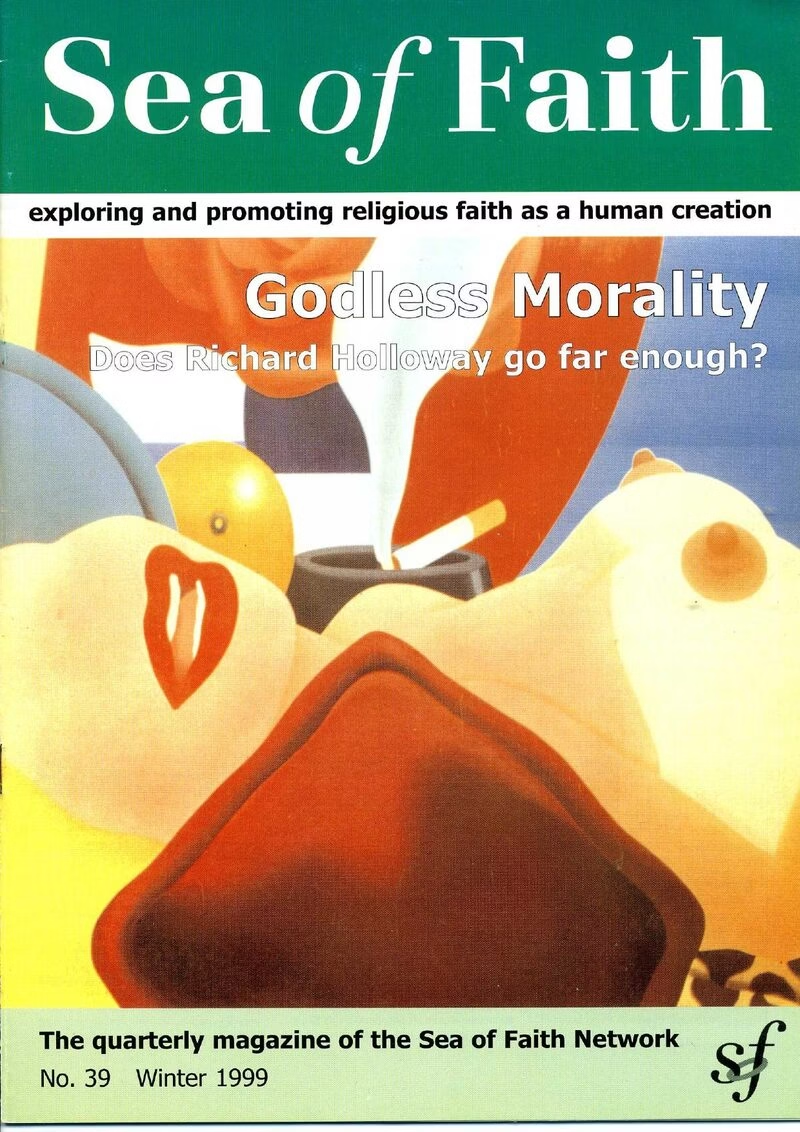
Editorial
Contents winter (vecemMBER) 1999 @ No. 39 ALL CREATURES GREAT AND SMALL 15 Anne Ashworth on Andrew Linzey’s Animal Rites FEATURES DoinG WITHOUT MR F1x1IT 4 Miles Howarth reflects on the World Conference for Religious Wuat 1T MEANS TO BE HUMAN 18 Janice Price on the Dalai Freedom Lama’s, Ancient Wisdom, Penny WISE, CHURCH FOOLISH 6 Modern World Penny Mawdsley takes leave of the Church REGULARS Wuere Does Spirit Live? 8 Joanna Dales explores nonrealism Mopir1ep RAPTURE 3 in relation to the great poets Editorial SopuHi1a So Goop 10 BEACHCOMBER 17 Trevor Greenfield compares SoF ee : s Alison Webster discovers memes and ‘wisdom literature PoOSTBAG 20 Your letters REVIEWS RICHARD HOLLOWAY SPECIAL 11-14 Assessing Godless Morality PosTCRIPTS 22 by Seafarer EDITORIAL Sea of Faith The quarterly magazine of the Sea of Faith Network Hobsons Farm, Dent, Cumbria LA10 5RF Editor: David Boulton Modified Rapture have the distinction of being the only journal, with the possible exception of the Doffcockers and Twisters Gazette, to bring out a December 1999 issue without a single reference to the millennium. But alas! temptation has got the better of me; and, as the blessed Oscar put it, there is only one way to get rid of temptation and that is to give way to it.
So, to get the silly bit out of the way first, let me wish all our readers a Happy New Millennium. May your joys abound on New Millennium’s Eve. O for a thousand tongues to sing the praises of the next thousand years...
But it’s not that millennium I really want to write about. Not the millennium of domes and giant wheels and computer bugs taking over the world on January 1 2000. It’s only recently that “The Millennium” has come to mean a chunk of one thousand years starting with the year 0, or 1000, or 2000 (by the western calendar). In traditional theologies, following Revelation 20, it was the longed-for period beginning with “the Rapture” which would see “that old serpent, which is the Devil” cast into the bottomless pit, leaving Christ and “those which had not worshipped the beast” to live and reign for a thousand years.
The apocalyptic books of the Bible — Daniel and Ezra in the old testament, Revelation and bits of Mark and Matthew in the new — have inspired a thousand forms of millenarianism: awesome, ludicrous, beautiful, tragic, poetic, heroic, utopian — and barking mad. Thomas Muntzer in sixteenth century Germany raised an army of saints to hasten the millennium. They slaughtered a few worshippers of the [= hoped that this organ might “Make do and mend! God knows there are wounds to be bound, wrongs to be righted, inequalities to be levelled out, a world to be mended. What the hell is religion about, if not that?” beast (mostly Catholics) before they themselves were wiped out. Gerrard Winstanley in seventeenth century England thought that “the rising of Christ in sons and daughters” would make Cromwell’s republic a communist paradise, where those who turned from worship of the beast of private property would inherit a new heaven and a new earth ruled by a Christ metamorphosed into “Reason” and “community”.
Political upheavals over the last two centuries have thrown up hosts of new millenarian sects, from Jehovah’s Witnesses and fundamentalist evangelicals in the Christian tradition to the Japanese Aum Shinrikyo outside it. As I write, the Israelis are deporting Christian millenarialists for allegedly trying to provoke Armageddon - the ultimate in pre-millennial tension - in Jerusalem.
We can smile at these delusions - or, if we are more sympathetic, we can sigh at the misery and alienation which produced all this apocalyptic escapism.
And yet... and yet...! Daft, deluded, dangerous, impractical, utopian as they so often were, these dreamers did have a vision of a better world, a new heaven and a new earth. They shared a divine discontent with things as they are, with the status quo. We can’t share their belief in divine intervention as the agency of change, but we can share their longing for change, and their resolve to be part of it.
Living as we do in postmodernity, our millennial “raptures” will take a very different form from those of premodern and modern times. We are unlikely to place any reliance on blueprints for utopia: we know that all blueprints and all utopias are flawed, impermanent, contingent - and we know that, if we found ourselves living in one, our first duty would be to question and challenge it! Even utopias - especially utopias - need their rebels.
So a postmodern millenarianism has to do with aspiring towards a,new heaven and a new earth (and the two of course are one), in full knowledge that the star we follow will always be one move ahead of us.
I rather like the modified rapture of William Penn, who wrote that the function of true religion is not to take us out of the world but to help us mend it. No escapism, but also no cataclysm, no apocalypse now or tomorrow, just quiet mending. Make do and mend!
God knows there are wounds to be bound, wrongs to be righted, inequalities to be levelled out, a world to be mended. What the hell is religion about, if not that?
We are discarding the old religious forms - the gods and devils, divine and malign interventions, supernatural signs and wonders, irrational dogmas - but we need to ensure that we do not also throw out the dreams, the visionary gleams, which beckoned our predecessors towards New Jerusalem, Utopia, Erewhon, Nowhere. Where does this kind of millenarianism sit in Sea of Faith’s thinking? How can we make, do, and mend?
And once again, Happy New Millennium to you all!
Patti Whaley, Letters Editor, Sea of Faith, 145 Petherton Road, London N5 2RS Or e-mail them to: 101335.3561@compuserve.com Poetic licence avid Boulton’s review of A.N.Wilson’s God’s Funeral (“God is Dad”, Sea of Faith, Autumn 1999) contains many valid criticisms of the book, but also some invalid ones.
It isn’t “cranky” or “plain silly” to complain that Matthew Arnold’s poem Dover Beach is flawed by bad science.
Poetry doesn’t have to be literally true, but it should be true in some sense, and Arnold’s misuse of marine imagery falsifies his ideological fable. It is relevant that the sound of the sea comes not from the tide but from the surf, that there are no tides in the Aegean, that no scholar has found the reference in Sophocles, and that tides come in as well as go out.
What, after all, are we meant to understand by the phrase “Sea of Faith”, whether used by Matthew Arnold or by Don Cupitt?
There is an analogous error in William Golding’s Lord of the Flies, when the spectacles of Piggy, the representative of short-sighted scientific rationalism in his ideological fable, are used to light a symbolic fire, although such spectacles would have concave lenses which couldn’t light a fire. Golding’s use of optical imagery similarly falsifies his ideological fable. Mixed metaphors in poetry lead to mixed metaphysics in prose.
Wilson’s omission of seventeenthcentury atheists is serious, but even more serious is the omission of the much more influential eighteenth-century atheists — Meslier, Diderot, Holbach, Sylvain Marechal, Lalande. Similarly Wilson’s omission of such positive middle-class atheists as Shelley, Bradlaugh and Holyoake and of the working-class atheists in general is serious, but even more serious is the omission of the formal freethought movement which produced most atheist speakers and writers during the nineteenth and twentieth centuries (a mistake commonly made by moderate freethinkers, such as the Sea of Faith).
And, yes, there is “someone else in the universe who thinks Swinburne was a great poet”!
— Nicolas Walter, London
NicoLas WALTER 88 Islington High Street, London N1 8EW postmodern humanist science.
That is precisely what is wrong with it.
It is a modern form of solipsism, like the classical Hindu belief that objective reality is an illusion.
This equation of the non-reality of gods outside human heads with non-reality of the universe outside human heads is a logical, ethical, scientific and philosophical mistake of the first order; and a commonsense mistake of the first order too.
It is a false equation of non(precise) measurability with non-existence. It is only the measurement and understanding (by humans) of matter and energy that is dependent on human consciousness and observation, not their reality or existence outside and independent of human heads; all the way from atoms, molecules and cells to geology, vegetation and animals, and to solar systems, galaxies and the entire cosmos, all of which existed for hundreds of thousands of millennia before any human heads existed. Einstein’s relativity, Heisenberg’s uncertainty principle and Bohr’s quantum mechanics relate only to the nature and behaviour of these objects, not to their existence.
Failure to understand this simple but crucial difference is widespread in socalled postmodernism, including the SoF.
— John Jackson
JOHN JACKSON 8 Woodville Road, Golders Green, London NWI11 9TN [For the record, this wasn’t said by the “real” historical Nils Bohr, but by Michael Frayn’s Nils Bohr in his play “Copenhagen”. - Ed.] Crashing Bohr agree with Seafarer (Postscripts, Sea of Faith, Autumn 1999) that Niels Bohr’s saying, “The universe exists...only through the understanding lodged inside the human head” very well expresses Not taking leave of God n “Not taking leave of God” (Postscripts, Sea of Faith, Autumn 1999) you say, “That leaves the Quakers as the only ‘church’ which does not insist on belief in God (because they deny all credal propositions).” Please add the Unitarians to those who deny all credal propositions.
Sometimes Unitarians are called “Quakers who talk”. Unitarians and Quakers hold similar points of view. Since the Unitarians talk, we are rejected from the Council of Churches. Quakers keep silent, and are accepted.
— Richard Boeke
RICHARD BOEKE Secretary, International Council of Unitarians and Universalists (ICUU). r.boeke@virgin.net [See Seafarer’s apology, page 23] LETTERS Cheerful givers ne of the less popular tasks of the Sea of Faith treasurer is to advise on the level of subscriptions for the ensuing year. A fairly modest rise is suggested, but in view of the commitments already on board, and the desire to finance a development worker beyond the next two years, it may be worth taking a fresh look at what we charge, bearing in mind it is such good value for money.
By way of making comparisons let us suppose that we attend church. If one were to give £1 per week (far below what is needed to balance the books) then we would be placing £52 per year in the collection plate. Those who take their commitment seriously give significantly more. I can imagine cries of dismay if subscriptions of £50 per year were to be mooted: there would be the fear that some would drop out, and that it would make the SoF an exclusive club for those who could afford it.
So perhaps there is a happy medium.
Maybe we should consider raising the subscriptions on a sliding scale of inflation plus 10% over a number of years. This would gradually lift the level of subscription to a point where subscriptions covered all costs, which we do not currently do, and put a little in the bank as well. We could then consider how to turn this sound financial position to good advantage.
— Harold Steel
HAROLD STEEL 6 Alder Grove, Poulton le Fylde, Lancashire FY6 8EH The will to love - The Road Less Travelled Dr Scott Peck suggests that “the growth of the human spirit is the end goal of human existence”.
How do we ensure the growth of the human spirit? Not by sitting around waiting for spiritual experience. We make the decision that we are going to face up to truth, to the way things really are - about ourselves, about our world and about our interactions. “A life of dedication to the truth means a life of continuous and stringent self-examination....Examination of the world without is much easier than of the world within.” We have to have a willingness to be totally challenged about ourselves. That will, and willingness to develop the capacity to transcend and transform our own nature, he calls LOVE. “Love is not a feeling” but “the will to extend one’s self for the purpose of nurturing one’s own or another’s spiritual growth.” I find that a most inspiring definition of love — immediately applicable, totally relevant, totally challenging.
Don Cupitt (“Democratic Christian Humanism”, Sea of Faith, Autumn 1999) hopes that “out of the present turmoil new communally-evolved religious systems that people can live by will develop”. I could readily participate in any world or local community dedicated to “the will to love” .
— Elizabeth Reid
ELIZABETH REID/SINCLAIR Grace Cottage, Abbotsford Road, North Berwick, Scotland Reidg.E@btinternet.com Doing good in the garden N® everyone is competent or has the aptitude or even desire to open an orphanage in a Third World country, set up a drug rehab project in their neighbourhood or be active in local politics. But isn’t it possible to make a difference in this world just by whether we live our individual obscure lives in a negative or positive fashion? I feel that just by recognizing and celebrating in my life the beauty of the world around me every day and by adding to it by cultivating my garden with things fine, rare, and colourful I am contributing to the overall sum of goodness in the world.
— Jane Baker
JANE BAKER 7 Gorse Hill, Fishponds, Bristol BX16 4EG Q’pit foretold Se members generally frown upon allegorical interpretations of scripture, but I have hit upon a prophecy that will profoundly challenge this prejudice. I have discovered that one of England’s greatest epic poems carries a clear and unequivocal prediction of the work of Don Cupitt, the Sea of Faith and the postmodernist move in SoF philosophy. I refer, of course, to that masterpiece The Hunting of the Snark by Lewis Carroll. “The Bellman himself they all praised to the skies— Such a carriage, such ease and such grace!
Such solemnity, too! One could see he was wise, The moment one looked in his face!
He had bought a‘large map representing the sea, Without the least vestige of land:
And the crew were much pleased when they found it to be A map they could all understand. ‘What's the good of Mercator’s North Poles and Equators, Tropics, Zones, and Meridian Lines?’ So the Bellman would cry: and the crew would reply ‘They are merely conventional signs!
Other maps are such shapes, with their islands and capes!
But we've got our brave Captain to thank (So the crew would protest) that he’s bought us the best— A perfect and absolute blank!’ This was charming, no doubt; but they shortly found out That the Captain they trusted so well Had only one notion for crossing the ocean, And that was to tingle his bell.
He was thoughtful and grave—but the orders he gave Were enough to bewilder a crew.
When he cried ‘Steer to starboard, but keep her head larboard!’ What on earth was the helmsman to do?” Who can doubt that the Bellman is a clear reference to our Don especially when the Sanskrit for “one who rings a bell” is “Q’pit”?
The crew are obviously the members of SoF and the Sea that they are crossing in search of the Snark is without a doubt the Sea of Faith. The ship must be the ship of the church — a very ancient image — and the difficulty in steering it refers to the problem of converting the church to a nonrealist position.
The Snark who is hunted is the Absolute which has been sadly lost but for which all SoFers hanker. It also refers to the search for the new, nonrealist mode of expression.
The blank map — which lacks any conventional signs — cannot be anything but postmodernist theory.
The steersman refers to the SoF steering committee who have difficulty in knowing which way to steer the annual conference because Don revises his philosophical position at least once a year.
And the tingling of his bell? Well, it could refer to 1 Corinthians 13 but I'm far too charitable to suggest it.
My next project is to tie this prophecy in with the Egyptian Pharaohs, Freemasonry, the Illuminati, the Gnostics and the Knights Templar (who have something to do with everything) and publish this autumn’s occult best seller.
— Ros Wheeler