
Contents
Articles
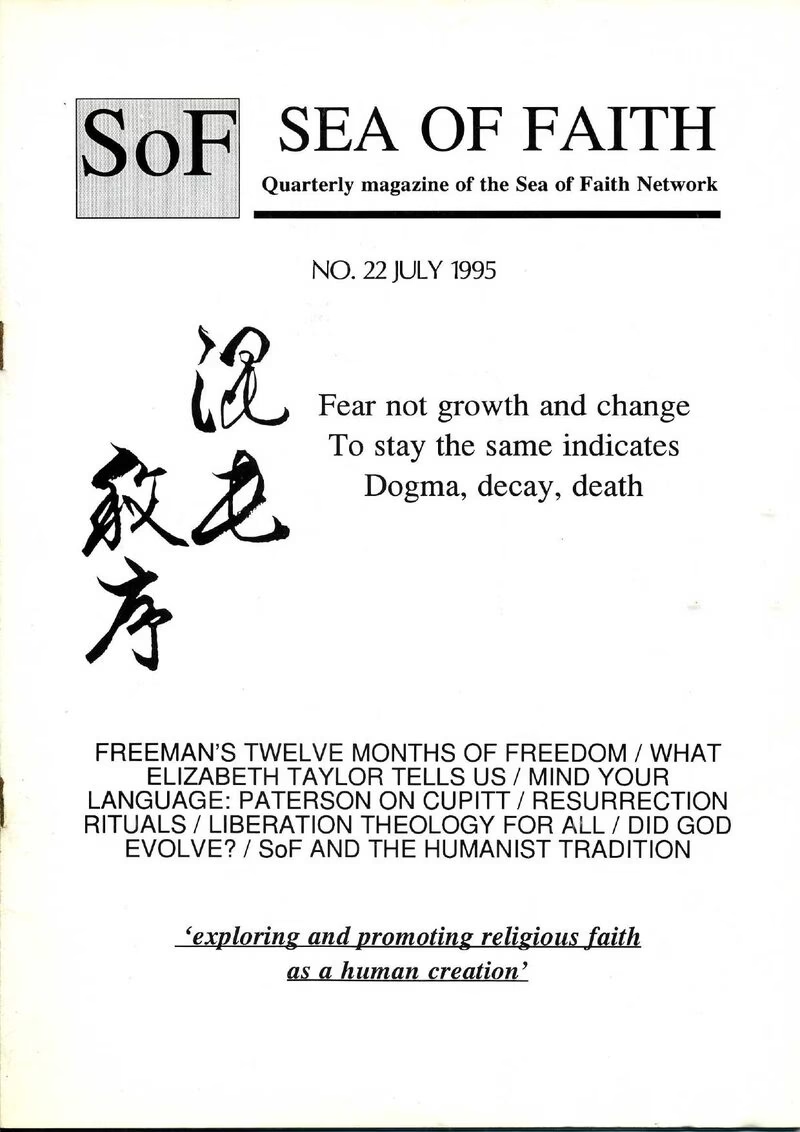
- Resurrection Ritual, Priscilla Morton
- SoF and the Humanist Tradition, Margaret Chisman
- What Elizabeth Taylor Taught Me, David Dulley
- A Case for Theism, T. Konwerski
- A Case for Theism: Editor's Response, David Boulton
- Non-Denominational School Prayers
- Haiku
- Twelve Months a Free Man!, Anthony Freeman
- A Liberation Theology for All, Peter Lumsden
- The Evolution of God, John MacDonald Smith
- Religious Politics? No Thanks!, Anne Coghill
- My Magic Roundabout, Derek Chorley
Reviews
- Minding Our Language, David Paterson
Regulars and Occasionals
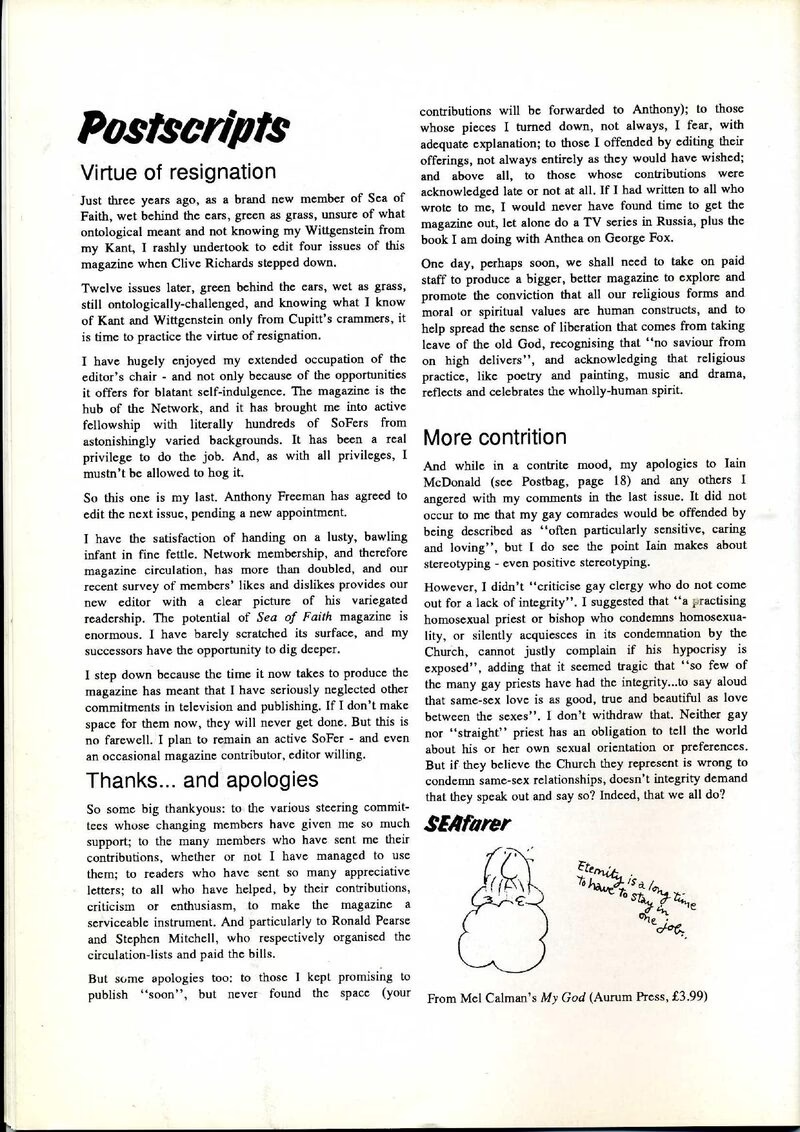
- Postscripts: Resignation and Contrition, David Boulton
Editorial
Contributions for the next issue should reach the editor by August 31. Send (with stamped addressed envelope) to Anthony Freeman, Old Bakery, North Aston, Bicester, Oxfordshire OX6 4HX HEAD AND HEART It seems we can’t wrench free from dualisms: mind and body, heaven and earth, sacred and secular - and, particularly fashionable now, head and heart.
Head and heart dualism holds reason, logic and clear thinking to be one thing, creative imagination, feeling and intuition another. So separate are they held to be that, although we know it to be anatomical nonsense, we locate one in the head and one in the heart.
This probably doesn’t matter if we use head and heart merely as convenient shorthand metaphors. But it begins to matter quite a lot if we really begin to suppose that intellect and creativity, reason and imagination, are wholly distinct and separable. And it becomes positively dangerous if we allow ourselves to fall in with the popular notion that intellect and reason are somehow masculine, and feeling and intuition somehow feminine.
The notion is shallow because it involves such broad generalisations. But it is also insulting to women and to men. To women, because it implies that they are not expected to trouble their pretty heads with hard logical thinking, and to men because it implies that the creative, intuitive man (if you can find him) is a bit of a cissy.
A moment’s thought can conjure up a catalogue of women whose intuitive responses are clearly matched by their intellectual capacity. And it is not unknown for poets and painters, composers and dramatists, to be men. The truth is that we are all thinking, feeling beings. That’s what makes us human.
That women and men sometimes bring a different style and differing life experience to our common activities is clear enough. But to tag these differences as head = male, heart = female is neither logical nor creative! It isn’t even good feminism. - Reason and imagination are both functions of the three-pound gelatinous blob we call a brain: functions which give us each a mind of our own (the mind, as they say, being what the brain does for a living). The brain lives on fresh blood pumped to it by the heart, which in turn is powered by lungs, engines of thé breath of life, which (from our Latin forebears) we call the spirit.
Intellect and intuition are inseparable elements of the one spirit. We do not know what we feel without thinking about it, and we cannot think thoughts without feeling their effect. SoF has some hard thinking to do, and some imaginative leaps to make - but not in separate compartments, thinkers here, feelers there.
Posthag Unitarians and humanism Just as it would be wrong to describe Sea of Faith as a development of Unitarianism, so it is wrong to assert that “‘This development from Unitarian Christianity through ‘religious humanism’ to plain ‘humanism’ was of course paralleled in Britain, as the short-lived Ethical Church movement melted into the British Humanist Association”’ (editorial introduction to ‘‘A Religious Humanist Manifesto’’, Sea of Faith magazine, April 1995).
This is an innacurate and misleading association of different trends. The Unitarian Universalist Church in the United States is an amalgam from 1961 of two evolutionary and religious trends which now have their own religious humanist congregations, many of which avoid or seriously humanise the word God. In this country a minority of Unitarian churches are religious humanist. The secularists and Free-thinkers were quite different. Personnel passed between both movements, as they did between Unitarians and the orthodox, but they were never the same ship.
Far from calling the 1933 Religious Humanist Manifesto ‘ta fascinating pre-echo of Sea of Faith’’, I call Sea of Faith a late deja vu of what has already happened in different streams before it. - Adrian Worsfold, 13 Manchester Square, New Holland, Barrow-upon-Humber, DN19 7RQ.
— Adrian Worsfold, Barrow-upon-Humber
Positive stereotyping
Oh dear! I had thought that homosexual stereotypes would be a thing of the past for Sea of Faith members but here they are surfacing in Seafarer's Postscript (April 1995 magazine) just as they always have. Homosexual men sensitive...sensuous aesthetics...exotic vestments.
You only had to portray lesbians as tough women with a tendency to be truck drivers and the whole sorry picture would have been complete. Come, come! What of the gay engineers, mathematicians, computer scientists, chemists and athletes? Could it be that lesbian and gay people are just like anyone else - or is that something even SoF members find hard to acknowledge?
It is some twenty years ago that I wrote in reply to a letter in the United Reformed Church magazine Reform which had portrayed gay men in just the same way and had exhorted sympathy. Such support we can do without, thank you! was what I wrote then and I am very sorry to have to repeat that response now.
To compound matters, Seafarer goes on to criticise gay clergy who do not come out for a lack of integrity. This is adding injury to insult. One only has to witness the treatment meted out to those who have come out (I have experienced it myself but to a much lesser extent than others) to know what a difficult and painful dilemma faces lesbian and gay clergy in being open about themselves. The task of proclaiming same-sex love as "good, true and beautiful as love between the sexes" is one for the whole church and not for those whom she has sought to persecute.
Seafarer has genuinely shocked me by his (surely not her) ignorance and insensitivity masquerading as sympathy. In your recent questionnaire you did not ask about members' sexuality but if you wish to keep your lesbian and gay members you will have to do better than this. - Iain R McDonald, Ordinand, United Reformed Church, Mansfield College, Oxford. [Seafarer responds in his Postscripts, page 20]
— Iain R McDonald, Oxford
That other network
It seems that only 1% of our membership is under 30. We clearly are not yet catering for this age group which ought to form the bedrock of any organisation which has any intention of thriving. I think that the failure to take account of the interests and method of communication of the under-30s was particularly reflected in the conventional approach which everyone, even "the old hands in marketing" (and I think "old hands" is particularly revealing) took to publicising SoF activities.
We seem to be solely concerned with talk and the printed word. However, electronic communication is surely the medium of the young. Thus in comments and suggestions given, I saw no reference to the Internet as a possible source of promotion and recruitment.
I am aware that the Internet is overhyped, but it does have over 30 million users worldwide and is increasing at a staggering rate. It is no longer an American phenomenon, with at least 23% of computers on the net being in Europe. The UK is estimated to have up to 0.75 million users, second only to Germany. The user is typically between 18 and late 20s.
On the Internet there are hundreds of conference and news groups relating to religion, humanism, atheism and sub-sets of these, and world-wide web pages, gopher sites and the like exist for General Religion and Theology, Christianity, Buddhism, Islam, Hinduism, Sikhism, Miscellaneous Religious Resources, Atheism, Religious Cults and even "Anglicans on line"!
The interest is there. This is why SoF should consider becoming involved if it wishes to attract a large under-30s membership. Surely we should be promoting our ideas through this electronic forum? We need to offer an alternative approach to "realists" on the net, both religious fundamentalists with their strident propaganda and indeed to their no less vocal atheist opponents.
It would be possible to do this by making the magazine available on the net as an electronic magazine, and/or establishing an electronic archive of the best of our magazine articles. We could make some contribution to the many newsgroups on religion and humanism. We could even establish a web site to publicise our activities.
Finally, we could use e-mail rather than the current "snail mail" service to communicate with others on the net.
Of course as an organisation, because of our current age profile, we will generally lack technical expertise (some will understandably be technophobic), and the computer may not be our favourite means of communication. But if we want to make an impact, or even survive, isn't it essential that some of us look to this new medium on SoF's behalf?
If we were to do this and were successful, we would have the problem of a vastly increased and substantially different membership. We need to ask the present membership if we could cope or indeed would wish to cope with this? What do you think? - Jim Davies, 72 Ivydale Road, Nunhead, London SE15 3DS.
— Jim Davies, London
Birth of SoFnet Since you published my letter in the January issue, the Hertzian waves have been rolling up on the shores of both Great Britain and New Zealand, as electronic mail (e-mail) messages have criss-crossed the time/space void.
It’s time to give a brief report on progress in the short time since the initiation of what has come to be called ‘*SoFnet’’.
The response to the invitation for expressions of interest has been warm both in the UK and NZ. Already folk previously unknown to each other are exchanging greetings and personal notes as though they had been long-time familiar friends. There are now (April) 23 people of diverse backgrounds and interests on SoFnet, including some couples on the same e-mail address.
How does it work? Each member sends messages to a common address list so that everyone sees and may comment on any one contribution to a ‘‘discussion’’. The advantage of this mode is that it is non-hierarchical: everyone has equal access and is part of the group, no matter their geographical isolation.
Exchanges have included comment on new books and videos, enquiry and answer about a visiting theologian, notice of meetings, reports on lectures, poetry (linking with David Herbert’s ‘‘Poetry by Post’’ initiative), personal information, and discussion on the purpose of local SoF groups. Messages have passed between the UK and NZ SoF Steering Committees. The text of the NZ SoF newsletter has been distributed on SoFnet.
It is not our wish to be an exclusive computer sect.
Participants see SoFnet as complementary to the other activities of SoF, and wish to share our discoveries with the wider SoF community. If you have access to an e-mail account you are very welcome to join the electronic network. A brief message to me at my e-mail address is all that is required. - Ralph Pannett, pannet@met.co.nz. ..and in brief...
— Ralph Pannett
It was interesting to read that the average age of members is so high. Maybe that is because for most of us it takes a good deal of time before we come to realise that we are non-realists. - Jain Robertson, Kristian Brennersvei 70B, 3026 Drammen, Norway.
— Iain Robertson, Drammen, Norway
I have just finished reading Jostein Gaarder’s best-selling novel Sophie’s World, It has apparently swept the continent and is near the top of the hardback list in Britain. It is basically a primer in philosophy written in the form of a novel. What struck me is that what this unknown Scandinavian writer has done for philosophy could be done effectively for the ideas that have been circulating throughout the SoF network during the last half-dozen years. Richard Barnes? David Lodge? Ailen La Tourette...2 - John Coombes, 2 Pizey Avenue, Burnham on Sea, Somerset TA8 2HS.
— John Coombes, Burnham on Sea, Somerset
I hope that Sea of Faith people will soon assume that religious belief is a human creation. Subsequently we can work towards using, modifying or dispensing with religious belief as a stimulus and/or means_ towards making a better world. The shortness of this letter is not intended to suggest that the work would be simple or easy. - Eileen Cameron, 48 Barnton Park Avenue, Edinburgh EH4 6HE.
— Eileen Cameron, Edinburgh
I think that SoF has gone too far too fast in introducing humanism so early in the movement’s history. It simply reduces its effectiveness to influence Christians. At any rate I don’t buy their ideas. I looked at their literature many years ago and found it uninspiring. I do not wish to diminish or denigrate Humanism or imply that Humanists are less than Christians. I just don’t think you can convert Christians into Christian Humanists. I would like SoF to be more explorative and less dogmatic in its opinions. It might even change some of its ideas and in the process set a good example to the churches, Nevertheless, I look forward to receiving your magazine! - S P Bird, 26 Birkdale Avenue, Blackwell, Bromsgrove, Worcs B60 IBY.
— S P Bird, Bromsgrove
My husband and I read your article on Quakerism. Being a Quaker myself (my husband is an Attender) I felt very much at one with the ideas expressed and have now joined the Sea of Faith movement. Thank you! - Helen Waycott, Howgill, The Green, Ripley, Surrey GU23 6AJ.
— Helen Waycott, Ripley, Surrey