
Contents
Articles
- In the Name of Heaven: An Open Letter to Those in the Deep End, A G Alger
- Real Ale, Real God?, Gerard Sullivan
- Why So Abrasive?, Tim Miles
- Jesus and the Grand Inquisitor, Don Cupitt
- Fooling for Christ's Sake, Jane Sherwin
- Last Rights, Anne Ashworth
- John's Gospel: The Unauthorised Version, Lloyd Geering
Reviews
- Paradise Rewritten, Jim Davies
Regulars and Occasionals
Editorial
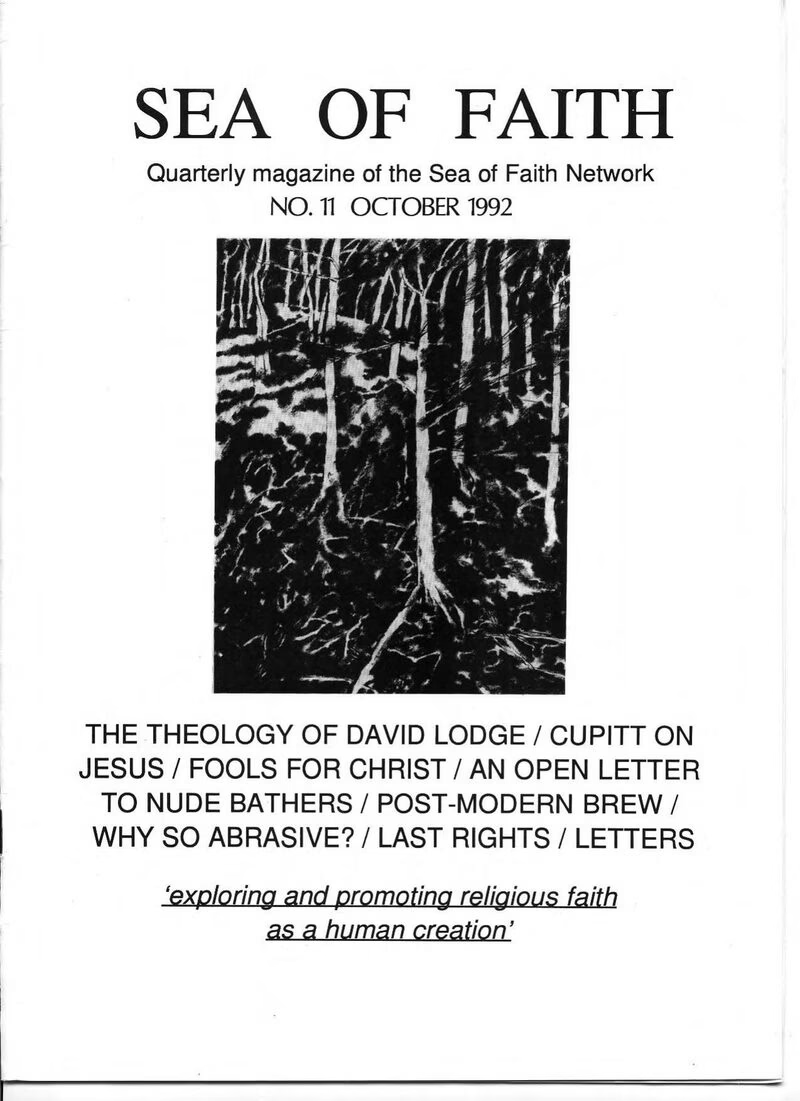
Critic Peter Fuller places him in the visionary TurnerPalmer-Nash tradition. "What binds everything in Blackburn together is his longing to pass through the appearances of things and to offer the viewer an imaginative vision of that harmonious and transcendent reality which lies behind them. In the end, we may want to admit that the idyllic world which Blackburn reveals is only an illusion. Even so, these pictures belong to what Herbert Marcuse once called 'the cosmos of hope'. For the kind of illusion they encourage us to enter into is that upon which spiritual life, perhaps civilization itself, depends." SE4farer PUT THAT IN WRITING! some editorial reflections I'll say this for the Sea of Faith steering committee: they arc no slouches when it comes to making decisions. In April this year I had never heard of the Network. I was familiar with Don Cupitt's earlier books, those which followed the momentous Sea of Faith TV series, but I was unaware of any organisational follow-up till I saw the Network conference advertised in The Friend. I signed up early in May and received my first SoF magazine, which indicated that Clive Richards was seeking a replacement for himself as editor. In a moment of rash enthusiasm I offered to help. Five days later Clive wrote to say the steering committee had appointed me and would I please get on with it.
I had never knowingly met or consorted with any SoF heretic other than Don Cupitt whom I had once heard lecturing in Manchester Cathedral and had subsequently invited onto a TV series I was doing for ITV called My God. First, I thought, I'd better rcad up the backnumbcrs to find out what I was letting myself in for. I feared the worst: a neurotic Doubters Anonymous, a depository of hand-wringing ex-believers and whingeing vicars who had lost their faith but were damned if they were also going to lose their stipends. What I found was an intellectually lively and emotionally engaged bunch of contributors exploring modern ideas in an undogmatic and anti-dogmatic fashion. OK, some of them used words like ontological and went on a bit about Wittgenstein, but I could look the long words up and mug up on Wittgenstein from my daughter's university textbooks.
The real test was the Leicester conference. There we were, my even-more-sceptical wife and I, rubbing shoulders with more than 200 men and women with a story to tell. Some proclaimed that God was dead, History was dead and they weren't feeling too well themselves.
But again and again, in accents recognisably Quaker, Anglican, Unitarian, Humanist, they joyfully and creatively articulated their own core values and their own sense of purpose, some in the formal sessions, some in the play-time workshops and some over the dinner-table or between pints of non-real ale at the bar. Yes, we thought, Anthca and I, we can get on with this lot if they can put up with us.
So I'd learnt a little about the Network. Now I had to learn how to produce a magazine. It's true that I've spent much of my professional life as an editor, but running TV series like World in Action and Celebration isn't much of an apprenticeship for editing SEA OF FAITH. As a TV editor you have lots of clever people doing the hard work for you. You propose, others dispose. Running SEA OF FAITH you give the orders and you obey them. You're on your own.
I was committed to buying a computer for my own business needs. All I had to do was add the software that would turn me into a modern desk-top publisher. But, . alas, I belong to a generation which rather lost its technical bearings when they changed the colours of the wires in electric plugs. So I've been in trauma for the last few weeks, and I'm afraid this must suffice to explain, if not excuse, some of the oddities you have no doubt spotted in the layout of this issue. I'll try to get it right next time. Meanwhile, the whole exercise has left me with renewed respect for Clive Richards, who produced ten admirable issues - and assured mc, with a sincerity which shone through his dark shades, that there really wasn't much to it...
But the point I really want to make in these back-cover reflections is this. SEA OF FAITH is your magazine, not mine. We are committed together to explore and promote religious faith as a human creation. The exploration and the promotion must be a shared activity, and much of that activity should be taking place within these pages. So I want to invite - urge - you to put your own thoughts, ideas, doubts, affirmations, arguments, explorations down on paper.
It can be an article (try to keep it to 1200 words) or a letter or whatever you fancy. It can advance the frontiers of theology and philosophy and be ever so ontological, or not, as the case may be. There must be things you don't like about the way SoF organises itself or expresses itself: then join the critical debate which is already going on inside. Argue, debate, question - and do it here. You too can write for pleasure and profit: our pleasure, our profit.
What, if anything, should SoF be doing, as distinct from saying? What can we affirm? How do we promote our ideas - if we arc in the promotion business?
It will help if you can type out your piece - but clear hand-written contributions will not be discriminated against. Add a paragraph about yourself. It is helpful if you include a stamped addressed envelope for acknowledgement - and essential if you want your copy returned.
Contributions for the January 1993 issue should reach me by the end of November, addressed to David Boulton, Hobsons Farm, Dent, Sedbergh, Cumbria LA10 5RF.
So put it in writing. A network is a lot of holes tied together with string. Be a piece of the string, not just one of the holes.
POST AG Telling the children I have only recently discovered SoF Network and have felt exhilarated by recent issues of the magazine. John Pearson ("Not in front of the children?", SEA OF FAITH 10) pointed out that up to the age of about ten it is relatively straightforward telling children about God and Jesus, but after that it becomes more difficult. I agree.
We almost totally fail young people. "Religious Instruction" has never grown up whereas children have. They are left in a vacuum, only to throw out the baby with the bathwater and assume that if they can't take the mythology, symbolism and dogma there is nothing left. Many are easy prey to indoctrination.
Could not Religious Instruction (is this an inviting title?) turn on discussion about the nature of God, involving an outline of world religions and philosophies? This approach can transcend religious and cultural boundaries and provide an agenda for teaching about tolerance, lack of dogma, pride, the "cardinal virtues" and so on.
Finally it could be shown how the Bible and religious works can be seen "through adult eyes" and children can make up their own minds about what God is. Any good education system into the next century must surely include a broad religious and philosophical grounding on which to make informed decisions, not shallow judgements. The most urgent question to be addressed is the training of teachers. - Elizabeth Reid, Grace Cottage, Abbotsford Road, North Benvick, East Lothian EH39 5DB. [We shall return to this subject in the next issue with extracts from "Spiritual Education in a World without Religion", Ruth Robinson's appendix to John Robinson's "The New Reformation"] in the atheist camp?
— Elizabeth Reid, North Berwick, East Lothian
I found myself obscurely disturbed by Martin Wood's "Opting Out" (SEA OF FAITH 10). The nub of my objection is that Mr Wood wants to merge two categories - "non-realist" and "atheist" - which I think it is vital to keep distinct. I remember A J Ayer arguing strenuously on television that Don Cupitt belonged in the atheist camp with him. Cupitt, just as strenuously, resisted the invitation to join.
The atheist, to put it simply, has no truck with the word God, whether used literally, metaphorically, to name an archetype in the unconscious or in any other way. It is a meaningless word.
But the non-realist uses the word meaningfully even if it doesn't point to a reality "out there". The non-realist will find slipping back into promoting the dichotomy from which we are trying to free ourselves. Inevitably this will promote a backlash to the effect that religious faith is a divine creation, and the result will be deadlock.
Secondly, one of the worries expressed by various people at the SoF conference in July 1992 was that instead of a "network" we might find ourselves becoming a "movement" - a body of people with a leader and a distinctive programme of beliefs. The words "religious faith as a human creation", so far from countering this view, actually reinforce it. A formula of some kind is useful on a magazine cover, but I suggest that thought be given to providing a less abrasive one. The word "exploring" should in my view certainly be retained, but I wonder if we could indicate that one of the things which we are exploring is the idea that talk of God should not be interpreted literally.
In any attempt to avoid abrasiveness one needs to start where the other person is. In the present case it could be pointed out - as something obvious and not controversial - that when we say "sitteth on the right hand of God" we do not imply that God has a right hand in any literal sense. A more sophisticated hearer might also be willing to agree that when expressions such as "activity" and "power" are used of God they should not be understood literally.
Finally it can be pointed out that the same is true of the words "exist" and "real". (Perhaps there is a temptation to say that all these words are a "human creation", but what else could they be?). There are difficulties in saying "God exists" in a literal sense; but they arise not because one's religious commitment is in doubt - this is quite a different matter - but because the "greatness" of God cannot be captured in language. The commitment, whether of an ordained minister or of anyone else, need not be tied to literal interpretation of "God"-language, nor to the belief that some events can be termed "natural" and some "supernatural". Those who argue that we are denying what Christians have believed for nearly two millenia could perhaps be reminded that there is no obvious word in New Testament Greek corresponding to "supernatural".
In short, "religious faith as a human creation" is a provocative thing to say. "Talk of God should not be understood literally" is not.
Tim Miles is Emeritus Professor of Psychology at the University of Wales, Bangor. He is a member of London Yearly Meeting of the Society of Friends.
POST AG Telling the children I have only recently discovered SoF Network and have felt exhilarated by recent issues of the magazine. John Pearson ("Not in front of the children?", SEA OF FAITH 10) pointed out that up to the age of about ten it is relatively straightforward telling children about God and Jesus, but after that it becomes more difficult. I agree.
We almost totally fail young people. "Religious Instruction" has never grown up whereas children have. They are left in a vacuum, only to throw out the baby with the bathwater and assume that if they can't take the mythology, symbolism and dogma there is nothing left. Many are easy prey to indoctrination.
Could not Religious Instruction (is this an inviting title?) turn on discussion about the nature of God, involving an outline of world religions and philosophies? This approach can transcend religious and cultural boundaries and provide an agenda for teaching about tolerance, lack of dogma, pride, the "cardinal virtues" and so on.
Finally it could be shown how the Bible and religious works can be seen "through adult eyes" and children can make up their own minds about what God is. Any good education system into the next century must surely include a broad religious and philosophical grounding on which to make informed decisions, not shallow judgements. The most urgent question to be addressed is the training of teachers. - Elizabeth Reid, Grace Cottage, Abbotsford Road, North Benvick, East Lothian EH39 5DB. [We shall return to this subject in the next issue with extracts from "Spiritual Education in a World without Religion", Ruth Robinson's appendix to John Robinson's "The New Reformation"] in the atheist camp?
I found myself obscurely disturbed by Martin Wood's "Opting Out" (SEA OF FAITH 10). The nub of my objection is that Mr Wood wants to merge two categories - "non-realist" and "atheist" - which I think it is vital to keep distinct. I remember A J Ayer arguing strenuously on television that Don Cupitt belonged in the atheist camp with him. Cupitt, just as strenuously, resisted the invitation to join.
The atheist, to put it simply, has no truck with the word God, whether used literally, metaphorically, to name an archetype in the unconscious or in any other way. It is a meaningless word.
But the non-realist uses the word meaningfully even if it doesn't point to a reality "out there". The non-realist will find something profound but the atheist will dismiss as nonsense a passage like this (from Cupitt's The Sea of Faith): "God (and this is a definition) is the sum of our values, representing their ideal unity, their claims upon us, and their creative power...God is man-made only in the non-startling sense that everything is".
Mr Wood maintains that "the words of most if not all Christian hymns are patent nonsense", and breezily asserts that "the language used in Christian religion is dead. It needs burying.
Only when a new language is introduced will a new culture begin to emerge". But the non-realist feels himself rooted in, or creatively drawing on, a tradition of which ancient and modern liturgies, scriptures and, yes, hymns are a vital part. At least I do, and nothing in Cupitt's work suggests other than that he does too. If we do choose to junk this tradition as nonsense then we will want to call ourselves atheists. I choose not to and don't want so to call myself.
We don't, I think, need a wholly new language: what we need is a new understanding of the Christian mythical tradition. It is the essential property of myth that it can be endlessly reinterpreted and reapplied to developing human consciousness. The orthodox believer (Mr Gummer is a good example) would argue that such reinterpretation drains Christianity of all meaning. I would argue that it is the authentic growing point of Christianity and always has been.
Nothing grows out of nothing. In seeking to disinherit us of our past, Mr Wood takes us potentially everywhere and anywhere.
Mr Gummer, one might add, takes us back to a time which never existed. - Dr John Florance, 143 Evington Lane, Leicester LES SPS.
— Dr John Florance, Leicester
Belief and action I must reply to Stephen Wames' suggestion (SEA OF FAITH 10) that disjunction between belief and action does not only not matter but is actually "creative" and that "consistency between thought and act" is "unnatural". Certainly lying is much more creative than honesty; and if by "natural" is meant that which ensures more easy survival, that which is closer to our animal instincts than behaviour guideed by the conscience which distinguishes us from the rest of the animal kingdom, then one must agree that disjunction between belief and action may indeed be "natural". Certainly more natural than it is reflective of human integrity.
While he allows that public conformism does bring such worldly reward as the very job he himself is paid for, he suggests that such a gift is of no account. Why then does he externally conform? All that seems creative in that is the falseness of his position. Is he encouraging the growth of creative human freedom in his parishioners when he teaches and preaches dogma which he has been intellectually privileged enough to be able to put aside? Is it his or their freedom and growth he is considering most? It is bad enough for a priest to be teaching and preaching dogma he does not believe, but to try to elevate such behaviour to the heights of "virtue" is arrogance indeed.
Certainly one should not state opinions in social conference in a way which causes severance, nor simply for a "desire for successful human argument", but if a view on the way in which human life should be conducted has been formed after great thought; and if one cares about people, there should be sufficiant passion and determination to try to bring about the changes one has come to deem necessary. This won't happen by thinking one thing and saying or doing another.
We may well be wrong in our beliefs, but so long as we are prepared to continue to learn from others we can continue to grow. That is freedom. That is development. What can we learn from listening to or observing such as Stephen Warnes when what he says and does does not indicate his own truth? - Iris Green, Bryn Llan, Tynygongl, Anglesey.
— Iris Green, Bryn Llan, Tynygongl, Anglesey