
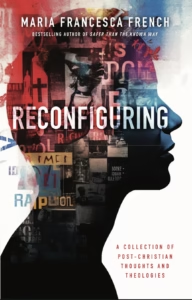
Reconfiguring. A Collection of Post-Christian Thoughts and Theologies by Maria Francesca French. Quoir (USA, 2023). 229 pages. £15.65.
This book of writings follows on from the author's previous best-selling study of radical theology, Safer than the Known Way. The book's 40 brief chapters are an exploration of further aspects of radical theology and have no overall cohesion other than to provide 'a theological imagination for the future' that addresses a whole range of cultural and religious issues. These varied tentative and personal reflections – often accompanied by reference to the work of some distinguished theologian or thinker – have been written over a period of two years (2021–2023) during which the author triangulated life between various locations in the USA, England and France.
The reflections are generally acute and well-informed, and her scriptural knowledge is impressive. For example, an early chapter on Hell (Ch 2) puts us right about the difference between Sheol, Gehenna, Hades and The Abyss.
However, the author's favourite theme is, 'that life is worth living' (Ch 31). 'Rather than believing some big Other in the sky is working it all out for us, we now have to accept agency and responsibility for ourselves' (Ch. 40). The key question is not whether a religion may or may not be true, but what kind of transformation can we bring, what sort of intention and purpose will we bring with us in our work of exploration. (Ch.39)
The general tenor of the work is that of a faith journey, revisiting and 'reconfiguring' previous convictions and topics with the benefit of a deeper, later understanding. Knowledge is seen as evolutionary: 'It is about being humble enough to know that your first experience isn't the ultimate one.' Thus theology is a constantly moving target led by faith and when we lose our religious imagination for what could be true our theologies become too systematized, even sterile. (Ch 31)
A subject of particular interest to the author is language. The word 'god' is assumed to have a clear meaning understood by all, but that is clearly not the case. She asks, 'Why is it that it seems acceptable for everything to change except the language to describe what is indescribable?' Here she follows Carl Raschke's call for a radically new kind of thinking, 'what heretofore has been "unthought".' The unthought is something neither rational nor irrational, but 'the "undergoing" of an "experience with language," in so far as language "befalls us, strikes us… transforms us."' (Ch 32). This deconstructionist, or apophatic, approach reminded me of the medieval mystical work, The Cloud of Unknowing, though this is not referenced.
Towards the end of the book French writes of the post-Christian milieu, 'Our reality has been fundamentally changed forever. We can never go back to the way things were.' In the light of such a 'deficit' the essential for her is, 'What do I do with this deficit?' She insists the best response to our new situation would be just to rest: 'we need to sit in the emptiness and just be.' (Ch. 40) We need to learn more about ourselves and our desires rather than the ones a specific type of 'God' wanted for us. It means to engage life in all its glorious complexity and accept responsibility for ourselves.
The book concludes with the author's account of a trip to the Catholic parish church where she grew up – before she moved on to Evangelical and Post-Evangelical phases of her life. Showing up in the middle of the day she expected to find the church to be open, but it was locked. This spoke of a changed era no longer a time when one could expect churches to be open just to call in for a moment's reflection or solace. If religion has now become more of a marginal pursuit, no longer at the focus of human concourse, one wonders if radical theology is capable of filling the resulting gap or providing the consolation for which people have long turned to religion. Or is it just a new form of Gnosticism?