
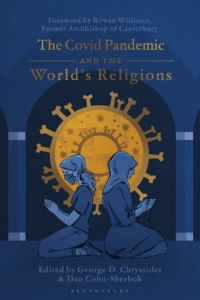
The Covid Pandemic and the World's Religions: Challenges and Responses by George D Chrysides and Dan Cohn–Sherbok (editors). Bloomsbury Academic (London, 2023). 256 pages. £16.99.
I have learned much from this book – much that I ought to have learned long ago. It will be of particular interest for those with an interest in inter-faith matters. There are two voices from each of the following religious groups: Judaism, Catholic and Protestant Churches, Islam, Hindu, Buddhism, Shinto, Sikh, Baha'i, Jain, African Traditional Religion, Zoroastrian, Unitarian, Jehovah's Witness, and Christian Science. It was a personal disappointment to me that Quakers were not included.
The contributors were asked to face five questions: How does your faith explain why such events occur? How has it affected your religious practices? What changes has it necessitated? What differences might we expect once the pandemic is over? What have we learned from it?
Helpfully, there is an early section which offers a short biographical introduction to each of the contributors, together with a table of the acronyms used. The first chapter is a 'setting-the-scene' chapter, giving a brief historical sketch of the relation of religions to plagues over a period of some three millennia. It is couched in a vocabulary which does not encourage any search behind the questions and responses which make up the rest of the book. The perspective thus described is a traditional one: the world is one which 'we have been given', not one of which we are a part. But it also makes a telling comparison by asking the difference between pandemics and global warming, which latter 'should be comparatively simple to address because we ought to know both that it is our collective fault and that we have the means to cure it, scientifically if not yet politically.'
What emerges is a number of stories giving the reader a variety of pictures which in turn are then available for further questioning. The editors have, so to speak, collected the data of their research and have made it available for us, the readers. A final chapter summarises the contributions and, except for some minor points, the editors have not told us what we ought to conclude – they have treated us as adults who are able to ask our own questions and form our own conclusions.
There are a number of common themes about practice and unsurprisingly, there is also a common theological theme – that of theodicy, the attempt to justify belief in an all powerful god who will allow such plagues and pandemics. This immediately reminded me of the most recent book I reviewed in these pages: Unknowing God by Linda Woodhead and Nicholas Peter Harvey, which takes a radical look at what they term as the 'omni-god', an examination which contrasts sharply with the introductory chapter of the present book.
Rowan Williams' foreword refers to the contrast between the liberty of individuals to dispose of the stuff of this world and the wisdom required for a collaborative attempt to strengthen one another's security. He continues: 'The pandemic mercilessly exposed the different levels of vulnerability experienced by different sorts of community, with those already disadvantaged often bearing the heaviest loads. For many, it was an eye-opener as to the gross inequalities running through supposedly advanced societies, showing clearly how power was gained and perpetuated by some at the expense of others, and how the poorest regularly pay most in our transactions.'
Although the introductory chapter points out that the Covid pandemic has been a matter of worldwide concern, identifying 'the sheer numbers involved, the political difficulties, the failure to take warnings to heart and the rush to provide vaccinations and other preventive measures', it does not consider any possibility of change within any religion, nor the possibility of changed relationships between religions, and that in spite of the commonalities which have emerged.
A friend has pointed out that the Covid pandemic is perhaps the first occasion when all religious groups have faced a common experience and that this might provide a unique opportunity to reconsider the relations between them and their shared roles in gaining what is to be learned. This book, read with power in mind, would support such an opportunity.
David Lambourn is SOF Network Treasurer.