
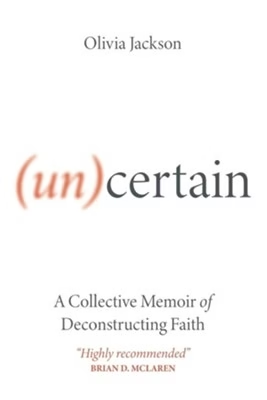
(Un)certain by Olivia Jackson. SCM Press (Norwich 2023). 256 pages. £19.99.
'Uncertain' is a collection of explanations from ex-believers for their loss of faith. Each individual deconstruction of faith is taken from a survey designed to reveal the various triggers that cause a certain type of faith to be questioned and/or rejected. The survey is dominated by the American, Evangelical community so although the focus is coherent it may be a bit narrow. What repeats is how serious emotional or psychological issues are dealt with in this community, either by church leaders or church goers.
There is negligible mature, open-minded support, instead an exhortation to accept the caprice of a providential God. All events are God's will, part of the grand design or natural order, so remedies require appeasement to God. This explains how a mother who had been up all night with her child in a hospital ward was asked by a local Church leader, 'did you take communion?', how a missionary suffering from PTSD was asked by a senior leader, 'is there sin in your life?' and autism, trauma symptoms and even sexually abused children are frequently treated by having their demons prayed out. All problems and misfortune, whatever their nature, are put down to a mixture of lack of faith, not praying hard enough or innate sinfulness.
It is strikingly clear that the God that rules in these fundamentalist circles is very much the God of providence, who ultimately provides no help at all, and when this becomes clear faith breaks down. But other things also trigger deconstruction. The 'male God' is addressed in one chapter, and how this affects not only perceived gender roles, but how it allows the perception of women as Eve-like temptresses to persist. This false masculinity is a basis which leads to women being blamed for arousing the animal in men, the responsibility lies with women not to provoke a bestial response, as explained by Austin: 'I often feel that women have to bear the shame that men are feeling…'. There are many examples of homophobia, class snobbery and a racism rooted in the colonial aspect of missionary work, all of which culminated in the recent widespread support for Donald Trump in the Evangelical community. Many of these deconstruction stories repeat that the believers and the missionaries are basically good-hearted or well-meaning, although the ultra-conservative nature of much of the politics within these circles is driving more people away. One individual who contrasted the pacifistic, harmonious aspects of Christianity with the 'Christian soldier' archetype was told, 'You're not a Christian anymore.'
The book juxtaposes brief extracts from the ex-believers' stories with personal commentary from the author who underwent her own deconstruction. The extracts are revealing and interesting, although the same point is sometimes made over and again, and although there is extra breadth and depth in the author's comments there could have been more exploration of the causes of fundamentalism, both the credulousness of the followers and the sense of entitlement and exceptionalism of the followed. The psychology and emotions of all who have deconstructed are treated with sympathy and consideration, but there is relatively little space devoted both to the people they are escaping from and to what degree these issues of control and shaming exist in other fields, such as politics or the daily workplace. However, the lay out of the book gives the narrative to the interviewees rather than the interviewer – a commendable aim.
The first part of the book addresses how and why people left their Church and/or faith. The second part looks at the stumbling blocks to deconstruction, and the conclusion shows the new individual paths ex-believers took to reconstruct. It is here that the book makes its most telling points. One person found spiritual paths truer to their spirit in Buddhism and shamanism: 'The Church is trying to hold onto something they don't really own or hold.' Each journey leaves behind a prescribed, personal, judgemental God of definite answers, and is replaced by a respect for each individual spiritual journey and a space where questioning is welcomed. God as mind becomes a God who lies somewhere between entity and concept. Margaret from Canada summed up the book's message: 'I hope we're doing more sitting round the table, breaking bread together and seeing each other's humanity first and not each other's ideologies or politics.' Though the book may focus too narrowly on the US Evangelical Church, the tales are at times both harrowing and inspiring, and highlight the need for forums where spirituality can be discussed freely and without fear or shame.
Robert Boucnik is a Maths teacher from Hastings.