
Contents
Articles
- The Freeman Saga, David Boulton
- Conference: Gathered Together
- A Kingdom Theology, Don Cupitt
- This Is My Story, Anne Horner
- Long Spoons, Richard Smith
- 'Undo Common Sense?' You'd Far Better Notter, Jane Cole
- Sea of Faith Network Constitution
Regulars and Occasionals
- Postscripts: Family of Love, Dennis Potter and the Archers, David Boulton
Editorial
OURSELVES AS OTHERS SEE US This nineteenth issue of Sea of Faith magazine is inevitably dominated by a certain amount of introspection. Our sixth Conference, in the year of our fifth birthday, devoted more time than usual to what some, not unreasonably, called navel-gazing: looking at ourselves as a Network to clarify our minds on what we are, what we could be, what we have done, and how we could do it better. Since a good deal of space in this issue is given over to Conference reports, this process of self-examination and self-assessment is reflected in these pages.
But when, perhaps on our tenth birthday, we look back on our fifth, it will not be our internal reorganisations and our constitution-making we remember as the mark of 1994 but the scrutiny we came under from outside: from the press and broadcasters, from the churches, from the established humanist institutions.
The Freeman affair, unwanted and unwarranted, nevertheless made the wider world aware of the Sea of Faith Network. And what did the wider world make of it? Some journalists and broadcasters simply saw the makings of a good row, and therefore good copy. Some saw a bunch of cynical atheist priests hanging on to their privileges and stipends. Some saw the work of Satan. Some saw an organised conspiracy, some a motley, muddle-headed lot who played clever with words and got their vicars in a twist. Some saw a humanist plot to undermine old-time religion, others a religious plot to undermine old-time humanism.
Hundreds of local papers and parish magazines had their say. Should a Freeman (wonderful irony in the name) be expelled, tolerated, welcomed in the church? Shouldn’t this Sea of Faith lot rename themselves Faith at Sea (a popular favourite)?
But - as our What the Papers Said feature elsewhere makes clear - there were more understanding voices too, more commentators and columnists who took up our arguments and examined them dispassionately, and sometimes sympathetically. Among these, two views of the Network were discernible. One saw it as primarily a forum for radical religious debate, uncommitted to any one particular view. The other saw it as representing a particular position, variously described as Cupittian nonrealism, Christian humanism, religious rationalism. And, curiously, these two ways of looking at us from the outside were reflected in our own internal self-assessments, where some emphasised the open forum exploring model and some the promoting model which assumes there is a position to promote.
So what are we? An open forum where all-comers can share their doubts and discoveries in supportive company, untrammelled by dogma and conformist pressures? Or a people with a view: a view which, because we have found it helpful, liberating, inspiring, we want to promote?
We are, of course, both. We do take a distinctive view, that all religious faith is a human creation. Taking that view, we promote it. We promote it because we think it is true!
But it is precisely because we see religion as a human construct that we cannot be dogmatic about it. Only those who perceive religion as revealed from On High, from some locus outside and beyond human consciousness, creativity and imagination, find themselves ensnared by dogma, for only if there is an objective God doling out objective religious truths can there be the certainties we call dogmas.
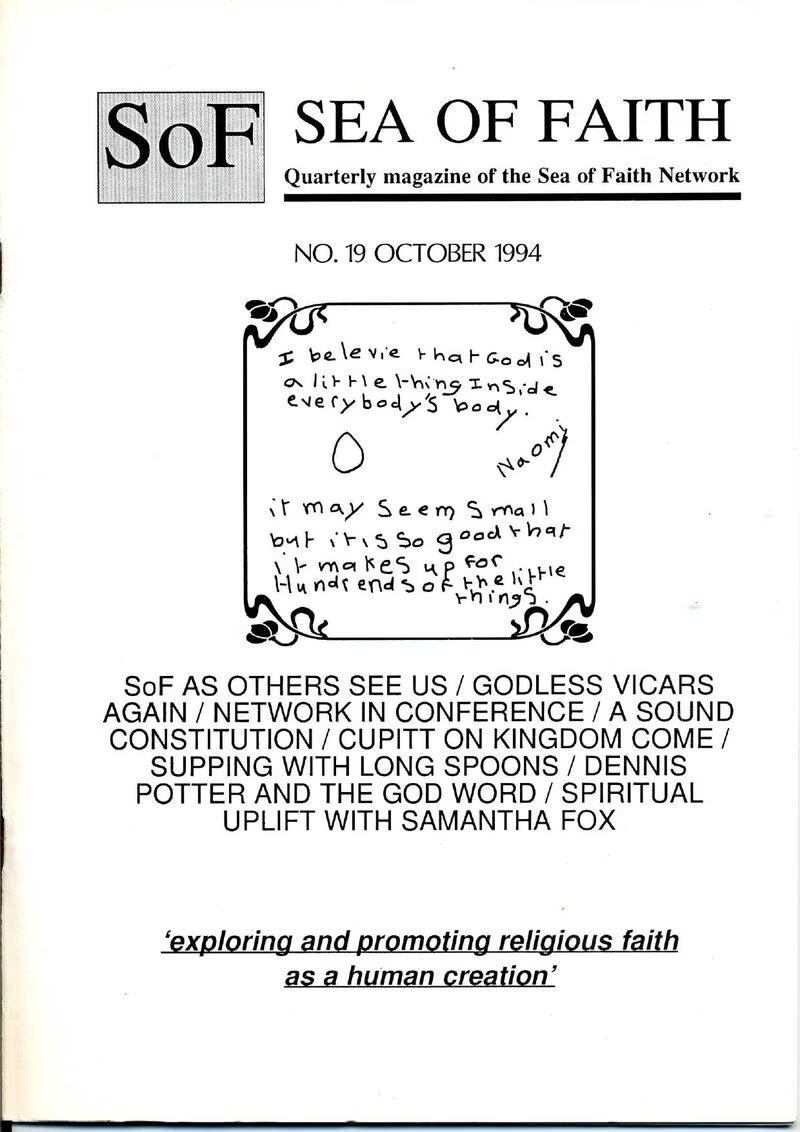
Many in the Sea of Faith Network tend to see God not as an objective being but as a subjective presence within us, as the Good, as a wonderful, inspirational symbol of Mercy, Pity, Peace and Love. This God-in-us, this Godmade-one-with-humanity, gives our lives meaning and purpose, inspires our worship, and generates the love, compassion and idealism which builds a better world.
So our one dogma is that there are no dogmas.
What we promote is that there is no dogma to promote. We explore, and we promote the value of our exploration. We are an open forum because we have learnt that we must work out our own salvation. And in promoting our faith that religious faith is wholly human in its origin and in its almost infinitely varied expression, we combat (let us not be afraid of the word) the old idea of the Tyrant God, the manipulative God, the schoolmaster God, the rewarding-andpunishing God, the Patriarch God. We are free of him - and free, therefore, to try to undo the untold damage he has done.
Now we are five, and we haven’t even begun.
JULY 28 1994 Chorley is my darling Reading the July magazine, I found myself ploughing through article after article, most of which I was simply not able to understand, and asking myself why I bother to subscribe to it.
What joy, then, near the end, to come across Derek Chorley’s delightful, humorous - and above all simple - piece about getting people together, putting aside their differences, supporting each other, dancing together.
More of the same please! (Will such a ‘‘non-academic’”’ letter get printed, I wonder?) - Penny Kimmins, 3 Manor Park, Ruddington, Nottingham NG11 6DS.
— Penny Kimmins, Ruddington, Nottingham
A brilliant article straight from the heart which speaks to the heart - ‘‘If I Were Pope’’, by Derek Chorley. More like this please, and more humour in the magazine. Too many of the articles are so intellectual that any feelings or spirituality, something we are seeking to find, is not communicated, This is not only my opinion but that of others I have shared the magazine with. - Julia Nicoll, 299 St Albans Road, Hemel Hempstead, Herts.
— Julia Nicoll, Hemel Hempstead, Herts
Religious experience I feel sad that the Sea of Faith spares not even a wave or two for the religious experience. Having had one myself, I don’t think that such experiences ought to be regarded with suspicion, at least in so far as they resemble my own. Not a God being ‘‘revealed’’ but a state of unified being (religare: to bind together), experienced; not an invocation of the supernatural, but of the natural, here and now, part of being human.
OK, I’m only 99% convinced of the ultimate validity of the experience - I was bom, it seems, with an ultra-questioning mind - but it was the most intense experience of my life, so wouldn’t it be intellectually dishonest of me to ignore it?
What I am convinced of is that if this type of religious experience were common, humanity would be largely purged of its divisiveness and the world would be a much happier and more moral place than it so heartrendingly is today. - Vivien Gibson, 60 Gordon Road, Ealing, London WS 2AR.
— Vivien Gibson, Ealing, London
Divisive language I was saddened to read Eric MacDonald’s comment (Sea of Faith July): ‘‘I sense a growing insolence, a sense of ‘we know best’, of snooty rejection of the poor deluded bastards who still believe’’.
Within our organisation which is given to religious exploration and tolerance, the great thing is that we can express our views in an atmosphere of brotherly love and friendliness. Using words like ‘‘snooty”’ and ‘‘insolence’’ are going to spoil things and cause divisiveness.
I understand how some non-realists are happy using the language of traditional services, but I like simplicity and clarity. Unless I keep explaining myself, people knowing I attend such services would assume that I was a Realist, believing in a loving Father who hears and answers prayers. This is why I’ve been exploring the idea of setting up a new Humanist Christian Church.
People like myself aren’t trying to tell other members ‘‘we know best’’. They are indulging in a little honest and harmless exploration. - Angela Barkshire, 44B Norfolk Road, Rickmansworth, Herts, WD3 ILA.
— Angela Barkshire, Rickmansworth, Herts
Pen pals Carole Evans’ idea for an SoF pen friends scheme touches on an area where, I feel, the network has not yet reached its potential. This is the area of mutual support in what, for some, can be an isolated and perplexing quest for authentic spirituality. Local groups may go some way towards providing this, but there isn’t necessarily cne just round the corner, and anyway the next meeting may be two months away! It may be, too, that many folk in local groups are not looking to SoF primarily as a support network, this being something provided by the church or similar grouping within an established religious tradition.
For those like myself who don’t feel attracted to this setting, it is, as Carole Evans observes, difficult to meet like-minded people.
I gave these views an airing in a previous Sea of Faith magazine - the article was called ‘‘In Search of Community’”’ - and I was very heartened that two people replied to it at length, sharing their own similar experiences.
— David Herbert, Cambridge
I felt too that at Conference this year there were many others asking how SoF could begin to translate the wonderful atmosphere of that event into something that is ongoing through the rest of the year. One suggestion that came up was the idea of forming special interest groups. I found several people who, like myself, were keen on writing poetry and sharing their work with others. - David Herbert, 67 Howard Close, Cambridge CB5 8QU. [Is there among our several hundred members one who will volunteer to organise a pen friends scheme? And perhaps another who would organise a poetry exchange? - ED.] Agnostic humanism Peter Gamble writes (July) that he became a conscientious objector because he belicveed in the beauty and truth of the teaching of Jesus, though at that time he considered himself to be an atheist. He says later that the teaching of Jesus seemed to require a God somewhere or other, and some years after the war he was ordained in the Church of England.
It was the vision inspired by the teaching of Jesus which led me to make an act of faith in God some years before the war and during the war to become a conscientious objector. But in my case the God image faded and some years later I realised that I was an agnostic humanist.
Agnostic because the force and seeming rightness of the teaching of Jesus caried such conviction that I felt it had to be grounded in human nature itself rather than something we could accept or ignore at our pleasure. If for some people that means that it comes from God, I do not see how I can object. There is no objective proof since our awareness of meaning, purpose and value are all purely subjective. We feel them inside ourselves rather than seeing them in the world outside.
Biologists can examine us like any other species, studying how life arose from inorganic matter, how different species formed with their own sense of how best to live, and how our genes have survived in natural symbiosis.
They are looking at the subject objectively, doing their best to exlude subjective feelings.
When we use our own subjective inner eye we are aware of our dynamics, what we strive to do, what we value and how and why we construct and organise our lives socially and physically. We are aware of the life force in us, not like biologists, but living it. The vision of the mystic, the inspiration of the saint and the harmony and beauty that inspire the arts all come from the depths of our subjective awareness, In our daily lives it is love that binds our hearts, anger that arises at unfair treatment, and an inner light that guides us - all subjective.
But physicists seeking to understand the nature of matter see no sign of consciousness, let alone the values we find in it, Materialists claim that the physical sciences could in theory give a complete account of what we are, how we arose and how our brain cells operate, leaving no room for spirit. Consciousness is considered to be a fortuitous by-product of matter.
As a guide to the life we live this is totally inadequate as it gives no weight to our subjective view, the view which in fact dictates and dominates our lives. Dualism overcame this age-old mind/body problem by specifying separate substances, a material body and a spiritual mind.
This proved unsatisfactory and it seems to me that people were projecting their own dual vision, subjective and objective, onto the outside world, rather than accepting the inherent shortcomings in our powers of understanding.
Our two views operate together very naturally in daily life but in theological and philosophical terms they do not readily coalesce, which leaves us with a mystery rather than a solution. I find this quite satisfactory, in fact quite a relief, and much better than plumping for a unified theory that does not ring true. Part of the mystery is the unspecified unknown which may well be called God, which is that in the universe which in ourselves we know as personal sentient being, tingling with awareness of purpose and value. - Paddy Smith, Farm Cottage, Puttenham, Guildford, GU3 IAJ.
— Paddy Smith, Guildford