
Contents
Articles
- The Agreement Between Anne Ashworth and Me and the Difference Between Us and Graham Shaw, Ronald Pearse
- A Transformational Religion, John R. Lickorish
- Self as Mere Symptom, David Dulley
- A Nonsupernatural Theology: What Radical Christianity Is, Elizabeth Burns
- What Is There to Read Besides Cupitt? (1), Anne Ashworth
- What Is There to Read Besides Cupitt? (2), Basil Youdell
- The Religious Resource & Research Centre: A Consultation Paper
- Questions for Radicals, C. B. Spurgin
- The Sacrifice of Isaac: A Postmodern Bible Study, Tim Roffe
Interviews
- Religious Experience: Don Cupitt and Loyal Rue Answer Some Questions Posed by John Mann, Don Cupitt, Loyal Rue
Editorial
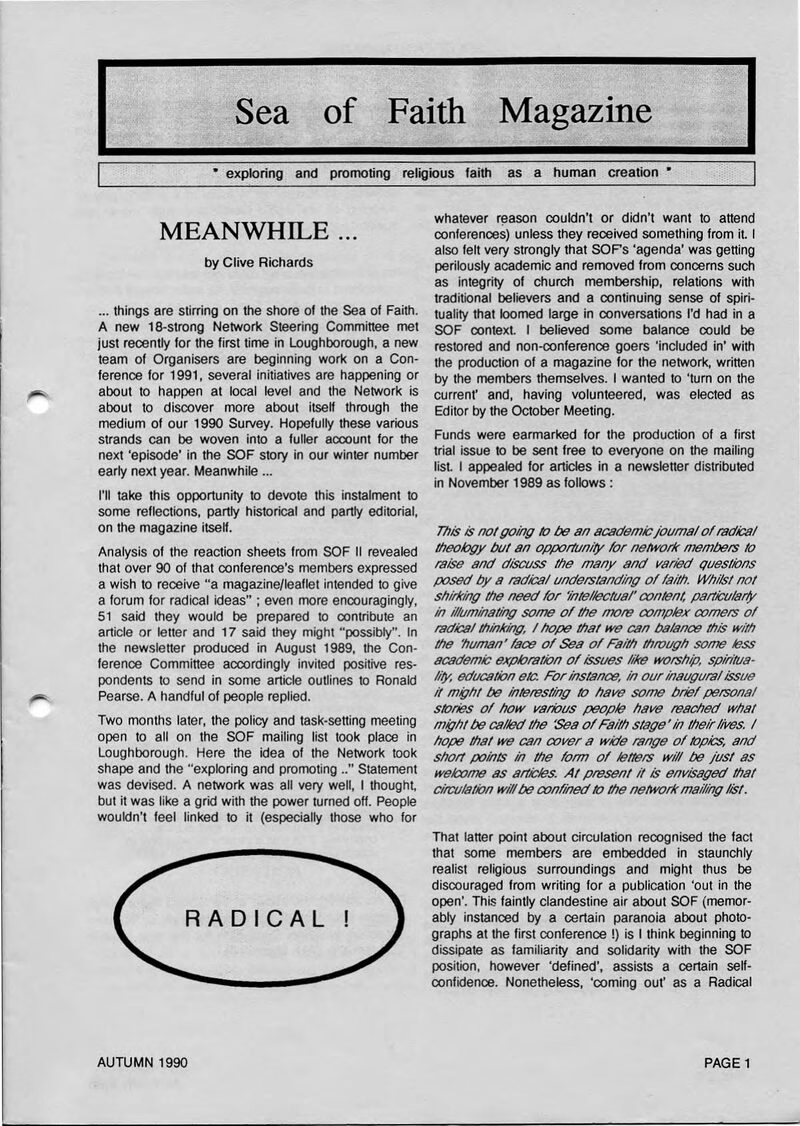
Sea of Faith Magazine ' exploring and promoting religious faith as a human creation ' MEANWHILE ... by Clive Richards ... things are stirring on the shore of the Sea of Faith.
A new 18-strong Network Steering Committee met just recently for the first time in Loughborough, a new team of Organisers are beginning work on a Conference for 1991, several initiatives are happening or about to happen at local level and the Network is about to discover more about itself through the medium of our 1990 Survey. Hopefully these various strands can be woven into a fuller account for the next 'episode' in the SOF story in our winter number early next year. Meanwhile ...
I'll take this opportunity to devote this instalment to some reflections, partly historical and partly editorial, on the magazine itself.
Analysis of the reaction sheets from SOF II revealed that over 90 of that conference's members expressed a wish to receive "a magazine/leaflet intended to give a forum for radical ideas" ; even more encouragingly, 51 said they would be prepared to contribute an article or letter and 17 said they might "possibly". In the newsletter produced in August 1989, the Conference Committee accordingly invited positive respondents to send in some article outlines to Ronald Pearse. A handful of people replied.
Two months later, the policy and task-setting meeting open to all on the SOF mailing list took place in Loughborough. Here the idea of the Network took shape and the "exploring and promoting .." Statement was devised. A network was all very well, I thought, but it was like a grid with the power turned off. People wouldn't feel linked to it (especially those who for whatever reason couldn't or didn't want to attend conferences) unless they received something from it. I also felt very strongly that SOFs 'agenda' was getting perilously academic and removed from concerns such as integrity of church membership, relations with traditional believers and a continuing sense of spirituality that loomed large in conversations I'd had in a SOF context. I believed some balance could be restored and non-conference goers 'included in' with the production of a magazine for the network, written by the members themselves. I wanted to 'turn on the current' and, having volunteered, was elected as Editor by the October Meeting.
Funds were earmarked for the production of a first trial issue to be sent free to everyone on the mailing list. I appealed for articles in a newsletter distributed in November 1989 as follows :
This is not going to be an academic journal of radical theology but an opportunity for network members to 49/50 and discuss the many and varied questions posed by a radical understanding of faith. Whilst not shirking the need for 'intellectual' content partiCu/arty in illuminating some of the more complex corners of radical thinking, / hope that we can balance this with the human' face of Sea of Faith through some academic exploration of issues like worship education etc. For /17SIB8CO, in our inaugural issue it mVi/ be interesting to have some brief personal stories of how various people have reached what might be called the 'Sea of Faith stage' in their lives. / hope that we can cover a wide range of topics, and short points the form of letters will be just as welcome as art/Cles. At present it is envisaged that circulation will be confined to the network mailing list.
That latter point about circulation recognised the fact that some members are embedded in staunchly realist religious surroundings and might thus be discouraged from writing for a publication 'out in the open'. This faintly clandestine air about SOF (memorably instanced by a certain paranoia about photographs at the first conference !) is I think beginning to dissipate as familiarity and solidarity with the SOF position, however 'defined', assists a certain selfconfidence. Nonetheless, 'coming out' as a Radical AUTUMN 1990 PAGE 1 SEA OF FAITH MAGAZINE with be with us as an issue forever and is one to which those of us less inhibited by circumstance should remain sensitive. Circulation is also bounded by a more prosaic factor, cost, which if we are to begin to develop the magazine as much for "promoting" (i.e. producing surplus copies for wider dissemination) as "exploring", will have to be taken into account when we review the magazine's role in the New Year when current funds are exhausted.
While contributions began to trickle in for the first issue, I was involved in a rapid learning experience as my much loved old typewriter was junked in favour of a new personal computer and laser printer together with the requisite wordprocessing and desktop publishing software with which to assemble the new 'product'. For this essential capital expenditure I must thank my partner, Lyn Bulman, to whose successful career I provide full-time domestic support. I am fortunate in being able to organise my time to accommodate the burst of concentrated activity involved in getting something like the magazine together.
The first issue was produced against a background of not just unfamiliarity with new technology but also my having to divide my time between Loughborough and Bristol, where Lyn had started a new job in the summer of '89. The appearance of the first magazine in March of this year was almost as much of a relief as finally selling our house in the East Midlands after nine tedious months !
Newly-installed in Bristol, I was able to settle down and reflect on the magazine and its contents. My aim is a balanced mix of material but I can only work with what people actually contribute. I have successfully commissioned several articles, however, but this is limited by the clues people give me of what they might be capable of offering. I had expected a certain reticence in the first instance, until potential writers saw what kind of magazine it would turn out to be.
However, I have certainly not been deluged with material. Issue length, and indeed frequency, has mostly been dictated by what's been available to me within my chosen discipline of a mix of content.
Deciding what level to pitch at is a tricky business since SOF has within it quite a range of intellectual background and taste. This time around I have included two contrasting articles on books, each written to a similar brief from myself, to illustrate this point.
Coming out quarterly, it is hard to preserve any lively continuity in debate but it is heartening when articles provide stimulus for others to write, as here with Ronald Pearse and John Lickorish picking up themes from the summer number. Inevitably you won't be surprised to find me appealing for new writers I Religious radicalism is a multi-faceted thing and the radical argument is very much on a continuum stretching from a fragile, uncertain or decaying liberalism right out to the apparent neo-dogmatism of ultra-radical minimalism (what!?). Well anyway, in between, all human life is there in a shifting play of meaning as we juggle 'certainties' with 'moral and spiritual aspirations'.
What are the areas we could get into that are hitherto unexplored in these pages ? I've been flicking through a document entitled "Some Agendas Of This Conference" which some of you may recall from original SOF I in 1988. It collates comments and questions from those attending that event, many of which remain pertinent and unaddressed today. Here're ten for starters !
How can we guard against our radical beliefs becoming elitist and inward-looking and make them relevant to people who suffer - either physically, financially or environmentally ?
How does radicalism affect our attitudes to sexuality ?
How to incorporate 'radical theology' within the secondary school curriculum of R.E. ?
How can our radical beliefs aid people in their quest for spiritual growth ? Where do we discover the "sacred" ?
Is it "Christianity" or do we require a new name ?
What distinguishes a radical Christian from a humanist ?
What is the feminist contribution to re-creating (1) theology and (2) an understanding of the 'God within' ?
How susceptible are other faiths to radical re-understanding ?
Is the 'greening' of radicalism the answer to finding a practical spiritual discipline ?
Does the phenomenon of SOF signify anything ? Is it more of an end than a beginning ? Or just a means of adapting to a post-Christian posture ?
I'm not offering the above to be tackled like a bunch of exam questions (I) but merely to indicate some of the scope available. Copy date for the next issue is 12th January, 1991. Meanwhile ...
PAGE 2 AUTUMN 1990 SEA OF FAITH MAGAZINE LETTERS TO THE EDITOR COMMUNICATION NOT CULTURED ANONYMITY ! from Rex Gibson (Broadway) I've made another effort to take advantage of all the hard work done by SOF by reading the transcripts and the magazine. Not easy reading.
Partly, surely, because only a few people, like you and Cupitt, have acquired through hard labour which most of us never do, the ability to write with absolute clarity - the skill needed surely if you aspire to thinking absolutely clearly. Of course the audiences SOF gathers can lo/X9w what the lecturers talk about, but when it comes to contributing in writing most have to drop out. To put it another way, I can think of very few of my friends who would thank me for passing on the magazine as recommended reading - they simply don't know what you all assume to be common knowledge. My wife can't make sense of a single paragraph.
I'm convinced that unless you exclude all but those capable of absolutely clear exposition (often the only people who don't use technical vocabularies) when it comes to scholarly articles, you won't succeed. I'm also convinced that unless you break up the atmosphere of cultured anonymity and allow real communication to appear and evoke more real communication the magazine can have no future.
I think you'll find a striking uniformity in the distance from their imagined 8U0'1017061 taken up by all the contributors, or nearly all I I think this is what creates the atmosphere of anonymity which, as with most journals, imperceptibly brings it about that the reader retires to the distance from which he or she is being addressed and ceases to be emotbna/4; kwrsona/4/ involved. Vast numbers of journals have gone with the wind for this very reason.
— Rex Gibson, Broadway
DEFINITION, A MEANINGLESS QUESTION from Norman Richardson (Leicester) The Summer edition of SOF Magazine gave an account of the East Midlands Group which I attend regularly. As a member of the Society of Friends, I enjoy the wide-ranging discussions there. Some of the subjects explored interest me greatly whilst others seem too intellectually high-powered and theoretical to have any impact. Particular sticking points are the pros and cons of exclusive Christian doctrine, beCause I see religion as a universal human attribute. Love, faith and inspiration have motivated humankind throughout history and did not have a beginning or an end in the appearance of Jesus.
I find it strange that so many people require a theoretical, doctrinal and historical definition of Christianity. For me, the concept of the divine in every person, not as a supernatural or magical otherness, but as a part of our humanness, is at the core. In Quakerism the most fundamental belief is in that of God in every person, and this can bring liberation and a very positive outlook. The question of being a Christian or not becomes meaningless if reliance on a rigid definition ceases and Christianity is seen as a way of love, and the person as a dynamic process.
— Norman Richardson, Leicester
ON HAVING A 'RADICAL' MASTECTOMY from A Conference Member To know that I had developed cancer came as a massive shock - yes, I was afraid. But I had to come to terms with no God, no life after death, no supernatural. I had looked into the abyss and come out the other side, so what was I afraid of ?
At the age of 52, (my friends tell me I look younger), I was afraid that I wouldn't see my grandchildren, that I'd miss out on my old age and I was fearful about the things I might have to suffer. In fact, when I heard the word cancer, I went into shock and my imagination saw my extinction from this planet within seconds of its having been uttered.
I had come to a testing time. Here I was, not capable of being in control of the situation, (being a teacher I am so used to being in control), and afraid of the unknown course of events that might be ahead.
Was I going to call on "The God of the Gaps" which is what many realist Christians claim people will do at such times ? No, my non-realist 'faith' stood the test.
My belief that there is no supernatural to call on remains intact and I am still with Don Cupitt's way of thinking honestly about the reality of non-realism.
Before the operation, my realist Christian brotherAUTUMN 1990 PAGE 3 SEA OF FAITH MAGAZINE CONTENTS Meanwhile Clive Richards Page 1 Letters to the Editor Page 3 The Agreement between Anne Ashworth and me Ronald Pearse Page 5 and the difference between us and Graham Shaw A Transformational Religion John R Lickorish Page 6 Self as mere symptom David Dulley Page 7 A nonsupernatural theology: What radical Elizabeth Burns Page 8 Christianity A.
Religious Experience - Don Cupitt & Loyal Rue Page 10 answer some questions posed by John Mann What is there to read besides Cupitt 9 (1) Anne Ashworth Page 12 What is there to read besides Cupitt 9 (2) Basil Youdell Page 14 The Religious Resource & Research Centre A consultation paper Page 16 Questions for Radicals C B Spurgin Page 18 The sacrifice of Isaac - a postmodern bible study Tim Roffe Page 19 in-law (who is a vicar) lit a candle for me in his church and I thanked him. After all, even if this candle wouldn't make a scrap of difference to the outcome of events, it was a kind thought, a loving symbol. Also I knew that the prayers of my realist Christian friends would neither be heard nor answered, but here were loving people wishing well for me and that helped a lot ; but my atheist friends helped me equally with their loving messages.
After the operation I had to wait a week to find out if the cancer had gone into my lymph system. If it had, that would be another ball-game entirely (with my limited medical knowledge that's how I thought of it anyway). Yes, I got jittery - maybe I wouldn't live to see my old age.
Did I 'thank the Lord' when the result was clear ? No, I thanked the consultant/surgeon and all the nursing and household staff for their good and dedicated work and their sympathetic encouragement throughout. I know the result would have been the same if the candle hadn't been lit and the prayers hadn't been uttered - yet, of course, I am grateful to them for their support. They will think their prayers were answered, and if that makes them happy, why not let them continue to think that way. I don't think I'd ever be much good as an evangelising radical It was good when the consultant came with the marvellous news that I stood "an excellent chance of seeing my grandchildren". It is very good to be alive and free of the 'jitters' I What is losing a breast compared to that ? I now know a little of what the less fortunate suffer when they go from one lot of bad news to the next. My 'Alleluia' is most definitely a non-realist cry of joy that life is very precious - to me anyway.
— A Conference Member