
David Galston, Restoring Humanism to Religion: Why Religiousness Matters More Than Belief (Westar Press, 2025). ISBN 9781598150711
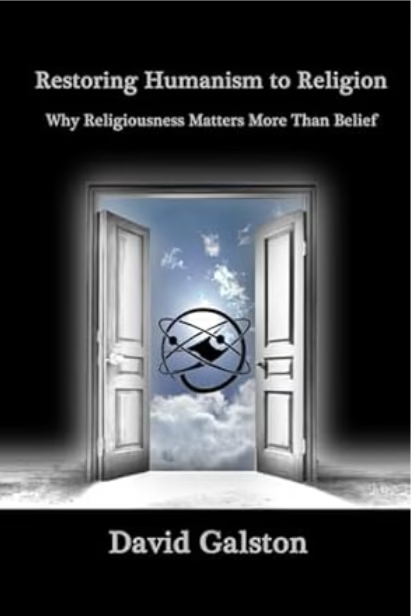
I first met David Galston when, some twenty-five years ago, I was invited to speak at a conference in Canada organised by the SnowStar Institute of Religion, of which David was co-founder and president. The conference venue was a hotel with unforgettable views of Niagara Falls. I remember sensing an association of David’s explosive energy with that of the Niagara waters.
SnowStar is no more, having merged with Westar Institute in California, home of the Jesus Seminar which opened a new and revolutionary quest for the historical Jesus in the 1990s. David Galston is now executive director of Westar, where he has become one of the most progressive voices calling for a new reformation in religion. In his new book he argues that, strange as it seems, religion must evolve by rediscovering its humanist roots and embracing what he calls religiousness. By ‘religiousness’ he does not mean the quality or practice of religion, or religious belief, but ‘a spiritual sense or an awareness of connection to the earth and others.’ It is humanism, not religion, that expresses human religiousness. Indeed, Galston’s religiousness is the opposite of religion.
This is an irony that invites some deconstruction. ‘In relation to religion,’ Galston writes, ‘religiousness is an ironic term, for it names a value for religion that is lacking. Without the sense of religiousness in its heart, religion lacks humanism even though humanism defines the spiritual relationship in which all humans have a share. Without humanist compassion, religion undermines its own value and continues on its slow trajectory toward irrelevance.’
So, if religion (meaning, mainly, the Abrahamic three) is to survive, it needs to shift its emphasis from divinity to humanity, from the supernatural to the natural, from over there to over here, from life everlasting to life now, from theism to a compassionate humanism. That’s a big ask! So big, that many of us have simply given up on religion and embraced humanism.
But Galston references Cantwell Smith who, in The Meaning and End of Religion (1991), insisted the word ‘religion’ never existed in any modern sense prior to the Enlightenment. ‘When we return to antiquity,’ says Galston, ‘there is no division, as we now assume, between the secular and the religious. Ancient gods were at the same time culture shapers, identity holders and state forces. The Roman gods were celebrated in everyday life whether in the household at the family hearth or nationally as the identity of the emperor or the inspiration of an army. Agriculture had its gods as did the weather and the trades. Gods were not part of a religion, they were the everyday activity of the people… Augustus Caesar represented the religiousness of the Roman imperial culture.’ Thus, what Galston calls religiousness and most of us call humanism preceded religion as we understand it today — hence the title of his book.
If we are to replace religion with religiousness, he says, ‘the challenge involves finding new forms of language that do not betray our human integrity, but these words must come slowly over time, and they must be the organic words of a new myth… There are signs that a new language is emerging, but religious traditions are fearful of adopting it or, in some cases, are simply unaware of it. Emerging spiritual language is understandably non-God language because, as it turns out, honesty about human spirituality is something that the traditional God cannot fathom.’ Thus, the language of religion ‘continues to carry the ancient luggage of an overseer in the sky.’ In a new (or newly discovered) religiousness, the word ‘God’ must fade away.
But it’s not just the word ‘God’ that carries all that baggage. Religion in all shapes and sizes has its own ‘ancient luggage’, which is why we need those ‘new forms of language’. And there’s the rub! It seems to me, the problem with the word ‘religiousness’ is that it fails to escape from the taint of religion. However hard Galston insists that in his usage the word has nothing to do with the quality of being religious, it will only be understood as something quite different, a synonym of humanism, if every time we use it we qualify it with Galston’s erudite explanations.
Once we have come to understand that religion is an entirely human creation, not a divine revelation, we are well on the way to finding the new language that fits our human condition. Galston calls it humanism in his title, but it seems that for him ‘humanism’ itself needs qualifying. He is not advocating the fundamentalist humanism of Richard Dawkins and the ‘New Atheists’ because it lacks human spirituality and, like organised religion, fails to ‘open the human spirit to joyful wonder, inclusive living, and shared vision’. But for me, that is precisely what a rich, inclusive humanism is all about. If it needs a qualifier, I am not persuaded that ‘religiousness’ is the right one (or, for that matter, ‘religious humanism’, which I have used in the past but now avoid).
For all that, Restoring Humanism to Religion is a wonderfully accessible read, calling as it does for a shift from outmoded beliefs to practices that foster solidarity, creativity, joy, and all that the wholly human spirit offers. It is a valuable contribution to the on-going exploration of religion as a human creation, available in the UK from Amazon and other on-line booksellers.
David Galston wrote three previous books: Archives and the Event of God (McGill-Queens Press, 2010); Embracing the Human Jesus: a wisdom path for contemporary Christianity (Polebridge Press, 2012); God’s Human Future: The Struggle to Define Theology Today (Polebridge Press, 2016).