
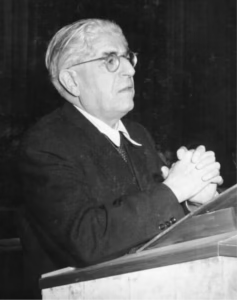
I first encountered Ernst Simon Bloch (1885–1977) while studying Jürgen Moltmann, Johannes Metz, Wolfhart Pannenberg, and Gustavo Gutiérrez, as commentators linked these theologians’ work to Bloch’s philosophy of hope. Although the theologians were better known in church circles, Bloch’s atheistic appreciation of religion was more radical and intriguing to me. Bloch finds in Judaism and Christianity an internal logic that points to atheism, yet he also seeks ‘to inherit those features of religion which do not perish with the death of God’, particularly hope.
Bloch’s philosophy developed over two World Wars, with the Great Crash of 1929 between them, which led to global economic policies that gave rise to fascism. This authoritarian movement was supported by the emotive power of myth and institutional religion (Nazi-pagan mythology and the Deutsche Christen). His political context bears some similarities to our own. Since the second great crash of 2007-8, economic policies (quantitative easing and austerity) have again contributed to high levels of inequality and have given rise to authoritarian leaders and nationalist movements, again supported by myth and religion (“Christofascism”). Indeed, as I write, we may even be on the verge of another World War.
Bloch and Subversive Religion
Bloch was from an assimilated German-Jewish family. As a secular Jew, Bloch confesses that he privately turned to atheism at his bar mitzvah. But he did not lose interest in religion. Indeed, according to Fredric Jameson, he should be lauded as Marxism’s revolutionary theologian.
His early work, The Spirit of Utopia, written between 1915–16, explores religion and theology alongside folk tales, music, and art as cultural creations and as sources of cultural disruption, with an important critical or subversive role that can offer the potential for social change.
Bloch is aware of traditions of scriptural interpretation, from Rabbinic commentary and Spinoza to contemporary German historical-critical scholarship. These traditions point to contested meanings within scriptural texts and their interpretations. A radical layer of liberation hope, exemplified by the Exodus narrative and prophetic traditions, can be found beneath later post-exilic editorial redactions, including the priestly theocracy and the religion of Law of the Ezrah-Nehemiah cultic reforms. The God of Exodus 3.14 is not a tribal deity or a theistic political authority, but ‘I will be what I will be’, the future possibility for a liberated people.
Bloch’s reading of the Bible is political: he seeks to uncover ‘an underground Bible’. Bloch contrasts this intention with the existentialist concern of Rudolf Bultmann. According to Bloch,
the banner should cry not “Demythologize!” […] but “De-theocratize!” Only that can do justice to the Bible’s still saveable text. The Bible only has a future inasmuch as it can, with this future, transcend without transcendence.
Drawing on marginal figures, such as the messianism of the 17th-century mystic Shabbataï Tsevi, Bloch noted that Jewish mysticism had resisted cultural assimilation, and that Messianism was resisting political Zionism. He explored these movements of resistance, integrating them into his understanding of Marxism while becoming a (heterodox) Marxist.
Bloch recognises such currents of political resistance within Christianity too. Although the Church hierarchy can legitimise social order while offering a false, pacifying hope that defers justice to the afterlife, the prophets, including the apocalyptic Jesus, recognise injustice and offer an alternative vision to motivate change. Bloch points out that ‘the Church and the Bible are not one and the same. The Bible has always been the Church’s bad conscience’.
Bloch also finds resources for political resistance in later Christian theology — in mystical and apocalyptic traditions among heterodox figures such as Marcion, Eckhart von Hochheim, Jacob Böhme, Joachim of Fiore, and in rebellious social movements — Albigensians, Hussites, the Lollards and Anabaptists. Apocalyptic movements refused accommodation to existing power structures, while mysticism dissolves a fixed external deity. By de-objectifying God, mysticism can also be seen as supporting a proto-atheistic tendency within Christianity, while opposing ecclesiastical authority.
A Life in Exile
Bloch opposed a militaristic Germany and its entry into the First World War, and so lived in Swiss exile from 1917 to 1919. After returning to Germany, he wrote a philosophically engaged study, Thomas Müntzer as Theologian of Revolution (1921, not translated into English). The radical German theologian, preacher, and revolutionary Müntzer (1489–1525) lived through the political upheaval in early sixteenth-century Europe and was the subject of Friedrich Engels’ The Peasant War in Germany (1850). But whereas Engels had extracted Müntzer’s class struggle from religion, viewing his political and religious ideas as the result of material socio-economic conditions, for Bloch, Müntzer’s millenarian theology was essential to his politics.
The rise of fascism forced Bloch to leave Germany again in 1933. He eventually relocated to America between 1938 and 1949, where he wrote most of his The Principle of Hope, which was published in three volumes during the 1950s. It is an encyclopaedia of myths, fantasies, artworks, daydreams, and religious themes — “revolutionary anticipations” that form anticipatory consciousness.
Bloch had a difficult time in America, where his limited proficiency in English and his late break with Stalinism isolated him, even from the Frankfurt School, then in exile at the Institute for Social Research. His third wife, Karola, a communist and occasional agent of the German Communist Party, gained citizenship before he did. After the war, he moved to Leipzig, where he worked into his mid-70s, but he was viewed with some suspicion in the GDR too. When the wall divided Germany in 1961 he was on holiday in the West, and he chose to remain there, where he completed several book projects, including Atheism in Christianity, a readable collection of forty-four reflections on the revolutionary potential of the Bible, produced in his 83rd year, in 1968.
Utopian Hope
Hunger is a defining characteristic of human existence for Bloch (whereas ‘Dasein for Heidegger is never hungry’, notes Lévinas). Hunger and thirst orient us toward the future, anticipating the satisfaction of need. Hunger is an “anticipatory consciousness” that relates to hope and shows hope to be ontological (a part of our nature) rather than psychological (a perception of lack).
For Bloch, hope is not merely optimism but an educated or informed hope (docta spes) with a future-directed orientation towards not-yet-realised possibilities. Hope arises at the intersection of imagination and material possibilities — when history becomes open to transformation towards a possible “Not-Yet” (Noch-Nicht). This key idea of Bloch, the “Not-Yet”, has both ideological and material aspects. These are the human “Not-Yet-Conscious” of hopes, dreams, and longings (that people may sense but cannot always articulate) and the social-historical “Not-Yet-Become” of history (that have not yet taken concrete form).
Exploring hope, Bloch reclaimed the concept of utopia (literally ‘no-place’) as an anticipatory consciousness (Vor-Schein, “pre-appearances”) of the future, i.e., the “Not-Yet”. Daydreams, art, literature, political movements, and religious symbols all express nascent or immature utopian consciousness. But he distinguishes between “abstract utopia”, which imagines a totalising political vision or blueprint for a future abstracted from a given historical situation and provides an unrealistic model of a perfect ideal (such as heaven or a socialist state), and a “concrete utopia”, which is a coming together (concrescere) of dreams and yearning (which he calls “warm streams” of hope) with social critique and analysis (the “cold streams” of hope) in historical processes.
Authentic hope must be realisable, or ‘concrete’, rather than abstract. Concrete utopias emerge from existing social contradictions — poverty, injustice, alienation — and anticipate their transformation. There is no historical inevitability in hope: the future is dependent on human choice and action and so hope carries an ethical and political demand: it calls for praxis, i.e., engaged theoretically-reflexive action.
Bloch’s Atheism
Bloch frames religion as a site of meaning-making and ethical protest, giving rise to anticipatory images of a transformed world. For example, he reclaims the motif of the serpent in Genesis 3.4 who promises Eve, ‘when you eat of it your eyes will be opened, and you will be like gods, knowing good and evil’. He identifies this with the work of Moses and Jesus (cf. Numbers 21-9, John 14). Motifs such as Exodus, prophetic critique, and messianic expectation do not portray God as a transcendent Creator-God (or ‘demiurge’), but present narratives of liberation from oppression. These prophetic traditions resist the sacralisation of existing power structures and refuse to identify God with the present order. Religious symbols such as salvation, resurrection, and the Messiah should not be taken literally, but understood to encode humanity’s longing for justice, reconciliation, and fulfilment. While the Kingdom of God portrays a classless, egalitarian society, it is not presented as an abstract utopia, but as an ideal or prophetic vision that invites social analysis and contemporary critique.
Taking the biblical theme of the Kingdom of God, for example, Bloch says that,
…the kingdom, even in secularized form, and all the more so in its utopian-total form, remains as a messianic Front-space even without any theism, indeed it can only remain at all, as every ‘anthropologization of heaven’ from Prometheus to the belief in the Messiah has increasingly shown, without theism. Where the great world-ruler is, freedom has no space, not even the freedom of the children of god and not the kingdom figure, the mystic-democratic figure to be found in chiliastic hope. … Atheism is therefore so far from being the enemy of religious utopia that it constitutes its precondition: without atheism messianism has no place.
Comparing Bloch and Moltmann
Bloch’s non-realist philosophy of hope differs markedly from Moltmann’s theology of hope. Moltmann challenges certain metaphysical attributes of God (such as divine impassibility in The Crucified God), yet for Moltmann hope is grounded in divine promise rather than in human utopian imagination of historical possibility.
For Moltmann, Christian hope is grounded in the resurrection of Christ, understood not as a mythological symbol but as an historical event with eschatological meaning — an event that occurs within history yet opens history towards God’s future. God shows his faithfulness in the resurrection, which is read as an anticipation, or “prolepsis”, that marks the beginning of the realisation of the Kingdom of God. This prolepsis invites the church to respond with ethical discipleship and political responsibility. So the church is called to respond by being a community of anticipatory practice, embodying justice, reconciliation, liberation and new life — participating in the “economy” or work of the Trinity.
However, if one doubts that the resurrection of Christ is historical, Moltmann’s theology of divine promise offers no hope. Indeed, it offers no hope to society beyond the church. By contrast, Bloch’s rejection of theism still regards theology as a motivational resource and a contribution to concrete utopian hope. But liberated from theistic framework, religion is valued for its imaginative and moral power. Religion is valuable to Bloch precisely because it is human, historical, and future-oriented, motivating social analysis and concrete action.
Bloch’s Hope Today
In a foreword to an English-language anthology of Bloch’s writings on religion (selected by Jürgen Moltmann), the American theologian Harvey Cox writes:
I have often speculated on how different theology would be today if Ernst Bloch, rather than Martin Heidegger, had been our conversation partner for the past twenty years. Would we be as miserably lacking as we are in a theologically grounded social ethic? Would we be as disastrously out of touch with the revolution that is transforming the third world and burning the centers of our American cities? Would we have needed the catharsis of the death-of-God theology? Would we have allowed the ecclesiastical furniture shuffling of recent years to pose as a real renewal of the church? Might we have produced a theology that was truly radical in its impact on the world and not just in its rhetoric?
These words have left me with much to think about. The Secular Enlightenment’s emphasis on reason failed to resist fascism and dictatorship in both Nazi Germany and Soviet Russia, and reason fails us in democracies today. But Bloch’s aim was to find in art, in culture and in subversive strands of ‘de-theocratised’ religion ‘warm streams’ of utopian hope that keep alive a longing for change and support reason with a hopeful vision.
I find Bloch to be a deeply religious thinker, not in the sense that he seeks God, but in the sense that he seeks the utopian hopes and dreams in the deep wells of religious and cultural experience that have been expressed in religious and cultural life. Such cultural and political resources of hope are needed today.
Photo credit: Ernst Bloch auf Begegnung der Geistesschaffenden by Hans-Günter Quaschinsky (1925) Bundesarchiv, Bild 183-27348-0008, CC-BY-SA 3.0 (Wikimedia Commons).