
Contents
Articles
- Taking the Michael
- On Finding a New Church, Teresa Wallace
- Time to get Post-Party Political!, Peter Cadogan
- Janis, Me and Bobby McGee, Rowan O'Neill
- Nonrealism: You Can't Do Without It — But What Do You Do With It?, C. Ram Prasad
- Passage to India, John Pearson
Reviews
- Dream On!, David Boulton
- Unweaving Professor Dawkins, Jude Bullock
- High Moral Tony, Graeme Smith
- It's Good to Talk, Ian Markham
- Carry on Camping..., Tim Woodcock
- Ludo's Credo, Alison Webster
Obituaries
- Celebrating Pam, David Boulton
Regulars and Occasionals
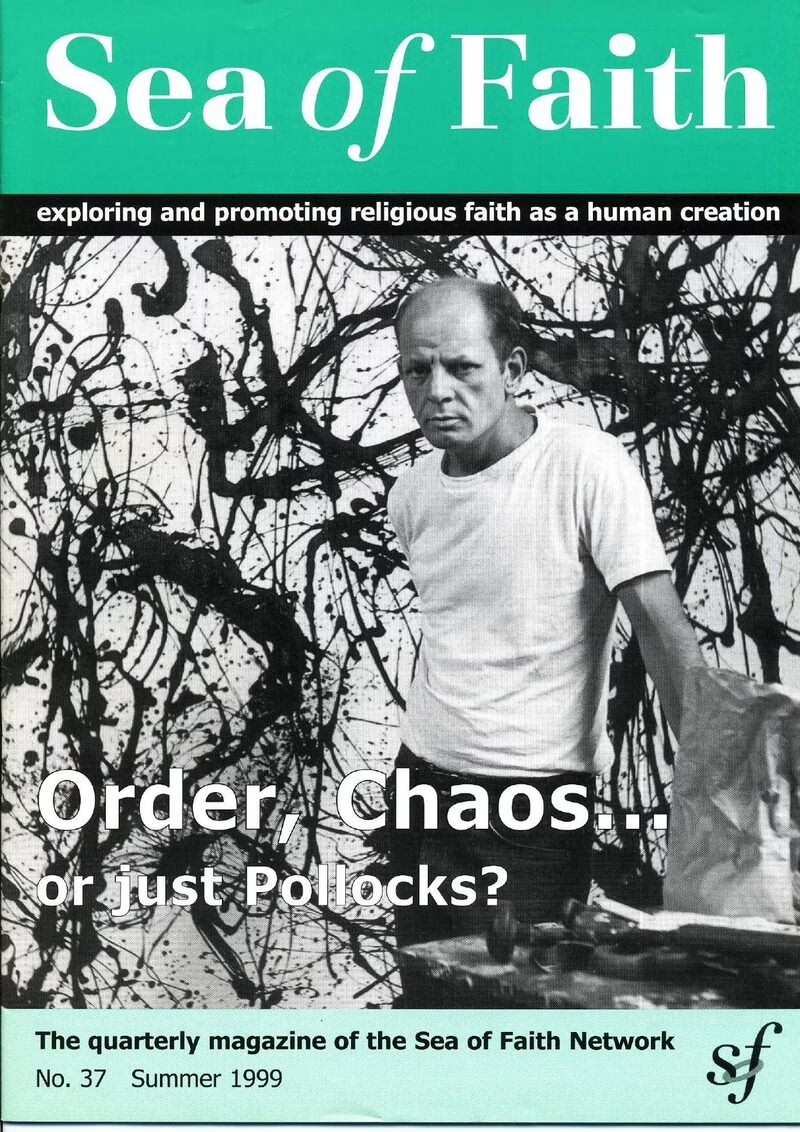

Editorial
On our bomb there sits a dove.
Hallelujah! Bang the drum!
Blow the world to kingdom come...” (Sydney Carter, 1960s peace song) en your steering committee agreed some months ago to make the theme of this year’s SoF conference “What is Religion For?”, a new wave of “ethnic cleansing” was under way in the Balkans and the international community seemed helpless to stop it. As I write, that part of the international community calling itself NATO has just called a conditional halt to its campaign of bombing the hell intoYugoslavia, loudly proclaiming the victory of good over evil, God over the Devil, and civilisation over barbarism. Whether the wretched Kosovars, Serbs, Albanians and Macedonians who must live (or die) with the resultant hatred, bitterness and trauma will join the New Triumphalists is yet to be seen.
But what has all this got to do with our Network, and with our theme, “What is Religion For?”?
Quite a lot, I suggest. Our Network is about exploring meaning in religious culture and religious language when the old-time religion, with its irrational supernaturalism, its gods and holy ghosts, is dead and decomposing. Our newlyemerging sense of what religion is for, what purpose it might still fulfil in our godforsaken and god-forsaking world, must have something to do with what we can make of the values religion is supposed to affirm and celebrate: the human values of compassion, honesty, generosity, lovingkindness, fairness - Blake’s “mercy, pity, peace and love”. Unless we are content to relegate these values to the realm of romantic poetry or private piety, we have to find ways of applying them in the real material world. If our values won’t stretch that far, does our religious-humanist language have any content? And if it has no content, what is religion for?
I am not suggesting that the linkage between the action of bombing and the “Our Network is about exploring meaning in religious culture and religious language when the oldtime religion, with its irrational supernaturalism, its gods and holy ghosts, is dead and decomposing.” application of our values is a simple one: only that there is a linkage, and that if we choose to discuss what religion is for without exploring the connections, we are refusing any critical engagement with the real world. (And let’s be clear, old jokes apart, that theological nonrealists are every bit as much engaged in the real world as old-time realist believers).
We are a network, not a campaign or a lobby, and we don’t need an SoF “line” on NATO strategy (and I don’t imagine NATO strategists would be much concerned if we had one). But we all need to be clear that our theology must be done in the real world, engaging with real issues - than which nothing could be more real than the business of killing our enemies for the good of our friends, and for the satisfaction of feeling we are doing something.
A good starting point, perhaps, is the recognition that those who passionately opposed the bombing and those who equally passionately supported it were, for the most part, motivated by a shared compassion for the appalling suffering of the ethnically cleansed and a shared revulsion against the barbarities of the ethnic-cleansers. Pro-bombers, often with the heaviest of hearts, backed NATO because the stream of misery seen on their televisions night after relentless night convinced them that “something must be done”: something more effectual than UN pussy-footing and diplomatic bluster and blunder. To bomb and damn the consequences (including the consequence of killing innocent men, women and children) was at least to do something.
Anti-bombers, on the other hand, called for a halt because “doing something” quickly turned a tragedy into a catastrophe. There was an alternative, the anti-bombers say, to making things worse, which was not to make things worse. There is no certainty that harder-headed UN diplomacy, draconian sanctions, direct support for the brave Serbian peace movement and democratic opposition, would have succeeding in making things better in the short term, but they would not have unleashed the frenzied response which could only make things worse for the one million men, women and children we were supposed to be protecting, and whose lives we are now responsible for rebuilding.
Do our values, expressed in our religious language and practice, our stories and our dreams, have anything to say to us in this situation? If not, what earthly use is religion? If they just seem romantic, sentimental, impracticable when they face a testing time, are they worth the candle?
There is another dimension we dare not forget. It would be an oversimplification to say that six hundred years of Balkan feuding was all about religion: but it would be a grosser falsehood to say that religion played no part, and grosser still to suggest that it ever effectively challenged or ameliorated the wretched hatreds in which it became embroiled. The Catholic cross was long the symbol of Croatians, the Orthodox cross that of the Serbs, the crescent of Islam that of the Albanian Kosovars. Religion gave each community its identity, its separateness, its sense of superiority, its conviction that God was one of them. Is that what religion is for? Can we live with that?
Whether in the last few grim months we lined up with the compassionate bombers or the compassionate advocates of relentless diplomacy, our insistence that values are to be taken seriously - are, indeed, the irreducible matter of religious sensibility once we have shuffled off the old gods and dogmas - will surely lead us to redouble our efforts to find alternatives to the violence which has scarred the last century of this millennium.
There was a time when it was taught that godliness made people good. But the godly turned out to be no better than the ungodly. So we withdrew our faith from God and placed it in Humanity, with hope that “a loftier race than e’er the world has known shall rise / With flame of freedom in their soul, and light of science in their eyes. / They shall be gentle, brave and strong...” Fat chance! The Somme, the Holocaust, Hiroshima, the liquidation of class enemies and ethnic cleansing soaked our century in blood and shattered the illusion of an evolutionary moral ascent of humankind.
We have to do better in the next millennium, or perish in the attempt. Either the values to which we have chosen to commit ourselves will help us find ways forward, or they will prove idle dreams.
Which is one way of saying that either the values we have now come to understand as wholly human can be made to work, or they can’t. If they can’t, let’s not bother asking “What is religion for?” Let’s do the garden, go clubbing, fiddle with ourselves while the world burns.
I don’t suggest (you will be relieved to know) that SoF can solve the world’s problems or resolve dilemmas which have been with us for centuries. But we can choose to be merciful, compassionate, peacemaking and loving. And if we can’t figure out how to make things better, we can at least choose not to make things worse.
Religion may be for rather more than that. It surely can’t be for less @ EDITORIAL SoF’s very own Weekend Break in the Lake District Friday 1st to Sunday 3rd October 1999 Our second Sok-organised weekend break last autumn was fully booked. So, by popular demand, we have again booked the 40 rooms at Glenthorne Quaker Guesthouse in the heart of Lakeland and on the edge of Grasmere Lake and village.
Patti Whaley, Letters Editor, Sea of Faith, 145 Petherton Road, London N5 2RS Or e-mail them to: 101335.3561@compuserve.com Confession aving criticised Don Cupitt’s lecture to the SoF November London conference (Letters, Sea of Faith, Spring 1999), I should say that having read his book on the same subject (The Revelation of Being, SCM Press, 1998) I have found much of interest.
I hope that many others will read it.
— Margaret Davis, Chepstow
MarGaret Davis 7 The Hop Garden Bulwark Chepstow NP6 SRX Thanksgiving for Anne T. piece by Anne Ashworth (“Nonrealist worship”, Sea of Faith, Spring 1999) spoke to me as I continually have one ear to the traditional forms, with their (for me) beauty and glory, and the other ear listening to the contemporary, struggling to gain a clarity which will support a living faith. For me the essence of prayer is “paying attention”, as W.H.
Auden wrote in 1970: “To pray is to pay attention to something or someone other than oneself. Whenever a man so concentrates his attention on a landscape, a poem, a geometrical problem, an idol or the true God, that he completely forgets his own ego and desires, he is praying. The choice of attention, to pay attention to this and ignore that, is to the inner life what choice of action is to the outer. In both cases a man is responsible for his choice and must accept the consequences whatever they may be.” Excuse his sexist language. But he gets near to the core of the nature of prayer in a secular world.
— Ronald Beasley, Edinburgh
RONALD BEASLEY 37 Warrender Park Terrace, Edinburgh EH9 1EB Intercession and petition must say how much I appreciated Anne hworth’s article. It was very useful to have a step-by-step guide on how to contribute to and make use of the various parts of the liturgy. When asked to lead intercessions in my own church, I have for some time tried to concentrate on how we as individuals and as a community can hope, resolve and decide to take action on the various issues which are routinely “prayed for”, often with very little idea of what is actually expected.
As a tutor in psychology I find SoF very useful. Perhaps there are other psychologist members of SoF who would like to make contact.
— Mavis Cracknell, Surbiton, Surrey
Mavis CRACKNELL 15 Malcolm Drive, Surbiton, Surrey KT6 6QS john.cracknell@btinternet.com Meditation have just joined SoF, after long hesitation, because I want to explore the metaphors of faith as a valuable and informative human attribute: religion as a human construct. However, my reservations about the “movement” are powerful and fundamental: 1. SoF represents an expression of mourning for the deceased god. The continuing yearning for an honest way to “worship” speaks to the need to re-enact familiar rituals and routines in a way that brings the dear departed back to mind. 2. The emphasis on the “good” and the “spiritual” denies real sources of conflict between individuals and peoples. Until the “problem of evil” can be addressed and articulated in a new language which permits a reaction other than helplessness, we will never “re-invent religion”.
I wish to engage fully with these issues.
I hope others in SoF do, too.
— Mary Sullivan, London
Mary SULLIVAN 6 Barwell House, Chester Street, London E2 6HZ Dedication T" exciting thing about the nonrealist position is that it gives responsibility back to us for the world we live in. The message of the resurrection applies to the here and now. We can espouse the Christian ethic “love thy neighbour as thyself” in everyday living, eschew selfishness and build a better world - heaven on earth if you like. As part of the human race, we can all make a contribution.
John West (“Making Those Waves of Positive Action”, Sea of Faith, Winter 1997) suggests we can do something about our environment. Yes, but that is not enough.
We live in a competitive, consumerist society dictated by the market economy.
Our standard of living has improved and yet it does not seem to have made people happy. Erich Fromm in To Have or to Be talks about shifting the emphasis from “having” to “being”, and urges us to look again at the way we lead our lives. In Charles Handy’s book The Hungry Spirit we see how, even in a capitalist society intent on maximising profits, we can give ourselves space to contemplate the purpose of it all and make some changes in our goals.
The time is ripe for change. Let us grasp our human responsibilities; there is no supernatural power out there to do it for us. Can we turn our beliefs into action?
Are there any like-minded people willing to seek out ways forward?
I think we must work under a recognisable umbrella — could it be the Sea of Faith? We need to be identified as a movement concerned to promote a “responsible society”, to build a new philosophy for living. Please, anyone interested, do get in touch.
— Avis Souance, Teddington, Middlesex
Mrs Avis SOUANCE 24 Manor Road, Teddington, Middlesex TW11 8AB No one path Ithough the word “Unitarian” Avorisinally meant belief in one God (i.e. denial of the Trinity, and of the divinity of Jesus), the denomination encompasses all strands of liberal religious viewpoints, from frank humanists to liberal Christians who can’t quite be Trinitarians. I describe Unitarianism as an attitude system rather than a belief system; the cardinal attitudes are freedom, reason, tolerance and love.
One of the essences of Unitarian religion is that ideas change and develop; indeed, if they don’t, they stagnate.
Religious truth is both relative and dynamic; your belief may be different from mine but that doesn’t mean either of us is wrong, and your belief now may be different from yesterday or 30 years ago, but that doesn’t mean you were wrong then. So Unitarians don’t claim to have a monopoly of the truth; no-one has that, even (or especially) those who think they do.
Everyone has to seek their own path; if others find the Unitarian path to be comfortable to walk along, that’s good; but I would never say that it’s the best, or only, path. It works for me; but I need Sea of Faith too.
— David Arthur, Wakefield
Davip ARTHUR 27 Barnes Avenue, Wakefield WF1 2BJ david@arthur56.freeserve.co.uk LETTERS.
Living life backwards he most unfair thing about life is the way it ends. I mean, life is tough. It takes up a lot of your time. What do you get at the end of it? Death. What’s that, a bonus? I think the life cycle is all backwards. You should die first, get it out of the way. Then you live in an old age home. You get kicked out when you're too young, you get a gold watch, you go to work. You work forty years until you’re young enough to enjoy retirement. You do drugs, alcohol, you party, you get ready for high school. You go to grade school, you become a kid, you play, you have no responsibilities, you become a little baby, you go back into the womb, you spend your last nine months floating, and you finish off as an orgasm.
— Anon