
This article follows an In Conversation session in January 2025.
Brigid the resistor
At the start of February, Ireland celebrated Saint Brigid’s day with a bank holiday. Instituted only last year, this is Ireland’s first bank holiday for a female and brings Brigid out of the shadow of her fellow patron saint, Patrick. But who is this bank holiday for, is it Brigid the saint, Brigid the ancient goddess, or Brigid the resistor?
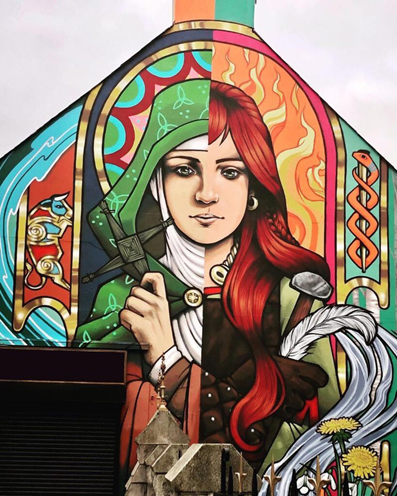
Brigid as Goddess
Brigid first appears as a pre-christian goddess. The earliest written records about her are from a 7th century Christian monk called Cogitosus. Due to the very limited archaeological evidence, it is hard to tell how much of what was written was about the goddess or the saint.
Brigid, or ‘Brid’, was a wise sage and goddess of poets, dairy farming and the spring. Her festival was on ‘Imbolc’ (meaning ‘in the womb’) marking the start of spring around the 1st of February. In some stories there is a trinity of Brigids, sometimes called sisters, who are associated with healing and blacksmithing.
While there is little archaeological evidence for Brigid, we can be confident that the changing of the seasons was ritually marked. There is a passage tomb in Tara that is illuminated by the rising sun on the festival of Imbolc. These passage tombs are over 5,000 years old, overlapping with the Sumerians and earlier Pyramids of Egypt.
Brigid as Saint
Just as there is no purely pagan source about Brigid, there is no purely Christian source either. Many aspects of the saint’s hagiography seem like adaptations or appropriations of the pagan goddess. Her saint's day is unchanged and she remains patron of poets, healers, blacksmiths and dairy farming.
Some stories say her mother was a slave baptised by St Patrick and her father a druid, all agree that her early miracles are acts of generosity. She worked on the farm churning butter, which she would give away to the poor, much to the annoyance of her father until the stocks were miraculously replenished.
Brigid valued her freedom and resisted marriage. She resented the attention her physical beauty drew from men. When one man told her that her pretty eyes would be married to him, willing or nilling, she plucked out her eye and gave it to him. (It healed back…) She vowed chastity and for the rest of her life lived as a lesbian: her closest relationships – and bed – were shared with fellow nuns.
Her most famous miracle was when she asked a miserly pagan king to grant her the land to establish an abbey. He refuses and mocks her, saying she can have as much land as she can throw her cloak over. She threw out her cloak, and it expanded to cover a forest, lake and acres of fertile land. This gave rise to the idiom ‘There’s room under Brigid’s cloak for all of us.’ Brigid got her abbey and the king converted.
Being from a protestant background, I hadn’t really heard of St Brigid growing up. I remember making a St Brigid's cross at school once and my catholic-schooled friends tell me that it was something they did every year, keeping their reed crosses over the door of the house.
The origin story for the cross is that when St Brigid was visiting her druid father on his death bed, she made this cross out of the straw on the floor to teach him about Christianity. He was so taken by it that he converted then and there. It’s amusing that he was so impressed, as he would have seen the symbol many times before, given it was a pre-Christian symbol of protection.
But suspending our disbelief about the whole story, we can imagine that in seeing Brigid make the cross, he realised that his tradition and belief was going to be adapted and maintained by Christianity, not destroyed by it. In this story, who is really being converted?
A miraculous abortion
Returning to Brigid’s chastity, the monk Cogitosus records an even more interesting miracle.
A certain woman who had taken the vow of chastity fell, through the youthful desire of pleasure, and her womb swelled with child.
Brigid, exercising the most potent strength of her ineffable faith, blessed her, causing the child to disappear, without coming to birth, and without pain.
She faithfully returned the woman to health and to penance.
If Brigid had performed this miracle in the 20th century she would have been locked up.
Abortion was illegal in Ireland almost all circumstances until 2018, and until 2020 in Northern Ireland (with regular NHS provision not actually being established until 2022).
And what of the young woman? Given that she’s described as showing a swelled womb, she would likely be beyond the 12-week gestation limit on abortions in Ireland and Northern Ireland. She could have been placed or incarcerated into a mother and baby home, suffering awful abuse at the hands of the church, or she may have suffered worse abuse from her own family. If she’d had a baby, it may have been one of the thousands forcibly taken from the mother and trafficked by the church, or ended up in one of the unmarked mass burial sites.
The contrast between St Brigid’s compassionate and caring response to this woman, and the cruelty actually experienced by women at the hands of the church and society since, couldn’t be more stark
So it is fitting that the campaign to mark St Brigid’s day came out of the campaign for justice for the Mother and Baby Home survivors and victims.
The campaign for a bank holiday
The proposal for an extra bank holiday was made to the government in the wake of the covid lockdowns. A cost-benefit analysis found an extra bank holiday would earn more than it cost thanks to ‘domestic high spending short break’ demand, and ‘extending the tourism season’. A similar argument was made in the 2019 Labour manifesto for the UK, advocated a St Georges Day bank holiday.
With the economic case made, all that remained was to choose the date. This was not a campaign led by the church, who wouldn’t see it as their role anyway. In any case, they couldn’t have pontificated on celebrating women without being met with derision, given their own awful legacy.
The Catholic church and women in Ireland
While the rest of Western Europe secularised from the 1960s, Ireland bucked this trend all the way up to the 1990s. Going by the census alone, in the 30 years from 1961 to 1991 self-identification as Catholic fell only from 95% to 92%. In the next 30 years, it fell to 69.1%. Attendance at church and personal prayer have fallen even more starkly.
The outcomes of public referenda reflect this change in attitude to the church, with complete reversals on key issues. Abortion was banned by 67% in a referendum in 1983, but that ban was removed by 66.4% in 2018. On marriage, in 1986 63% voted against allowing divorce, but by 1995 it was allowed and in 2019 a referendum to liberalise divorce passed by 82.1%. Same-sex marriage was legalised in 2015 with 62% support.
It's not the sort of thing you can prove with data, but the most plausible explanation for the changing attitude to the church must be the scandals unearthed since the late 1980s. Clergy abuse of power, the child sex abuse scandals, mother and baby homes and laundries – each shameful scandal compounded by the covers ups of the church and complicit state. It’s important to remember the scale and recency of these abuses: an estimated 30,000 women were confined to institutions run by the church, the last of which only closed in 1996. The then Taoiseach Enda Kenny’s speech on the Cloyne Report was considered one of the most significant in the history of Ireland, with the closing of the Irish embassy to the Holy See interpreted as further condemnation of the church.
The Herstory campaign
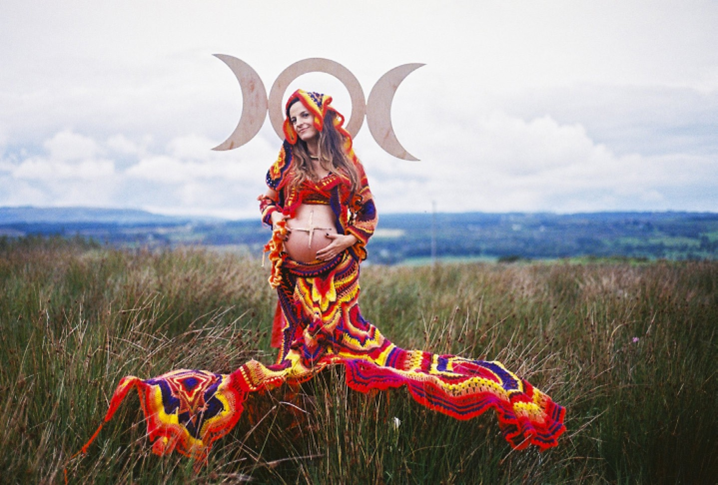
At the early stages the Herstory campaign explicitly linked these abuses to their call for St Brigid’s day. Their open letter to the Taoiseach says:
Mná na hÉireann fought for democracy, they got a theocracy. They fought for equality and got oppression. Religion replaced empire. One form of control, replaced by another.
…
Under the constitution, women had little access to the sovereignty they fought for, no autonomy over their own bodies. Marital rape was not a crime, contraception was. Women were prevented from working after marriage, banned from divorce, access to information was censored and there was little support from the State.
…
We, as a society, were coercively controlled by Church and State to behave in ways that were contrary to our nature.
…
We call on the Government of Ireland to recognise Brigid, our matron saint, in the same way that St. Patrick is honoured. Originally an indigenous Goddess of Ireland, she was appropriated by the Catholic Church who made her a Saint.
In the spirit of unity, let Brigid’s Day, February 1st 2022 and all other years thereafter, be a national holiday where we honour Brigid as Goddess, Saint and symbol of feminine power and strength.
Let this gesture symbolise how our society values women and men equally. Ireland, Éire, a wounded land named after the Goddess Ériu. In our healing, we can rediscover our true selves and find that real sovereignty is possible when men and women can truly empower each other through shared strength and unity.
Let this be our commitment to shaping Ireland’s future, a new era guided by Brigid’s principles of light, inspiration, imagination, healing, truth, justice and love.
Brigid’s day is not a celebration of the church, but a celebration of women’s survival despite the church.
The Herstory campaign tells many positive stories of women in Ireland, not just stories critical of the church. In the art, poems and press releases shared by the campaign, we see Brigid as a feminine icon. Stripped of the vestiges of Catholicism, her pagan-ness is emphasised. It was this image of Brigid promoted by the campaign, and this Brigid who won the support of many Irish parliamentarians and the public for St Brigid’s day.
The government’s own announcements emphasise the pagan aspect and downplay the catholicity. The regulation which legally established the bank holiday states it is ‘in celebration of Imbolc/St. Brigid's day’ and that it ‘marks the half-way point between the winter solstice and the equinox, the beginning of spring and the Celtic New Year.’ The accompanying press release notes, ‘This will be the first Irish public holiday named after a woman.’
In his statements to the press, then then Minister Charlie Flanagan TD said:
Raising her day to a national holiday is also a welcome recognition of the equality of the feminine with the masculine in society. Because of her very strong association with fertility and the natural world, Brigid is also the perfect patron of the ecology movement. She can become the Mother Earth figure of the awakening consciousness of the beauty and fragility of this Earth, and our human dependency on this Earth, and our interconnectedness with all the other species sharing the planet with us.
There are also those who oppose this reimagining of Brigid. Senator Ronan Mullen, on the catholic and conversative end of Irish politics, criticised the St Brigid's Day celebrations as ignoring the ‘historical Brigid’. Speaking in the senate, he said that ‘it is paradoxical that brave new secular and politically correct Ireland should indulge in the hijacking and cultural appropriation of a religious feast day.’
I obviously disagree with Mullen’s opposition to a feminist Brigid, but he is right to identify that the Brigid being celebrated is a challenge to the conservative tradition.
Brigid the feminist
The Brigid being celebrated today is knowingly mythic. The ‘Who is Brigid’ page of the campaign website opens with a quote from a Jungian psychoanalyst that wisdom can be gleaned and reawakened from ancient culture on the journey to equality, and that a goddess isn’t any one person but is everyone, the collective unconscious that we all share in common and whence comes myth.
There are so many new and unexpected ways that people are drawing on the tradition and myth of Brigid. It’s exciting to watch as, before our eyes, people explore novel aspects of the goddess and saint. From a feminist and queer perspective: her rejection of physical beauty and aversion to marriage and the egalitarian arrangements of her abbey. From a political perspective: her bold generosity in the face of miserly rulers and her exhortations to hospitality, as well as her origins and roots across Europe, in the Danube, Turkey, Spain and Ulster. From an ecological perspective: her affinity to nature.
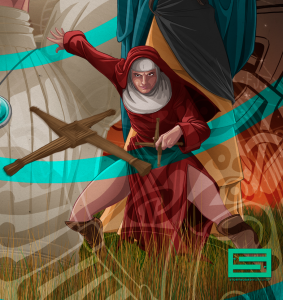
Brigid is being explored as a human creation, a deliberate reinvention and reimagination of myth, not as real historical person or an ‘out there’ pagan goddess.
Unlike past appropriations of Brigid by Christian monks, no-one feels any need to make an historical or metaphysical claim that she is the ‘real Brigid’. And this means that we can create the patron saint or goddess we need for Ireland today: a patron for equality, an icon of Irish women and a defender of the environment.
For me, celebrating St Brigid is celebrating the women who are – through their effort and persistence – embodying the spirit of the goddess and the saint and making Ireland and Northern Ireland a better place. This year in particular I was thinking of one of my friends who has become a Senator in the Irish parliament, and another friend who did a huge amount of campaigning for reproductive healthcare on both sides of the border over the past years. I messaged her about St Brigid after she posted an image on St Brigid's day, and I want to finish with her fantastic reply.
I’m glad she lost the patron saint of Ireland battle to Patrick, so she could become the alternative saint she was meant to be.
With thanks to Rachel Watters.