
In the last issue I encouraged you to send in your poems to me at poetry@sofn.uk , particularly those that are relevant to this year’s theme of “Resisting Faith”.
Tom Hall, an SOFN member who lives in Rhode Island, USA, has sent in an impressive poetic summation of the apparent contradictions in the nature of God, Jesus and his disciples. For me, the implied answer to the question at the end of the poem is that we should seek guidance from more than just the Bible if we want “a way of life that gladdens and fulfils”
I have been learning William Blake’s poem, The Tyger. It is less about a tiger than it is about the contradictory nature of God as revealed in the natural world: “Did he who made the lamb make thee [the Tyger]?”. Here is a link to a recital of the poem at Paddington Station, where I recite poems as James Pendle every Friday morning between 10 and 11 am: https://www.youtube.com/shorts/T3AWbbm2IoI
Paul Overend has been thinking about another beast. He writes, “I have been much moved by the theological yearning of war poet Rupert Brookes in On the death of Smet-Smet, the hippopotamus Goddess. Remembering particularly the sacrifice of WWII marked the age of the death of God for many.” In this time of geo-political change, it is worth reflecting on what Smet-Smet might represent to us today. The poem can easily be found online. Here is one link: https://www.rupertbrooke.com/poems/1905-1908/on_the_death_of_smet-smet_the_hippopotamus-goddess/
Different Gods
Tom Hall
Surely the Yahweh who ambled in the garden
With our first parents, then drove them out for fear
A second breach might render them his peers
Was not the Elohim who with a word
Called into being heaven and earth and life
Of every kind, and saw that it was good.
Nor was the God who ordered Joshua
To wage a genocidal war on Canaan
That Israel might live secure and free
Cut from the same cloth as Micah’s muse,
Whose sole injunction was to lead a life
Of justice, kindness, and humility.
Whatever the creed that drove the heartless Ezra
To cancel priestly marriages and condemn
Mothers and children to shame and desperation,
Its author’s deity was not the God
Who inspired the contradicting tale of Ruth,
The alien whose love was holiness.
Could Jonah’s mild taskmaster, who exhorted
That prideful prophet to display concern
For all the folk of hated Nineveh
Have led a vengeful post- exilic psalmist
To wish that all the babes of Babylon
Might have their brains bashed out against the rocks?
For Jesus Jews we meet in Didache
And Galilean archivists of Q,
Their Lord was a new David or a sage;
In Mary’s Gospel and in that of Thomas
He seems a Spirit with a human form;
Thus early on his nature was in doubt.
And what are we to understand when John’s
Report that Jesus (aka “the Word”)
Was co-creator of the universe
Beggars belief, only to learn that he
And his father Joseph hail from Nazareth,
A place of generally low repute?
Why is it John has Jesus early on
Declare that to be saved we must ingest
His body and his blood, then near the end,
At that climactic final meal together,
Replaces the salvific loaf and cup
With after-dinner footbaths for The Twelve?
We’ll never know why Matthew changed “the poor”
To read “the poor in spirit” and erased
The curses Luke found in their common source,
Nor make good sense of Luke’s chronology
That places Jesus in Jerusalem
For six weeks after his ascent to heaven.
When Luke’s Paul scolded fellow Jews who failed
To see his Jesus as God’s new Messiah,
He prophesied a Gentile supersession:
"They will listen!” But what sort of God
Would on such grounds desert his chosen people
And pave the way that led to Holocaust?
To what broad vision of the great scheme of things
Will you entrust the guidance of the one
And only life you get the chance to live?
From what commitment then derive the strength
To choose and sanctify in word and deed
A way of life that gladdens and fulfils?
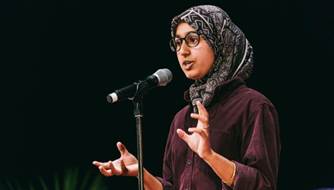
Others have been thinking about the problems of human nature. David Lambourn has been affected by Suhaiymah Manzoor-Khan’s, This is not a humanizing poem, which bemoans the requirement to be “relatable” and “recognisable” to others before they will feel compassion for you. The poem highlights how this requirement may be experienced by Muslims living in the United Kingdom. We have printed this poem on the back cover of this issue of Sofia, but you should also watch and listen to the author's original performance of the piece here.
I have been reading some poems by Arundhathi Subramaniam. In her poem, To the Welsh Critic Who Doesn't Find Me Identifiably Indian, she speaks of a requirement to be recognisably foreign. “Arbiter of identity”, she says to the critic, ironically, “remake me as you will. Write me a new alphabet of danger, a new patois to match the Chola bronze of my skin”. The poem can be found online and more information about Subramaniam can be found at here.
David Chapman has been reading Dylan Thomas’s poem, Do not go gentle into that good night. The poet is speaking to his dying father and the poem is a reminder that even as we approach our death, our words and behaviour affect others, particularly those who love us: “my father […] curse, bless, me now with your fierce tears I pray”. According to the first letter of John, it is in love that God is revealed to us (chapter 4: 7-12). Dylan Thomas can be heard reciting the poem below.
Please keeping sending the poems that are affecting you to me at poetry@sofn.uk. You can send a poem you have written or one by someone else. If you like, include a few words about why the poem is important to you.
In July I will be directing the Festival of Biblical Literature - hope to see you there!
