
When I was asked to talk about being human, I pointed out this could be anything, since all the experience and knowledge that we have comes through the lens of being human. What’s being implied by being human? Is it ethical? Moral? Is it about fulfilling your potential as human beings? That is something which the Christian religion has promoted, partly through the writings of St Paul. Is it about being humane? When we view the news at the present time, we might think we are not being humane enough, either in our national politics or in our global affairs. Or is it about having dominion? The book of Genesis talks about humankind having dominion over all other creatures.
Is it to do with being made in the image of God? One of the books I’ve read this year is called God An Anatomy by Francesca Stavrakopoulou, Professor of the Hebrew Bible at Exeter University. Her main thesis is that all understandings of God until the philosophical side of Christianity came along were of a physical being, who experienced just as we do, had a family, a wife, children... Hence ‘an anatomy’ – of the physical body which is God.
Or is being human not being superman? ‘I’m only human. What more can you expect of me?’. This sense of the weakness of being human. Is it to do with having a highly developed brain? Or having language? Is it about our deductive powers, our use of technology, so sophisticated that we can travel into space? Is it about being a political animal? Is having a sense of self the unique thing about being human? Not only having a brain, but having a mind, whatever the mind is. As the subject is so wide, I’m going to concentrate on just two areas of it. The first is the idea of humans being the story-telling animal and the second is humans as the religious animal.
The Story-Telling Animal
Storytelling is key to how we identify ourselves, how we interpret ourselves as human. In our literature there are so many stories which interpret who we are: our nationhood, the experience of extremity, and of beauty. For example, we have The Odyssey and the Bible with its stories of national identity, the exodus to the Promised Land. Or for us in our culture, there is the story of the Second World War, familiar to us because of our age. Only yesterday I saw part of a film about the Second World War and it was im- mediately nostalgic. Now we have another narrative developing of the demon Putin.
Or we have the Canterbury Tales, a wonderful example of what it is to be human, to be vulnerable, cruel, immoral and to be in search of something. It is a pilgrimage to Canterbury, so you could say they were in search of God. Then there are the fairy tales, cautionary tales. Or soap opera. Why are so many people addicted to soap opera? Because it’s a narrative way of discussing the problems of what it is to be human, to live in a society such as ours, and to face the changes and chances of love and crime, disappointment, illness and death. We have to exchange stories with one another in such a way as to make sense of who we are. Or we have gossip. I now live in a village and love nothing more than to meet someone as I go down the road who wants to have a gossip about the latest village matter.
In Christian theology narrative plays a major part. We have the story of Salvation History, the parables, the passion narrative. Then we get a work like Pilgrim’s Progress, an allegory which sets out specifically to interpret the theme of salvation through wonderfully imaginative story- telling. Or Bach’s oratorio, the Matthew Passion. In the TodayProgramme on 26 December 2019 Rowan Williams was asked how he’d define belief. He said, ‘Belief is a perspective on things, a framing of the facts you see – stories, perspectives, not so much statements you say yes to, but taking a stance.’ Stories ask questions. Doctrines give answers.
There are stories which form our lives in a way that we don’t always recognise are stories. The prime example is Christmas. Although some people complain every Christmas that it’s all commercial and nothing to do with the story that underlies it, nevertheless the whole of December is taken up with the coming of Christmas and it does give a shape to the year and the beginning of the new year. Storytelling gives shape to our lives.
Science does it as well as fiction. The Big Bang is a story, evolution is a story. You can have ana- lysis but in science you also need a narrative, you need a vision of where you’re trying to go and then you try to work out the details. Often a scientific idea starts as a narrative about how things might be, for example the Higgs Boson particle – the ‘God’ particle – and then follows the search to prove that story true.
Jeanette Winterson thinks about what it means to be human in her novel Frankenstein about Mary Shelley, the author of Frankenstein, and artificial intelligence in the present time. Can we create beings like ourselves with thought and high intelligence and if we do will they have consciousness? This is a quote from Winterson’s book: ‘What I can say is that just as conscious- ness appears to be an emergent property of brain function – you can’t pinpoint consciousness biologically – it is as elusive as the seat of the soul – but we would agree that consciousness exists – and we would agree that at present machine intelligence isn’t conscious.’
When I was working at Corpus Christi College in 2018, I wrote a weekly e-pistle, as we called it, to the whole college. I tried to think of some- thing different to say each week. I’d just come across the statistic that in this country 54% of people say they have no religion, and among the 18–24 generation, 70% of them say they have no religion. So I wrote about this and asked would any of you students like to write about it to explain why this might or might not be the case. To my surprise five of them wrote essays. Then I widened it and more essays came in from other colleges. And we produced a book, recently published, called Religion and Generation Z that was to address this very question.
When young people say they have no religion, it means that they have no cultural experience of religion at all, not in the high street, not in the home, not at school, if they go to a state school. They are unfamiliar with the literature of the Bible, so if you are studying English literature there is a big gap in reading even Shakespeare, certainly Milton. Or if you’re studying Reformation history, how many people even know what a Mass is, and what’s all this fuss about what happens to bread and wine in the Mass? Nevertheless, a lot of them are interested in what are called the ultimate questions. What’s the meaning of things? Why are we here? What’s it all about? What’s it for?
At this point in his talk Brian read extracts from his autobiography, Church Going Gone, to illustrate narrative theology.
The Religious Animal
I want to argue that humans are the religious animal. 84% of people worldwide have an important connection with religion. I remember when we went to Vietnam being very interested to discover how religions had come into Vietnam from India, on the one hand, from China on the other. The Catholic religion had come with the French during the colonial period. And the indigenous religions of ancestor worship were still around in the folklore and in the social customs. So if you went into somebody’s home, in the hall you’d very likely find a table on which small gifts of food were left for the ancestors, should they visit.
There is the religious side of ethics and morality, the idea that the moral compass of religion is important. And there is the dreamer. The Bible has people who have visions. Part of our distinctiveness as human beings is a yearning for what is beyond our reach. When we watch a programme about the universe, listen to Handel’s Messiah, or walk in the Lake District on a sunny morning, we might have a sense there is some- thing more. Or if you fall in love or marry, or watch someone die; someone being born, or hold a baby in your arms, you might have a sense that there is something more, something other, some- thing beyond.
During the Enlightenment period, Friedrich Schleiermacher (1768–1834), sometimes called the ‘Father of Liberal Christianity’, reflected the intellectual challenge facing Christianity at the time by calling for a completely new approach to religious belief. Instead of being founded on a past revelation of inerrant doctrines, he proposed that authentic religious belief begins with a distinctive sort of ‘intuition’ and ‘feeling’.
That is the conclusion I’ve come to myself through long experience. It is an experience of ‘the infinite’, Schleiermacher says, in and through finite things and events. He was one of the first scholars to see religion as a global phenomenon, and to suggest that all religions are based on such intuitions, each one developing from a distinctive basic intuition associated with its founder and their story. Then I come across the teasing problem of grappling with the metaphysical while engaging with contemporary science, which suggests that everything is within the physical universe.
I know that Don Cupitt was a significant founder of your Sea of Faith movement. Don and I were neighbours in Humberstone Road in Cambridge back in the seventies, and I remember a street party we had for the Queen’s Silver Jubilee. Don came up to me at the cake stall and said, ‘We’ve just published a book that’s going to cause quite a stir: The Myth of God Incarnate’ [ed. John Hick]. Don had begun to speak of a ‘non-real’ God and of Christianity as a vast embroidery of metaphors that helped us to understand the purpose of life and how we should live.
In August 1994 the Reverend Anthony Freeman was sacked from his parish post as a vicar, by the Bishop of Chichester, for his theological views. Basically, he had preached about the non-reality of God. I debated with him in front of a packed University Church here in Oxford and I defended the reality of God. I hadn’t come to my present views by then. My view now is that quantum physics will inform us about how we think of God. Obviously, it did not set out specifically to do that. It’s not interested in God. But I think theologians can be interested in this.
If we’re honest, many religious people still imagine God as being out there, a benign old man in the sky. They haven’t really moved on from the debates of Honest to God in the sixties – God as one who will pull the strings if he decides to: ‘whose robe is the light, whose canopy space’, to quote that wonderful hymn O Worship the King all Glorious Above.
Now in physics, space and time are seen differently. The Big Bang did not explode into space. Space and time were created by the Big Bang. Space is also stuff, material. It’s not nothing, it’s not a vacuum. Gravity itself is stuff, just as light is stuff; it’s actually material coming from the sun to us. It could be measured, it is physical. If that is correct, God cannot be beyond because there is no beyond.
You might be familiar with Paul Tillich’s idea of God as the ground of being. It’s an expression that seems to me to sum up the position I might take, if I were pressed to take one. If there is God, God is intrinsic to the universe and any other universes. I suppose this is a kind of panentheism. At one time this was heresy but I think far less so these days. I think of God as the life force. Many think of God as love, which is perhaps the life force. Or creative energy, or maybe compassion.
In the Taoist paradigm of the world the life force is called Chi. Chi is the spiritual essence and force which flows within and throughout all of existence. Humans have Chi, plants and animals have Chi, the Earth as a whole has Chi, as does the greater universe. This intuitive sense of the ultimate is a visceral religious experience, felt by all sorts of people regardless of faith. All these terms are ways of edging towards what might be the case, rather than trying to provide a QED definition or proof.
It’s all questions. People used to come to me at the University Church and say that the trouble with your church is that it’s all questions and no answers, isn’t it? I said yes, that’s about it, actually. Then they think here’s a terrible heretic. Let’s go to St Aldates or one of the more conservative churches in the city. I recognise that love, kindness, generosity, penitence, honesty, justice etc. are abstract realities that emerge from the physical universe. They are emergent qualities. Do these have existence beyond and outside the physical circumstances from which they emerge? A question there seems to me to be no absolute answer to.
I suggested that watching a programme about the universe – Brian Cox for example – could be interesting and could provoke some religious questions. Physicists and theologians have a fundamental interest in common – to explain why we’re here and how we got here and therefore, fundamentally, what it is to be human. There is more to life than meets the eye. If on a clear night you look upwards from anywhere on our planet, you are gazing into an incomprehensibly vast distance, measured in light years, into a universe that is not only huge but curved and expanding.
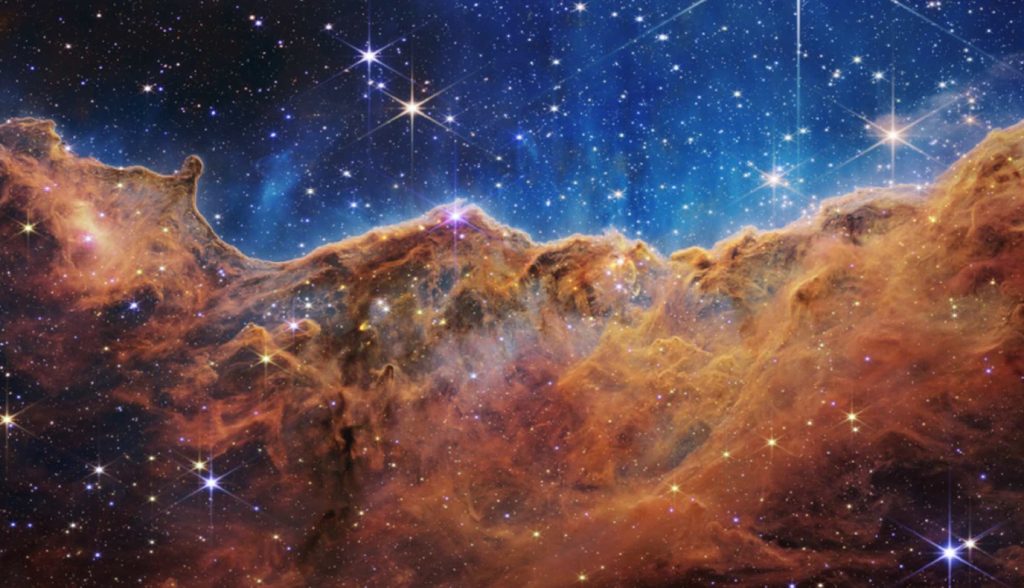
New image of the cosmos released by the James Webb space telescope in July 2022 nasa,gov
I’ve been trying to get my head around some big ideas from popular science books, particularly Carlo Rovelli’s Reality is not what it Seems, about quantum gravity. In it he talks about so-called granularity: ‘The world is made only of fields and particles; space and time are not something else, something different from the rest of nature: they are just a field among others.’ In another of his books, Helgoland, about the ideas of Heisenberg, he sets out to reveal to a wide public the mysteries of quantum mechanics.
Scientific colleagues that I’ve talked to about this in Corpus Christi College point out that Rovelli is a particularly zealous promoter of his own ideas, which aren’t necessarily shared by all physicists. But his picture of quantum mechanics presents a strongly holistic relational view of nature and reality. This seems to me ripe for theological interpretation, since it touches upon the very insight that theologians have intuitively found in metaphors, such as the doctrine of the Holy Trinity, the inter-relationality of the god- head. If Rovelli is right about everything being relational, it tunes in with that idea of ‘Only Connect’ – that connection is good and isolation is bad. If I’m saying there is a kind of life-force God, intrinsic to the nature of things, then this relational quantum mechanics certainly does not oppose that view.
______________________________________
Brian Mountford was the vicar of the University Church in Oxford for thirty years. He retired seven years ago and since then has been working as a college chaplain in Oxford at St Hilda’s College and latterly at Corpus Christ College. For the last few years he’s been on the team of John Hunt Publishing.
His publications include Religion and Generation Z – why 70% of 18-24-year-olds say they have no religion (collection of essays, 2022) reviewed on page 24; Church Going Gone, reviewed in Sofia 142, December 2021; Friday’s Child: Poems of Suffering and Redemption (2018); Christian Atheist(2011) reviewed in Sofia 102, December 2011. All published by John Hunt Publishing.
This is a shortened version of the talk he gave to the 2022 SOF Network Annual Conference.