
Survival of a Palestinian Farm on the West Bank
Graham, my husband, and I are having a day off from our volunteer work at the Tent of Nations. It is January 6th 2026, and we are in Bethlehem on the occupied West Bank. The western press has made much of the fact that Christmas has returned to the birthplace of Jesus. And yes, on the square outside the Church of the Nativity there is a Christmas tree with baubles and a nativity scene. The Jerusalem Patriarch arrives for his annual visit, and there is an endless parade of marching bands in pristine uniforms.
Does that mean normality has returned to this part of the world after more than two years of extreme violence inflicted on Palestine? Sadly, far from it.
The Tent of Nations is a hilltop farm to the southwest of Bethlehem, owned by the Nassar family, led by Daoud Nassar. Surrounded by settlers, they face threats in a variety of ways, and their peaceful struggle is a microcosm of the Palestinian struggle more broadly. Volunteers, amongst others, serve as a protective presence. We were here in summer 2024 and finally managed to return earlier this year.
In many ways, the farm is still the same. The stone at the entrance still announces that "We refuse to be enemies". The trees and vines still attest to the tender, loving, care bestowed on them over many years. This is not a farm as we know it in our western countries. For instance, apart from a very old tractor, you don't see any machinery, nor are herbicides or pesticides used. Everything just grows in a natural way.
What is also the same is the never-ending series of court cases the Nassar family have had to deal with. Courts offer a pretence of legality but they don't serve justice for the Palestinians. This is most obvious in the fact that, after 35 years, the family are still struggling to have their ownership of the land ratified, something that should have been a formality at the start. Since we were last here, more preposterous obstacles have been put in the family's way by various courts, all clearly intended to lead to a dead end for the family. Apparently, the authorities have not counted on the Nassars' dogged persistence in their fight for what is rightfully theirs.
What is different from last time is the weather, which can be atrocious in January. When the rain lashes down and the wind rages, we sit huddled around a wood stove in our wet clothes, remembering that in Gaza, only 70 km away, very few walls and roofs remain, let alone wood stoves. More reassuringly, at least we hear fewer bombs exploding than last time we were here.
As before, the other volunteers offer a strong sense of camaraderie and a desire to get things done as a group effort. We have meals together, and when the weather does not allow us to work on the land, there is always plenty to talk about.
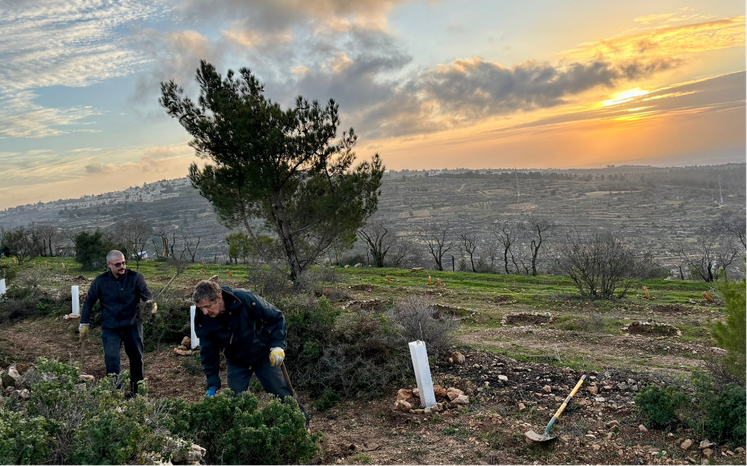
With respect to the work, our task was mainly to remove old shrubbery and repair dry-stone walls. As we left the farm at the end of our stay, a large van arrived, full of young trees, and since then 600 trees have been planted.
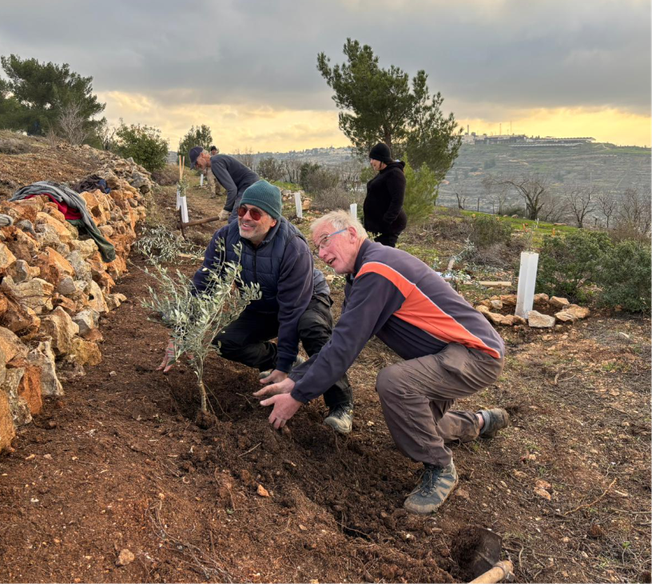
Planting a tree is not a single symbolic act. It is the beginning of an ongoing process of careful nurturing, part of the respectful and loving attention to the land.
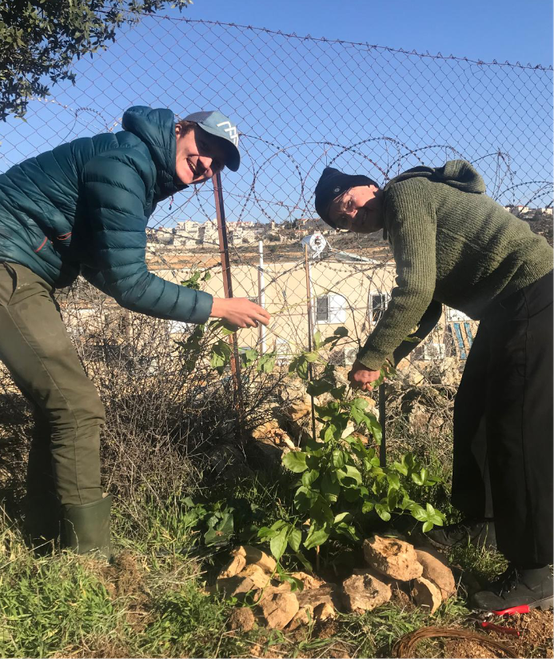
Moreover, it is a visible, positive statement that the farm is still working.
This is in stark contrast to the outpost settlers have built right on the border of the Nassars' land. The soulless dwellings, surrounded by a bare expanse of sand and concrete, convey a very different relationship with the land.
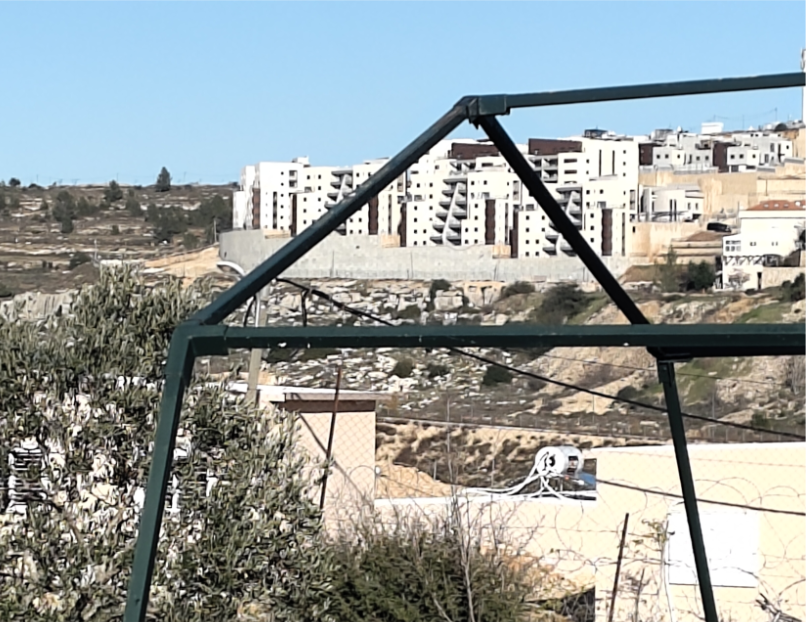
The border between the Tent of Nations and the outpost is marked by rolls of razor wire, and at night bright lights shine on part of our farm. Moreover, since we were there, a watchtower has been built not far away. Everything conveys that we are the criminals, whereas, of course, it is the settlers who are stealing land and destroying trees. The threats to the Tent of Nations are very real.
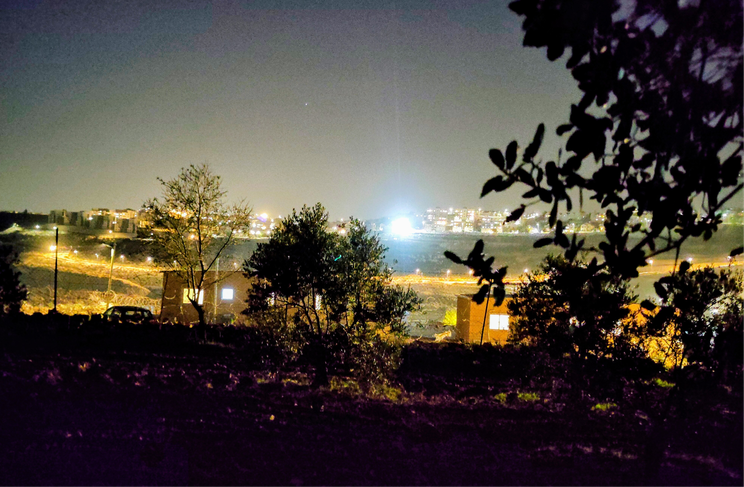
The Tent of Nations, like many other Palestinian settings, shows that the word "occupation" does not capture what is taking place. The occupier doesn't just occupy. It intrudes into all aspects of life, for instance by withholding water and electricity, the withholding of building permits and blocking access routes. The Israeli authorities don't pass up any opportunity to impinge on the daily running of the farm. These calculated intrusions into the work massively complicate the running of the farm. A great deal of time, effort and ingenuity goes into circumventing the restrictions.
The physical presence, the lights, the sounds, the physical threat, and the restrictions also aim to intrude into the Palestinian psyche. They aim to interfere with the internal freedom to be who they are. This is illustrated by an incident in which a volunteer was shouted at across the fence by a settler, who told him not to work too hard because the land would soon be theirs anyway. Palestinians are forced to accommodate the omnipresent aggressor, anticipating, pre-empting, and responding to whatever they will put in their path. They also need to free themselves from projections of violence and savagery (see e.g. Mohammed al Kurd's Perfect Victims1). However, it is striking how much of an authentic identity Palestinians, including the Nassar family, have managed to maintain. By refusing to be enemies and refusing to be victims, they resist the roles allocated to them. Their resilience, their land, Christian faith, friends and family afford them as much self-expression as possible, and they actively choose these opportunities for life and dignity.
The thought of the farm being taken over by the Israeli authorities is unbearable. Will they destroy what is cherished, as they have elsewhere? Will they build hideous houses, as they have elsewhere? And what about the environmental impact of unsustainable farming practices? How can the settlers reconcile the fact that the land is, in their view, given by God, yet treat it with such disdain and approach it with so little respect, care and love?
Dispossession would be far more than a loss, far more than a great injustice. It will cut to the heart. It will be an indelible stain on all our futures.
So, is there reason for hope? Daoud and his fellow Palestinians know very well that hope is not about passively waiting for God or fate to put things right. Everything about their lives is about actively pursuing their goal of ensuring that justice will prevail.
This is, for instance, apparent in Daoud's tribute to his father, who died 50 years ago:
We will continue [his] journey, with deeper determination, stronger faith, and unwavering love. We will protect the land he nurtured until the day we pass it on to the next generation, just as it was entrusted to him.
This peaceful yet determined defiance embodies hope.
I will finish with extracts of Daoud's New Year's message for the start of this year.
Daoud Nassar's New Year's message
As 2025 comes to an end, we look back on a year full of deep pain, heavy burdens on our hearts, destruction, and overwhelming challenges. It has been a year of darkness and despair, where is hope in the midst of all this?
At the Tent of Nations, hope didn't disappear; it took root. It lived in the soil we continued to cultivate, and it grew through the hands of volunteers who came to stand with us in solidarity. It was planted with every tree, shared in every harvest, and renewed through our unwavering commitment to nonviolence, justice and faith put into action.
Your active solidarity made this possible. Through your presence, prayers, advocacy, and generous support, you reminded us that we are not alone. Across borders, cultures, and differences, you stood with us and proclaimed, by your actions, that love is stronger than hate and fear, that resilience is stronger than despair, and that justice, even when it feels distant, will prevail.
Together, we lived active hope, a hope that refuses to surrender, a hope that walks, plants, and perseveres.
As we step into the new year 2026, we do so carrying heavy burdens and many unanswered questions. The road ahead is not clear, but we move forward with deep gratitude, grounded faith, and renewed determination to continue the struggle for justice through nonviolence, trusting that GOD is present in the journey, even when the answers are not.
May hope continue to grow wherever you are. May it take root in your hearts, your communities, and your daily lives. And may our shared journey toward justice and peace remain strong.
Happy New Year.
Christiane van Duuren is passionate about fighting for justice. Working on a farm on the West Bank is a way of making a small and practical contribution to everyday acts of solidarity and resilience.
Notes
Photos: courtesy of Christiane van Duuren.
1 Mohammed El-Kurd, Perfect Victims; And the Politics of Appeal (Haymarket Books, 2025).
To sponsor a tree, volunteer, or donate, visit the Friends of Tent of Nations: linktr.ee/tonfriendsuk or email tonfriendsuk@gmail.com.