
Contents
Articles
- One for the Dark Lord, David Boulton
- Having Faith in Fantasy, Helen Fisher
- The SOF Questionnaire
- A Magical Hero Myth, Tim Woodcock
Poetry
- The Gift, Juanita Bateman
Interviews
Regulars and Occasionals
- Postscripts: The Best of the Rest, Seafarer

Editorial
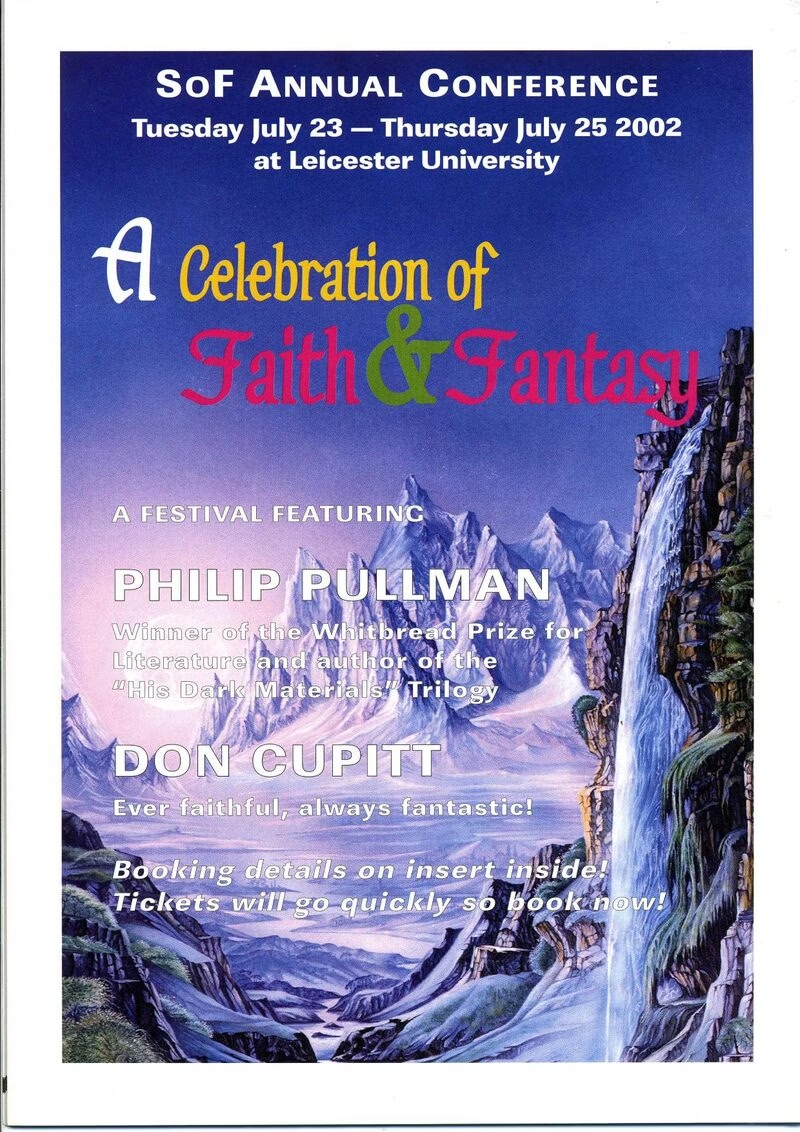
Editorial ONE FOR THE DARK LORD David Boulton on Tolkien HAVING FAITH IN FANTASY Helen Fisher on the benefits of fantasy BOOK REVIEW John Hunt’s own, reviewed by Paul Overend PHILIP PULLMAN: IN HIS OWN WORDS The man of the moment speaks THE SOF QUESTIONNAIRE Your chance to tell us what you want A MAGICAL HERO MYTH Tim Woodcock reflects on the Harry Potter phenomenon POSTBAG Your letters POSTSCRIPTS The best of the rest escape or engagement? editorial é Lt] =) te oO = The popularity of fantasy soared over the winter social order, which was passing away. Today, Harry 3 holiday. Stories of the imagination captured the Potter finds himself in a Gothic Public School, which i film and book market, and comment filled is not so frightening, if you can become invisible, as © newspaper columns. Perhaps they even took school playgrounds where drugs can be bought. Yet, ca centre stage over more traditional stories of Jesus, though Tolkien wrote in the 1930s and reassuringly é Santa and Scrooge. portrays a clear division between good and evil, The 0 .. ee . Lord of the Rings also explores sy “Fantasy and religion are similar in weakness and strength, giving £ ° lvi h es d vulnerable people hope and ambition © EVI WETE, TUCEETICA creativity an in the face of vast global powers. © supe rnatural ideas” Some articles in this issue argue 3 persuasively that fantasy might help a our imagination and engagement Be The theme of our conference will be ‘faith and with living. In particular, story might have = fantasy’, and this issue prepares for that by therapeutic value. Py considering the nature of fantasy. But, sometimes, It is understandable and wise that Philip Pullman i to approach a subject 'head on’ is reductive and avoids the description “fantasy” for his stories, © can miss the point. To ask what saying that they are “stark realism”. fantasy is would Indeed, neither do his stories essentialise ' 4 represent a secure social and moral fantasy, and no one description covers all. To know what fantasy is one needs to be gripped by reading or watching it, by dreaming it and order: one character, Lyra, is a liar and might as well be an orphan, and another, Will, mistakenly thinks of himself as a murderer. His final book seeks to overthrow Authority itself, killing 'God'. The award of the Whitbread Prize confirms that perhaps even by his work is being obsessed by it outstanding, for a time. Those and we look who have forward to experienced this reflect on fantasy in this edition.
There is a debate between these articles. Is fantasy simply escapism, a retreat from life, or does it better enable an engagement with life?
Don Cupitt's recent comments [cited inside p. 7] creativity and often include propose that supernatural fantasy is an escape “supernatural ideas, we might from reality. There is clear evidence to support also reflect on this question while reading this hearing him more on these themes at our conference.
SOF 52 / March 2002 tbag A rational Christian?
Having lived through both German wars, I am better qualified than most to comment upon the war as requested in your last editorial (SOF, November 2001: "The War"). Because "War is diplomacy carried on by other means" (Clausewitz), we should expect it to be preceded by serious diplomatic exchanges, but these were absent when the bombing started in Afghanistan. A similar situation existed before the illegal invasion of Yugoslavia. From these and similar hostilities we can deduce that the United Nations no longer has any chance of maintaining the high moral hopes we all had in 1945.
Thus it appears likely that UN will follow the League of Nations into the mists of history. Once engaged, nations at war have no choice but to pursue a determined course towards victory by any means, all other considerations being swept aside; throughout history, starvation has been a recognized weapon of war.
History indicates that prolonged periods of peace are more likely to be achieved when we have a dominant military power determined to subdue any opposition.
Today the world has contracted to such a degree that the possibility of universal peace can be maintained by such a dominant military power regardless of moral rectitude.
Thus there is the possibility of choice: peace or a proliferation of minor wars originating in disputes over differing aspects of morality supported by a variety of theologies. SoF appears determined to pursue the latter course by demanding a cessation of hostilities for humanitarian reasons, although the event that they fear seems doubtful: has anybody seen starving Afghan children to compare with those offered by Bob Geldof of African children? Because peace enables the human race more readily to progress towards perfection even under a Caesar or a Genghis Khan, it is my choice as made clear in my book, A Rational Christian.
— C.A.P. Ellis, Ilford, Essex
C.A.P. ELLIS 212 Roding Lane South Ilford, Essex IG4 5PP Mind your grammar I enjoyed Tim Woodcock's article (SOF, January 2002, "God Bless America").
However, I think that he is mistaken in rejecting "bless" as a grammatical imperative. Christian prayer is full of such imperatives: "Give us this day our daily SOF 52 / March 2002 Send your letters to:
Patti Whaley, Letters Editor SOF 145 Petherton Road London Nb5 2RS PattiWhaley@compuserve.com mon bread", "Forgive us our trespasses’, and so on.
— David Greer, Jesmond, Newcastle-upon-Tyne
Dona nobis pacem", DAVID GREER 20 Haldane Terrace Jesmond Newcastle-upon-Tyne NE2 3AN d.c.greer@durham.ac.uk An Open Letter to Don Cupitt Dear Don Cupitt, I was thrilled to read your article in the Guardian (Clinging to the enchanted world: 27-12-01). [had similar feelings when I first read Taking Leave of God and no other work of yours has ever been quite the same for me. As I thumbed through the newspaper I was so pleased to catch sight of your name associated with the statement "Fantasies of supernatural power are not of much use to children or adults" Three days later Richard Dawkins wrote in the Observer "a fine article in the Guardian last week by Reverend Don Cupitt and quoted your headline "We need to make a clean break with heritage religion and create something better suited to our own time".
Excellent!
Personally, I have never been keen on the fantasy of the Tolkien/Pullman/Potter variety and I agree with you about Philip Pullman invoking all the supernatural apparatus in his novels. He has replaced the churches’ myths with those of his own, but unless we look deeper into what religion is all about, we are never going to acquire any sort of understanding to create something better. Elaborate creative stories can never match the astonishing story of nature. "Biological thought confers meaning on the world rather than takes it away; in living landscapes we find not only our origins, but solace too, and spiritual nourishment, and a stimulus to intellectual curiosity. We may also reflect that the creation story of evolution, unlike those of religion, has the unusual characteristic of being demonstrably true - which is just one more aspect of its beauty " (lan McEwan, 1998).
You say that it is time to throw off the nostalgia and the illusions and make a fresh start. But how will this happen? Maybe we should call on the science of developmental psychology and start looking from a different point of view. We've nothing to loose and perhaps we will gain a lot of insight if we do make this link. "It is well known that psychology is one of the youngest and most subjective of the major scientific disciplines and, consequently, still conflict-ridden to an exceptional degree," says John W. Miller, author of Jesus at Thirty.
If we, in the Sea of Faith, are to explore religion as a human creation, surely, in the light of what is known of human emotional development and the way early experiences in the immediate family shape our emotional outlook, we should at least take a educated look into the inner world of the human being who inspired the creation of the Christian religion. Correlating the sacred and the secular can be unsettling but, as John Spong says, " Truth can never be deferred just because it is unsettling". If there is a Koran Con (SOF, January 2002) might there be a Bible Con? Is there a Torah Con? and why and how does a young man come to be convinced that his father lives in a parallel world? Surely we need to be focusing on the developing emotional mind of the child. Nothing is more important to the future of this planet than the mental health of its children. It is the greenest issue of all. Richard Dawkins slams all religion but Donald Capps author of The Child's Song - The Religious Abuse of Children says his book is not a diatribe against religion, it is about the hidden sufferings of children, the role that religion plays in the legitimation (sic) of these sufferings, and the things that we can do as adults to restore the spirit that was crushed so many years ago by well-intentioned adults.
We are in crying need of a psychology that will do justice to the content of religion. As we in the Sea of Faith are exploring religion faith as a human creation, should we not visit developmental psychology as one of our ports of call?
— Susan Olver, St Andrews