
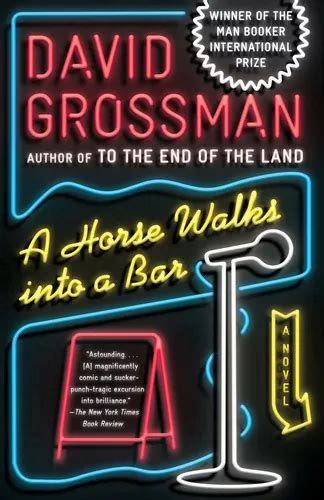
A Horse Walks Into a Bar by David Grossman, translated from the Hebrew by Jessica Cohen. Vintage (London 2017). Pbk. £8.99.
When I was asked to review this book in seven hundred words, my first reaction was I need five times that. But there is only one thing I really want to say: Please read this book.
The dramatic form packs a punch in both books, right to the solar plexus. A Horse Walks Into a Bar gets its title – obviously the first line of a joke – from the mouth of the main character, a stand-up comedian. The book is a tour de force which takes place during the entirety of one stand-up performance. Doveleh, the comedian, does something we perhaps both crave and fear from every comedian we ever see or hear – he goes for it. Doveleh spills his guts with a pace, a drive and an intensity which sends the reader rocketing through the book, unable to put it down in much the way a customer might wander in and then sit glued to her seat at the actual performance, unwilling to remain and unable to escape.
Grossman has form for genius fiction. He has written amazing, coruscating novels set in Israel, both committed to and critical of his country. A lifelong campaigner for peace, he lost his son Uri to war in Lebanon in 2006. His 2008 novel To the End of the Land was prompted by Uri’s death, and five years later he published Falling Out of Time, a brilliant, wrenching and generous novel about the loss of a child. Like A Horse Walks Into a Bar, it is a dramatic novel, told in clear, distinct voices, condensed, tight – which is to say poetic in the real, visceral sense of that misused word.
Grossman’s hard-hitting critique of Israel is here, as always, but couched in very different terms, tragically hilarious – never have those two ingredients been more ingeniously combined. The high wire nature of stand-up comedy is breathtakingly realized on the page, and as readers we participate in a live performance. A live performance. This is what fiction is, or should be: live, fresh, immediate. This book goes straight to the core, no messing. It’s short, at just under a hundred pages, a bull’s eye of a book.
The only comparisons that come to mind are Beckett and Dostoevsky. There is little enough writing of this calibre in the world probably at any time; it is literature on a whole different level, in a different dimension, even than the best – I think of the Italian Elena Ferrante’s wonderful books, particularly her stand-alone short novel The Lost Daughter, of Grossman’s compatriot, Amos Oz, and his latest novel, Judas. Grossman is simply in another league.
We are there, in Caesarea, watching Dovelah take the stage. Like all humour, his is sharp with an acerbic anger that probes and strikes with a little stab of recognition, a jab of laughter he surprises from us. Wait a minute, the joke’s on us: we’re in Natanya, much more dangerous, we’re part of an audience where ‘Every other person on the street looks like he’s in the witness protection programme and every other other person has the first person rolled up in a plastic bag inside the trunk of his car’.
On the heels of that, we learn that Doveleh is performing because he needs the money to pay alimony and child support to ‘…three lovely women and…three-to-five kids…’ and it’s his birthday. Danger everywhere, then, inside and out. We switch to a ‘him’ for Doveleh, to an ‘I’ for an uncomfortable invited guest in the audience who happens to be a judge, to a ‘she’ for an emphatically uninvited member of the audience whose presence proves uncomfortable for Doveleh – seamlessly moved from third to first to third person, as easily as we shift in our seats in that claustrophobic club in Netanya, wherever the hell that is.
It is a claustrophobic place, and meant to be. The dilemma it literally drives us towards and plunges us into, which I won’t reveal, is universal – that awful word, but accurate, for once – and also personal; intimate is perhaps the word for it, and for this book – and who can do better than that, in art or life?