
Kathryn Southworth reviews Saying it with Flowers by Peter Phillips. Ward Wood Publishing (London 2022) Pbk 74 pages £í9.99
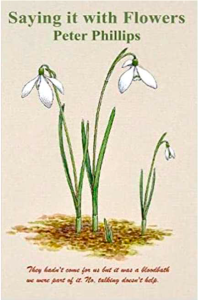
Peter Phillips has published six previous volumes of poetry, this title having its genesis in a short illustrated pamphlet produced by Hearing Eye. Many of these poems have already been published in magazines or won prizes. The genius of the title reflects simultaneously the modest accessibility of the author, together with the unexpected scale and resonance of these poems. What, then, is being said with flowers?
Most immediate and expected, is the theme of love, tinged with melancholy and, explicitly, mourning for Phillips’ late first wife. In ‘Red Carnations’ it is not by the enormous couple ‘clinching/under the clock’ but by the statue of the ‘crumpled, loveable, human Betjeman’, the poet’s first influence, that he wishes he could meet his lost beloved. He would show her the new St Pancras she never knew and tell her about their grown-up children. As he acknowledges, poignantly, ‘I know it will never / happen, but if it did I’d carry a whole/ bunch of red carnations, so you couldn’t miss me’. The final line shows the understated strength of the poet’s pay-off lines in general. Simplicity and charm mark the poems where he includes himself, like the poem ‘Daffodils’ addressed to ‘Dear House’, which he ‘fell for’ partly because of the flowers ‘queueing along/the path to the door’. ‘How nice’ that it now belongs to a family with new twins’. The voice is both innocent and low-key. Familiar flower associations are employed but develop a more chilling edge. So the elegiac ‘Forget-Me-Nots’ is not only about love tokens but also the fear of dementia and losing even the memory of the lost beloved.
As Joan Michelson has put it, ‘Phillips buries bullets (if not landmines). They lie in the text like his snowdrops which ‘didn’t see daylight for years’. Phillips uses the most unassuming of flowers to tell tales of gruesome human behaviour, of tyranny and massacre, the more horrific because hinted rather than stated. There are the snowdrops speaking of the bloodbath when ‘hooves ripped the earth/then came the cries’ or the sunflowers which recall howling dogs and a felled plane crushing them in a debris-scorched field. In ‘Tulips’ the flowers ‘started stomping. / Their black boots marched,/ iron crosses glittered on their tunics’ and ‘Ash Dieback’ has the trees recounting stories of ‘the yellow stars, groups rounded up’. ‘Poppy Parade’ is still harder, with the presumed veteran talking of his comrade’s guts ‘strewn/like manure, his eyes entreating/that final kindness’ which the persona delivered, his broken neck snapping ‘like a distant rifle shot’.
The last series of poems is the apocalyptic ‘Heat Wave’ sequence where on day 10 ‘A swan’s neck flopped/into the water’, on Day 22 the speaker, finding two bottles of water, padlocks them in his shed and on Day 23 saying he is glad to have no children.
Yet the last poem says as much of the vicissitudes of love and relationships as of climate which reads like a metaphor for relationships. As the speaker plans to leave for Australia with his partner, she breaks away:
There are degrees of love, aren’t there?
You can’t argue with climate,
persuade what there is to shine.
She left me.
In the essay included with the poems, ‘Inspiration – Or Where I Find My Ideas’ Phillips talks of how writing in other voices, such as flowers and animals (also represented in this volume) has been helpful to him. Indeed, it seems a way of liberating a wide range of emotions. There is anxiety, the ‘internal frown’ personified in the bindweed which ‘twirls around’ when it is disturbed, finding meditation, mysticism, ‘that kind of spiritual thing’ ‘doesn’t work’. On the other hand, there is the release of the bravura theatrical performance and ribaldry of Dame Edna Everage in ‘Gladioli’, the St Trinian’s schoolgirl boarders (or borders) of ‘Hollyhocks’ and the whimsy of ‘Cherry Blossom’ described as ‘an elderly lady’s hair-do’.
Like Betjeman, Phillips’s voice is light, sometimes old-school and with emotional depths concealed in understatement. As he says, the poems come from his ‘being receptive, patient and experienced enough to know which random thoughts and instincts can best be developed in a truthful way’. He accomplishes this with a scrupulous honesty which steers clear of the exhibitionist and confessional and which is touch-perfect.
Kathryn Southworth is a former vice-principal of Newman University College in Birmingham. Recent publications are her poetry collection Someone was Here (Indigo Dreams, Beaworthy, 2018) and her pamphlet, A Pure Bead, a sequence on Virginia Woolf (Paekakariki Press, London 2021).