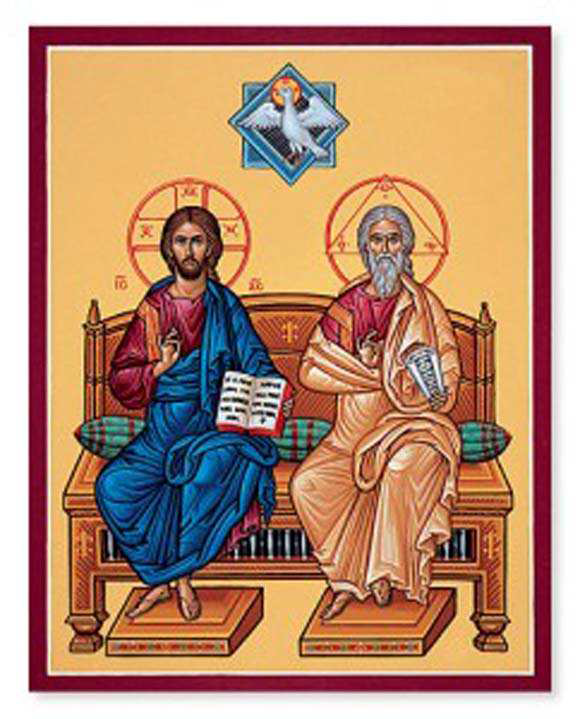
After the service two weeks ago, one of our youngest members asked me a question. It had a simple two-word answer, that I gave him. The question was this: The Bible says that Jesus sits at God’s right hand. Who sits on his left? And the short answer was: Nobody knows. The Bible doesn’t tell us.
But I felt that such an enquiring young mind deserved better than that short negative answer. Something more positive. So we thought about what it means to sit on someone’s right. It is a place of honour: the most important guest at a big dinner will sit on the host’s right. So I explained that when the Bible says that Jesus sits at God’s right hand, it is saying that Jesus is the most important person there.
That was not the moment to say more. But we have time now to explore the subject a bit further. First, to look at other implications of the right hand, and of sitting; and secondly to recognize how misleading such language about God can be, unless we are careful.
As well as indicating a place of honour, the right hand – especially the right hand of a king – represented action and power: it held the sword, it signed laws, it pointed the way. In addition, the psalms refer to God’s right hand as being full of gifts, so it also carried overtones of joy and pleasure. Therefore, to place Jesus at the right hand of God is not only to raise him to a place of honour, but also to associate him with the divine attributes of power and action and bringing joy.
But Jesus is more than simply positioned at the Father’s right hand, he is seated there. And this tells us a whole lot more about the status of Jesus. Sitting symbolises at least four qualities:
- One is permanence. When you call on someone and they invite you to sit down, it is not going to be a fleeting visit. Jesus’s life on Earth lasted a few years. Now he will abide for ever in his Father’s glory.
- Sitting is also a position of rest. His saving work completed, Jesus now enters into his ‘Sabbath rest’, as the Bible calls it.
- Thirdly, being seated is a sign of sovereignty. Jesus sits beside his Father to indicate his share in the divine Kingship.
- And finally, sitting is the position of one who passes judgement. In a court of law, the advocates – the prosecuting and defending counsel – stand; but the judge sits. The seated Jesus will be our judge.
All these years you have said in the Creed, ‘and is seated at the right hand of the Father’, and you never imagined how much information those few words contained. But now let us briefly think about the information you thought they contained, but in fact they don’t. And first a word of reassurance.
Some of you will know that I have a reputation for new ideas, that can throw doubt on some traditional Christian teaching. To show there is nothing new in what I shall say next, I will start by quoting a book on the Creed written by Bishop Pearson nearly 400 years ago, while he was in exile during Oliver Cromwell’s time in power.
Commenting on the words, ‘seated at the right hand of the Father,’ Pearson wrote: God, being a Spirit, can have no material parts; and consequently, as he hath no body, so in a proper sense can he have no hands. He then explained, that when God is described as having a face, mouth, arms and hands, it is only by way of analogy with human beings. And therefore, sitting at the right hand of the Father, doth not signify any determinate location or position of the body.
In other words, to say that Jesus is sitting at the right hand of the Father does not tell us anything about his physical whereabouts. If we thought it did, then we were mistaken. It tells us instead what the spiritual status of Jesus potentially is in this world and in our lives. Heaven is not another country or another world, to which Jesus has gone ahead as king – or at least crown prince. This may be the language of some hymns and prayers, and in places even the Bible, but it is only a metaphor to help us understand the spiritual reality.