
This year marks the eightieth anniversary of the death of Dietrich Bonhoeffer, executed by the Nazis in 1945. He is hardly a forgotten figure; on the contrary, he is the subject of continuing study and debate. And yet he remains an enigma. His theology – especially his prison writing – is perplexing. And the activity which led to his death – membership of an opposition network seeking to kill Hitler – is not what we might expect from a Lutheran pastor.
For all these reasons he is a fascinating subject, so perhaps it’s no surprise that someone has now made a film about him. Its title - Bonhoeffer: Pastor; Spy; Assassin – gives a clue to its content, as does the stated conviction of the filmmaker, Todd Komarnicki, that Bonhoeffer was above all “a hero”. Komarnicki’s previous films are mostly thrillers and action-movies, genres which celebrate heroism, and heroism is what we get here. The film presents a version of Bonhoeffer’s life which plays fast and loose with the facts in order to deliver thrills and pathos. It offers a cartoonish caricature of Nazism, and invents bogus episodes intended to bolster the image of Bonhoeffer-as-hero. For instance, in one scene he is shown personally drafting the manifesto of the anti- Nazi Confessing Church. In another he personally escorts a number of Jews to safety in Switzerland. In a third he personally participates in the detailed planning of an attempt on Hitler’s life. All these episodes are entirely fictional, and all misrepresent Bonhoeffer himself, and the anti-Nazi resistance in general.
However, in my own case, the film had the effect of driving me back to the biography of Bonhoeffer written by his friend Eberhard Bethge, to get a more reliable grasp on the actual course of his life. This article provides a brief summary of his biography, and it will be followed by a second, in a future issue of Sofia, which will consider his theology. The two cannot be separated. Much of the debate on Bonhoeffer focuses on his writings, but theological ideas do not exist in a vacuum. Theologians like anybody else are formed by their background and experience, by family and friends, home and work, success and disappointment. To grasp Bonhoeffer’s ideas we must know about his life.
Bonhoeffer came from a privileged background. His family was upper middle class with connections to the minor aristocracy, and his childhood was spent in affluent suburbs in Breslau and Berlin. His was not a particularly devout family, but from early on Bonhoeffer’s ambition lay in theology, where he was a star student. Having obtained academic qualifications, and a licence as a university teacher, he studied briefly in the USA in the early 1930s. But by the time he turned 27 in early 1933, he was back in Germany. Hitler had just come to power.
The Nazis moved quickly to take control of Germany’s Protestant churches. By the end of 1933 they had created a single centralised ‘Reich Church’ and banned anyone of Jewish heritage from serving as a minister. From the start Bonhoeffer was active in opposing this, but he and his colleagues were up against the power of the state, and many ministers and churchgoers were happy to go along with the new arrangements. The Reich Church was established, and in the autumn Bonhoeffer left the country.
He moved to Britain, and for the next eighteen months he worked as pastor to a German émigré church in south London. Here he built a network of contacts and friendships in the Church of England, above all with George Bell, Bishop of Chichester. He also used Britain as a base for travel to other countries to broaden his international church contacts.
Meanwhile in Germany, church opposition was moving towards a new strategy. The Nazis’ Reich Church was now an established fact, and in May 1934 the opposition gathered at Barmen to denounce it, arguing that it had forfeited the right to call itself a Christian church at all. A declaration drafted by the theologian Karl Barth was adopted, and a ‘Confessing Church’ was established, not as a clandestine movement but as an open alternative to the Reich Church. Bonhoeffer was still in London at the time of the Barmen conference, but he helped from afar by securing international ecumenical support.
In 1935 he returned to Germany, where he taught and lectured in the Confessing Church, developed his international contacts, and continued his writing. But all activity against the regime was becoming increasingly dangerous. Confessing Church seminaries were closed by the police from 1937, and through 1938 the Church faced constant harassment and intimidation.
In the following year Bonhoeffer left Germany again. He passed briefly through Britain on his way to the USA, unclear about his future. There is no doubt that he could have chosen to stay in America, where he had a warm welcome; teaching work was available, with the prospect of an academic career and widespread respect as a professed anti-Nazi. But he chose differently. It only took a few weeks for him to decide that, for better or worse, his place was in Germany. He returned shortly before the outbreak of the Second World War.
From this point his life took an entirely new turn which is difficult for us to grasp. Through his brotherin-law, Hans von Dohnanyi, he made contact with members of the Abwehr or German military intelligence. This seems astonishing: why would a professed opponent of the regime be talking to that regime’s military spies? And he was not just talking to them; from the autumn of 1940 Bonhoeffer started working as an Abwehr agent, based in Munich. Why did he do this? And why did the Abwehr employ him? Unless he had abandoned all his principles – which he hadn’t – it seems to make no sense.
It does, in fact, make sense, but only if we make an effort to understand German society under the Nazis. The regime was not as ruthlessly unified as it liked to pretend. It was shot through with internal rivalries, personal hatreds and institutional feuds. And in addition, there were deeply rooted traditions in German society whose values were different from those of the Nazis. Some of these the regime destroyed, promptly and brutally, including rival political parties and independent trade unions. Others it tried to co-opt, such as the church and the army.
The traditions of the German army, inherited from nineteenth century unification and from the state of Prussia before that, were steeped in class privilege and militant patriotism. This led to an ambiguous relationship with Hitler. Like him, army officers longed to avenge the humiliation of the First World War; but at the same time many despised the Nazis for their lower-class origins and brutality. These mixed feelings played out differently in different military institutions, and in the Abwehr hostility to the Nazis was particularly strong. Some of its members, including Bonhoeffer’s brother-in-law, believed that Hitler was leading Germany to ruin. On patriotic grounds therefore, they built a network inside the Abwehr with the aim of assassinating him and instigating a coup. However, to succeed they would need support across society. This was where Bonhoeffer came in: the conspirators believed that his connections with members of the Confessing Church in Germany, and with leading church figures in other countries, could help win over public opinion in the aftermath of a successful assassination and coup.
From Bonhoeffer’s side, his willingness to join the network was influenced by family and social connections. He came from an upper-class family, giving him a natural affinity with the upper-class officers – including his sister’s husband von Dohnanyi - who formed the network inside the Abwehr. They were anti-Nazis, and highly courageous, but their outlook was essentially patriotic and conservative. Whether or not Bonhoeffer shared these values, he understood them, because he came from the same class and social background as the officers who espoused them.
For three years as the War raged on, Bonhoeffer maintained contact with friends in the fragmented Confessing Church, and deepened his international connections by travelling to Switzerland, Norway and Sweden. On one of his trips to neutral Sweden he even managed to meet up again with Bishop Bell who had managed to travel there from England. The Abwehr network sought to protect him on these travels by providing him with nominal missions to act as cover. Meanwhile, whenever possible, he would find a quiet retreat to continue his writing, producing notes which would be published after his death as a book entitled Ethics.
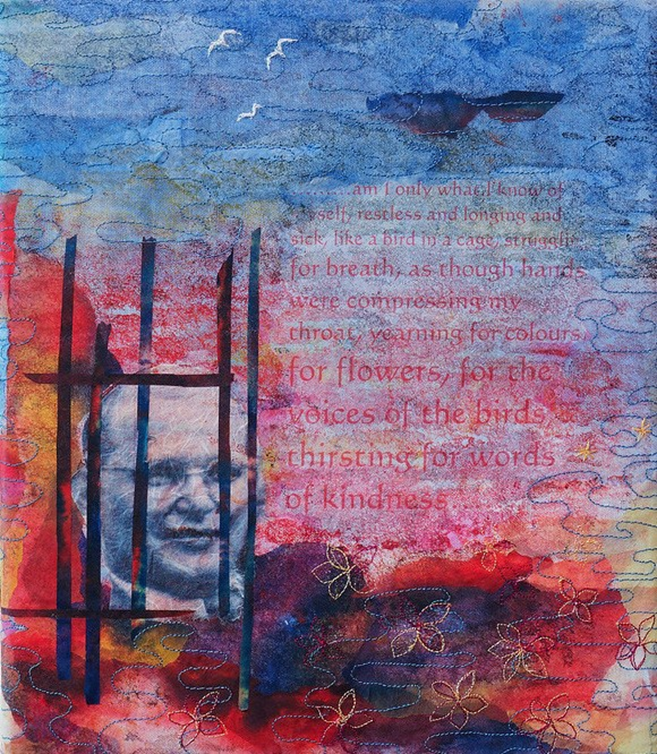
In March 1943 the conspirators made two attempts on Hitler’s life while he visited the eastern front, but both miscarried. This led to the arrest of many members of the Abwehr network, including Bonhoeffer and his brother-in-law. Any lingering hope of release disappeared in the summer of 1944, after the failure of yet another assassination attempt, and Bonhoeffer was moved to the high-security SS prison in central Berlin. And yet for most of his two-year imprisonment, he was allowed to correspond with friends and family, and to work out his thoughts in writing. These were the works which were later collated by Bethge and published as Letters and Papers from Prison. The end came in April 1945. By this time, as Germany was overrun by Soviet armies in the east and American and British armies in the west, Bonhoeffer and other members of the Abwehr network were moved repeatedly from one prison to another, including three months in Buchenwald concentration camp. In the first week of April, it seems that new evidence about the network came to Hitler’s attention, and he personally ordered that all prisoners associated with it should be executed. Bonhoeffer and others were quickly tried and condemned by summary court martial. He was hanged on 9th April 1945, just a month before the Nazi collapse and Germany’s surrender. He was aged 39.