
Contents
Articles
- On Mysticism, Mundane and Sacred
- Religious Experience and Theological Realism, Paul Badham
- Miguel de Unamuno: "A Reasonable Faith" is a Contradiction in Terms, Joanna Dales
- Towards a Postsecular Society, Mike King
- Christianity Without Words, James Hart
- Mysticism and Psychology, Janet Taylor
- Postscript: From Doubting to Doing, John Gamlin
Reviews
- Philip Knight gives an extended review of The Predicament of Postmodern Theology, Philip Knight
- Chris Mearns reviews A Reason for Living and Hoping, Chris Mearns
- Ian G. Williams reviews Islam: The Struggle for True Religion, Ian G. Williams
- Janet Trisk reviews Christianity Without God, Janet Trisk
- Andy Kemp reviews "To the Glory of God: New Religious Art", Andy Kemp
Poetry
- Poetry Corner: Savitri (extract), Sri Aurobindo
- Poetry Corner: edge of god sequence, Rosie Miles
Regulars and Occasionals
- Radical Theology Series: Part 3 - Soren Kierkegaard, Trevor Greenfield
Editorial
Joanna Dales is a member of the Yorkshire Group of the Sea of Faith and works part-time in her retirement with the University Chaplains at the University of Leeds. She admits that she ‘began to be obsessed with Unamuno’ when studying Spanish and philosophy simultaneously and needed a subject for a Spanish essay. the Steering Committee ‘to initiate a study on the allowability of doctrinal diversity within Christianity, in the context of religious faith as a human creation. The purposes of the study are to assist the Network in defining its position regarding situations where a religious tradition one of its members or representatives. The study should include both research and consultation with SoF members.’ To enable this consulatation, In summer, the SoF (UK) Network AGM asked inform the Network's views on this subject and to formally questions the acceptability of the views of the March edition (57) of the magazine shall be given to some preliminary papers, to invite discussion.
The May edition (58) will be "SoF approaches to Death and Dying", for which it is hoped to include a diversity of considerations ranging from biomedical ethics and liturgical rites to bereavement counselling. Papers are invited for the May next issue of the magazine by 25th March.
Please telephone (in the evening) or, preferably, email the Editor if you might have something in mind for either of these issues. sof 57 January 2003 Towards a Post-secular Society Mike King considers critiques of the secular that have opened again questions of the sacred.
Oliver Essame Letters’ Editor SOF Gospel Hill Cottage, Chapel Lane, Whitfield, Brackley NN1I3 5TF e-mail to oliver@essame.clara.net When I am asked "What is the Sea of Faith about?", I find it very hard to give a succinct answer.
Where are we going? Are we just a talking shop? As a short-term measure, that might suit some — me for one, since I have many questions and few answers.- But in the long run, if that is all we are, the Sea of Faith will eventually fizzle out. We need a raison d’etre, beyond Being: a.focal point for those who are seeking "The Truth".
It is difficult, with so diverse a membership, to arrive at a consensus as to what might be. our goal — and goals can be dangerous anyway. But perhaps our very diversity can be our strength.
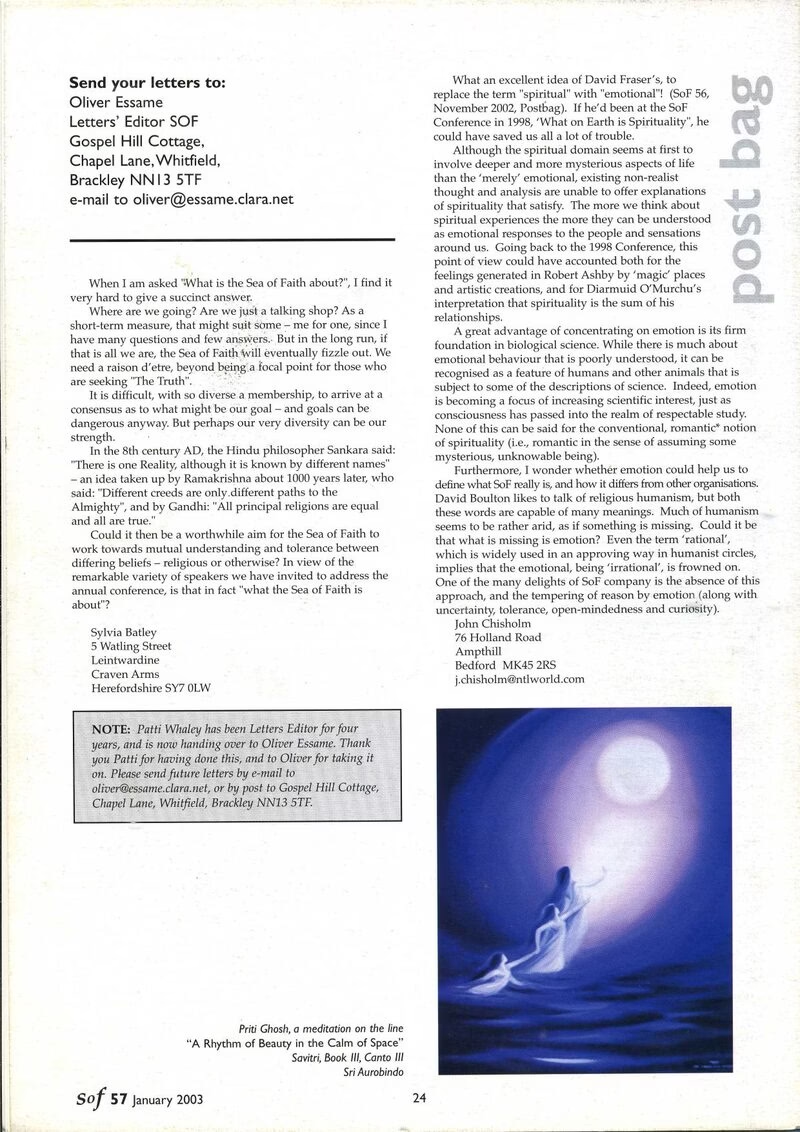
In the 8th century AD, the Hindu philosopher Sankara said: "There is one Reality, although it is known by different names" —an idea taken up by Ramakrishna about 1000 years later, who said: "Different creeds are only.different paths to the Almighty", and by Gandhi: "All principal religions are equal and all are true." Could it then be a worthwhile aim for the Sea of Faith to work towards mutual understanding and tolerance between differing beliefs — religious or otherwise? In view of the remarkable variety of speakers we have invited to address the annual conference, is that in fact "what the Sea of Faith is about"? - Sylvia Batley 5 Watling Street Leintwardine Craven Arms Herefordshire SY7 OLW Priti Ghosh, a meditation on the line “A Rhythm of Beauty in the Calm of Space” Savitri, Book III, Canto III Sri Aurobindo sof 57 January 2003 What an excellent idea of David Fraser’s, to replace the term "spiritual" with "emotional"! (SoF 56, November 2002, Postbag). If he’d been at the SoF Conference in 1998, ‘What on Earth is Spirituality", he could have saved us all a lot of trouble.
— Sylvia Batley, Leintwardine, Craven Arms, Herefordshire
Although the spiritual domain seems at first to involve deeper and more mysterious aspects of life than the ‘merely’ emotional, existing non-realist thought and analysis are unable to offer explanations of spirituality that satisfy. The more we think about spiritual experiences the more they can be understood as emotional responses to the people and sensations around us. Going back to the 1998 Conference, this point of view could have accounted both for the feelings generated in Robert Ashby by ‘magic’ places and artistic creations, and for Diarmuid O’Murchu’s interpretation that spirituality is the sum of his relationships.
A great advantage of concentrating on emotion is its firm foundation in biological science. While there is much about emotional behaviour that is poorly understood, it can be recognised as a feature of humans and other animals that is subject to some of the descriptions of science. Indeed, emotion is becoming a focus of increasing scientific interest, just as consciousness has passed into the realm of respectable study.
None of this can be said for the conventional, romantic* notion of spirituality (i.e., romantic in the sense of assuming some mysterious, unknowable being).
Furthermore, I wonder whether emotion could help us to define what SoF really is, and how it differs from other organisations.
David Boulton likes to talk of religious humanism, but both these words are capable of many meanings. Much of humanism seems to be rather arid, as if something is missing. Could it be that what is missing is emotion? Even the term ‘rational’, which is widely used in an approving way in humanist circles, implies that the emotional, being ‘irrational’, is frowned on.
One of the many delights of SoF company is the absence of this approach, and the tempering of reason by emotion (along with uncertainty, tolerance, open-mindedness and curiosity).
— John Chisholm, Ampthill, Bedford