
Contents
Articles
- What Are We For?
- A Mess of Postmodernism, Dinah Livingstone
- Eve's Legacy, Helena Woddis
- Lies and Secrets, Wendy Perriam
- Sea Change, Michael Elliott
Reviews
- Market Whys and Human Wherefores, by David Jenkins, Monica Furlong
- C of E - The State It's In, by Monica Furlong, David Jenkins
- Passion Play: David Boulton at the Opera, David Boulton
Regulars and Occasionals
- Dot Comma: The Great Disruption, David Taylor
- Beachcomber: How I Wonder What I Know, Alison Webster
- Dot Comma: The Sacred Depths of Nature, Alan James
- Dot Comma: New Book Notices
- Postscripts, Seafarer
Editorial
Sorry, but the third in our series quoting from early issues of the magazine has been held over.
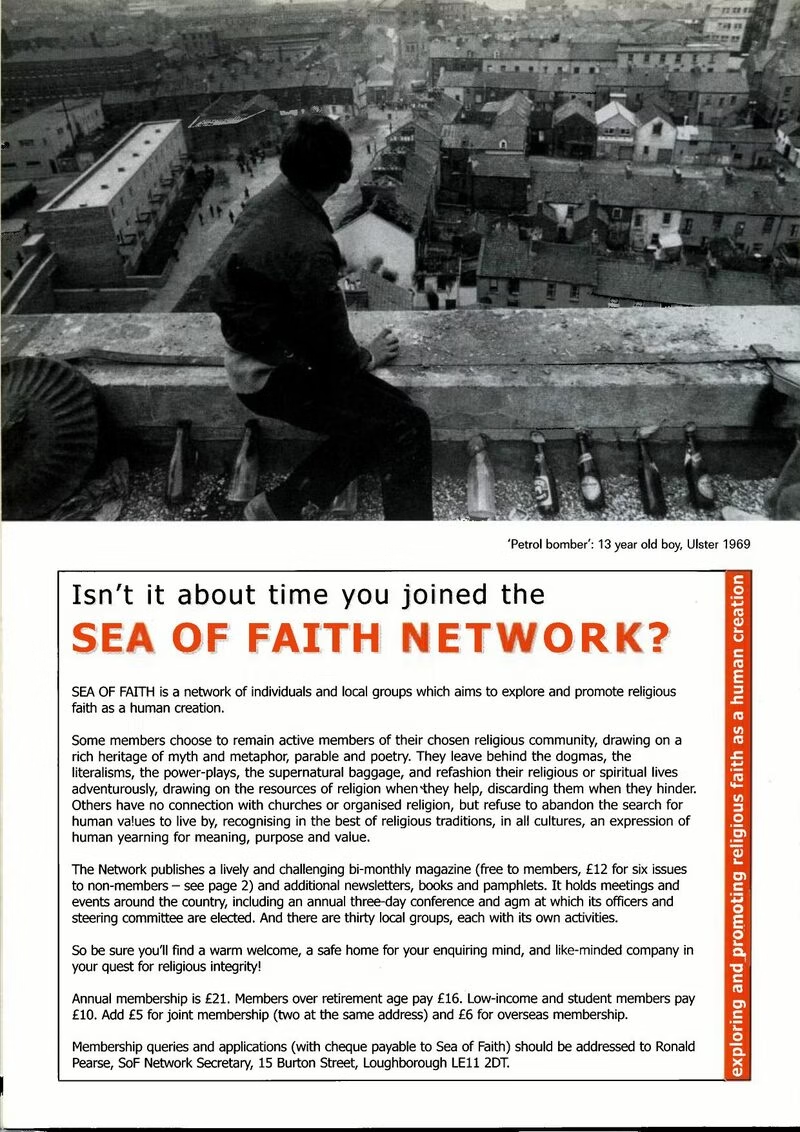
It is risky to write about Northern Ireland. Even that simple sentence will provoke complaints that “Northern Ireland” should be Ulster. And to call it Ulster will bring reminders that Ulster consists of nine counties, only three of which are north of the border. To call this the Irish problem is to rouse the wrath of those in Ireland who have lived for centuries with the English problem. Then there’s the risk that to write anything about “the troubles” or “the peace process” is likely to be out of date before the ink dries - particularly when, as is the case here, three or four weeks will elapse between the writing and the reading.
Both risks are the greater as the marching season gets under way, as the flags and sashes and lambegs come out to play, as the Assembly doors open and close and open again, as the decommissioning of guns on the lips. and semtex is promised and unpromised, as concession to orange is counterbalanced by concession to green, as the Good Friday (!) agreement is subjected to more intensive textual criticism and creative reinterpretation than the Dead Sea scrolls.
But I'll risk it.
Whenever a pub atheist or wine-bar humanist wants to knock religion, particularly the Christian religion, the words “Northern” and “Ireland”, usually in that order, are quick to form on the lips. Isn’t it religion which is at the bottom of it all? Catholics and Prods at each other’s throats. Holy war. As it was in the beginning, is now and ever shall be...
I first visited Belfast in 1969, to report on the Apprentice Boys’ parade in Derry /Londonderry which resulted in ten days of mayhem, put the army on the streets, and led to the decline of the old IRA and the rise of the Provisionals. I spent much of the next five years filming there. I sat in Paisley’s church as he sang in his own inimitable roar, “there’s power in the blood, power in the blood”. I listened as the triumphalist flute bands played the chorusses I had learnt at Crusader Bible classes, now with the accompaniment of the lambeg drum’s repeated crack of doom. Ancestral voices prophesying war... flags and drums Whenever a pub atheist or wine-bar humanist wants to knock religion, particularly the Christian religion, the words “Northern” and “Ireland”, usually in that order, are quick to form editorial Hobsons Farm, Dent, Cumbria LA10 5RF I researched and wrote a book, The UVE, 1966-73: an Anatomy of Loyalist Rebellion, which documented Paisley’s role in the paramilitary Ulster Protestant Volunteers, and his inflammatory influence on the terrorist Ulster Volunteer Force. And the more I saw of religion in Northern Ireland, the more certain I became that religion was not the prime cause of all the trouble.
First and foremost, it was about land and conquest. England had conquered Ireland and “planted” its own English and Scots settlers on the most fertile and productive land. The native Irish were driven to the barren hills. Having seized land, the settlers seized power. When their power was challenged, rebellion was put down. When rebellion succeeded in the south, the settlerhomelands in the north were annexed in a forced partition.
Native Irish in the north were gerrymandered out of civic power, discriminated out of the best jobs, demonised by a police force drawn almost exclusively from the conquering tribe, and made second-class citizens in their own occupied country. This wasn’t just ancient history: this was now.
Was religion not involved in this? Of course it was, but it’s role was secondary. No-one fought over doctrine. No-one was killed for transubstantiation, or knee-capped for the priesthood of all believers.
But what happened was that religion became a badge of identity, a banner under which a complex of historical and cultural phenomena could unite, and, above all, a means of imparting a spurious moral legitimacy to the power struggle: a power struggle which would have raged no less bloodily if religion had never been invented.
Small wonder, then, that the churches in Northern Ireland - with a few honourable and brave exceptions - have proved so slow, inadequate and out of their depth at structural peace-making.
But if “Catholic” and “Protestant” are tribal rather than religious badges in Ireland, that doesn’t mean that the peace process must necessarily lack any spiritual, moral or humanitarian dimension.
Hugely intractable problems like Ireland - or Israel, or the Balkans - are not God’s fault.
F PA the Importance of é' Being Human (Primrose Cottage, 16 Clay Lane, Wendover HP22 6NS, £5), in which he asks the big religious questions and offers nonreligious answers. And Lloyd Geering has produced a new book, THE WORLD TO COME: From Christian Past to Global Future, published in New Zealand and the USA but available in the UK from Ronald Pearse, 15 Burton Street, Loughborough LE11 2DT at £12 plus £1.50 p&p. the world to cor ireasure Anthony Freeman SOF 42 / July 2000 postbag Credo quia absurdam I am delighted that the Jesus Seminar has come to this benighted country. Robert Funk’s lecture tour will bring scholarly substance and rigour to our exploration of religion as a human creation. The Seminar’s activities will also have the beneficial effect of helping to destroy belief in God, all the more so because I suspect this is far from their intentions.
But there is one element of their consensus with which I have to differ, not on grounds of fact but of faith. They hold that, on a balance of probabilities, Jesus Christ, while a utopian visionary, did not expect supernatural intervention to fulfill that vision. That is to say, while he preached social justice and peace on earth, this was to come about by overcoming social distinctions and the practice of voluntary poverty by the rich; fear of the wrath to come should play no part in the process.
But it is precisely because these are my own ideals that I feel I cannot ascribe them to Jesus; it would be sensible to assume that if I make Him in my own image I am likely to be wrong. It would be prudent to take a “worst case” scenario — a Jesus J disagree with but still believe in. We do this in ordinary human relationships; if you can see your lover at their worst and still love them, you have a good chance of a substantial relationship. So my Jesus is to modern eyes a ludicrous figure, a poor deluded fanatic who thought the end of the world was imminent, and that Divine Power would assist his “two swords” (Luke 22:38) to overthrow Roman rule. So with Tertullian I say “Credo quia absurdam!” PETER LUMSDEN 23D South Villas, London NW1 9BY An unrealistic Jesus?
— Peter Lumsden, London
While I am with Dan Cohn-Sherbok on most of what he said (SOF No.41, in the text of his Jesus Seminar address) about the theology /Christology of the church, I cannot accept his view of the moral teaching of Jesus.
Of course it is unrealistic, but all ideals and all moral teachings are like that, and eventually they smash into the brick wall of reality. Of course people fail to live up to their moral standards. Everybody does, and Jesus understood this.
The UN Declaration of Human Rights is surely the most laughably unrealistic document ever produced, and yet its ideals represent some of the most sublime values that humanity has ever come up with, and God help us if humanity ever loses sight of its moral light.
Moral values/teachings are there to spur us on to action, 1 SOF 42 / July 2000 convict us when we fail and encourage and inspire us when the going gets tough.
Loving neighbours and enemies does not mean allowing them to do whatever they like. It would not be in their best interests, let alone anybody else’s, to allow them to perpetrate evil deeds. It means seeking what we see as the best for all those with whom we come into contact.
Refusing to class anyone as our irredeemable enemy or to take away their humanity, no matter what they do, yet also protecting them from themselves and others from them if necessary.
Forgiving someone does not take away their humanity, but reaffirms ours; neither does it remove from them the responsibility they have for their actions. Rather it shows that better is expected of them because they are human, like us.
Selfless love might be a tough and unrealistic ethic, and it might be risky, yet it has more power to inspire and activate than any “exchange rate” ethic. But more than that, it can be contagious and life-transforming.
BriAN C. SIMONS 17 Eva Road, Gillingham, Kent ME7 5NE What Jesus really meant I found the speech by Rabbi Dan Cohn-Sherbock to the Honest to Jesus conference to be a fair account of why most Jews do not regard Jesus as either the Messiah or part of the godhead. However, when he-goes on to talk about Jesus’ ethical teaching, I think he perpetuates a mistake which is frequently made by Jews, Christians, politicians and do-gooders.
— Brian C. Simons, Gillingham, Kent
Living as they did under a brutal dictatorship, the followers of Jesus will not have been starry-eyed about human nature. They were used to demanding rulers and Draconian penalties, and in the parable of the talents and his injunction to “render unto Caesar the things which are Caesar’s”, Jesus teaches his followers that obligations have to be met. As regards Jewish law, he could not have been more explicit in saying that he had come not to make the smallest change, but to fulfil it.
Every thinker and every leader is in dialogue with those who went before. We have four canonical and a number of other gospels because each writer was in dialogue with his predecessors and wished to correct their emphasis. Jesus was striving to correct a Judaism which had become orthopractic and obsessed with observing the minutiae of the law even when this endangered social justice and, in his view, their own salvation. What he was seeking to dowas to broaden their horizons using paradoxes and hyperboles. Since it is obvious that any society which rewards thieves and has no thought for the morrow would not survive, these injunctions could not possibly be understood as rules for living. What Jesus meant is that although the law says this to you, the kingdom of God can sometimes require you to go further — to go the second mile.
I once had a secretary who was the daughter of a Rabbi.
One day when she was being gently teased about Jewish attitudes, she laughed and said “You know, when a Jew dies the first question that God asks him is ‘Have you bought and sold in good faith?” This astonishingly transactional criterion of the value of a life is fully borne out in our present Rabbi’s speech when he says “We should act so that in every relationship there is an equal rate of exchange”. For all its faults, Christianity has offered to the world a much bigger and more inspiring vision of what human nature can be.
I agree that we need to rediscover the importance of mutual obligations in society. I agree that handing out money for nothing, as does the modern welfare state, can objectify, dehumanise and demoralise the recipients. What has gone wrong, surely, is that the teaching of Jesus has been taken out of its context. If this conference speech can be seen as reminding us of that context, then it will have made a valuable contribution.
ROBERT NAPIER robnapier@lineone.net Pray for the prey How far should we try to follow Jesus? I appreciated the article by Rabbi Dan Cohn-Sherbok. The love of Jesus includes: Love thine enemies as thyself; Forgive all unconditionally, without any reciprocity; Sacrifice oneself for others or for a cause; The meek shall inherit the earth.
— Robert Napier
Cohn-Sherbok argues that only rarely have these precepts been followed and then perhaps in a community isolated from the social world. In human relationships mutual concern and reciprocity are best carried out with an “I-thou” relationship (Buber) between autonomous moral agents. The approach of Jesus tends to distort this relationship and diminish the other to be an object of our concern or charity, or “T-it”.
Most of us are unable to fully follow the standards of Jesus and it is hypocritical to pretend that we can or that we should. Care and love have to be integrated with survival and creativity urges. The Amerindian prays for the soul of the prey that is necessary for him to eat. In nature there is both competition and co-operation.
DaviD STRACHAN david@davstrac.freeserve.co.uk A home for doubters I greatly enjoyed the SoF conference “Honest to Jesus” (Manchester, 1 April). Robert Funk’s talk was inspiring.
— David Strachan
No, I never want to trust old certainties. I want always to be enlarging my understanding of truth. Dan CohnSherbok’s talk was thought-provoking. Rabbis deny that Jesus was the Messiah, but many respect his ethical teaching; Cohn-Sherbok does not. “Love your enemies” is wrong, as it treats them like children. Treating them as enemies accords them respect.
Nevertheless, I thought, is SoF too open? Now you have got rid of the Creator God, if Cohn-Sherbok disposes of Christian ethics, you have nothing. I saw SoF as children huddling together for warmth, in an unknowable, unfriendly darkness. Initially I came away thinking SoF a bad thing. Christians of all times and places have doubts.
With God’s grace they may work through doubt to an enriched faith — unless they join Sea of Faith.
But now I think, it is so lonely when you reject God, that the Lord has inspired Sea of Faith as a solace, a home for His suffering children. He has found a home for you, just as He has found one for me.
ABIGAIL G. MARSHALL 74 Brierley Street, Chadderton, Oldham OL9 6RR Unclear Despite its bright new presentation, the May 2000 issue of SOF was the first (and only) one that I have not enjoyed. I missed the letters page - the thing I enjoy most in any magazine. I did not appreciate the repellent cover picture and the photographs, some of which I found positively vulgar. Having heard Dan Cohn-Sherbok’s excellent address at first hand, I didn’t need to re-read it.
— Abigail G. Marshall, Chadderton, Oldham
My real problem was Alison Webster. I am not stupid, but I found her article (“In Search of Startlement”) a struggle. Perhaps it is her style, since I am one of those to whom she condescendingly refers as “intriguing”, who failed to see the point of her miracle story at last year’s conference.
Monica Furlong describes Don Cupitt as “trying to talk to me and others like me, not conducting a conversation from which I am carefully excluded. He is conducting a dialogue, not a monologue” (“Don Cupitt as the joker in the pack”, SOF, May 2000). Alison’s article, on the other hand, is a monologue; she seems to be talking to herself and to “clever” people like herself.
I prefer writing and speaking that is simple, direct, and straightforward. I, the reader, would like to be treated with some consideration. To take the trouble to write in such a way that one can be understood is essentially to show respect for the reader. (Dr) ROSEMARY ARTHUR 27 Barnes Avenue, Wakefield WF1 2B] david@arthur56.freeserve.co.uk Trivial The SOF magazine for May said you were looking to provide “an even more youthful contemporary and appealing look...to con readers into thinking the average age is under 50”. May I suggest the figure printed should have read 15, not 50? I felt driven to string together some expressions like: tabloid journalism, dumbing down, tasteless, sensationalist and, above all, trivial. With so much wallowing in the past (your expression) not to mention SOF 42 / July 2000 blank space, shouting headlines and mindless pictures, it’s hard to see why you needed to drop readers’ letter.
— Rosemary Arthur, Wakefield
SOF for me is the magazine; there is no group where I live. Perhaps I’m one of a tiny minority which you don’t mind losing, but if the magazine is to continue like this I shall most certainly, though with regret, discontinue my membership.
— John Saban, Landkey, Devon
JOHN SABAN 2 Valley View, Landkey, Devon Ex32 OLW Triumphalist Once more the editorial (“Hell and Damnation”, SOF No.41) has brought me to the brink of resignation. It’s the simple-minded triumphalism that does it. A dishonest triumphalism too, with the best of one position set against the worst of the other. Multitudes of Christians no longer “believe in Hell” in the way lambasted. I imagine, and certainly hope, that many others in the Sea of Faith are not as cocksure about the alternative in the editorial.
Is there no place for the genuine seeker who hasn't yet arrived — does one ever? — but is humbly getting along with such truth as seems still to be vouchsafed in Christian practice and experience when sensitively and relevantly renewed for the present age? Why jeer? the editorial’s own alternative footing for faith, even if offered in “new words”, doesn’t seem too convincing and certainly isn’t incontrovertible. And anyway, apart from making a slick ending, what's the point of finding new words if there is still meaning to be extracted from the old?
— William Spray, Marlborough
WILLIAM SPRAY Windhover, Manton Down Lane, Marlborough SN8 1RP No F-word I like the new-style mag and the new SOF name. It avoids people being unnecessarily put off by the F-word, and lots of magazines are going for initials only for a more general image. Best wishes!
— John Chisholm, Ampthill, Bedford
JOHN CHISHOLM 76 Holland Road, Ampthill, Bedford MK45 2RS Cheering I only wish I had come on the Sea of Faith earlier. It is heartening to find expressions of doubt being voiced so helpfully. There’s a quotation from Graham Greene’s Monsignor Quixote: “It’s odd, he thought, how sharing a sense of doubt can bring men together perhaps even more than sharing a faith. The believer will fight another believer over a shade of difference; the doubter fights only himself.” Thank you for such a very helpful, cheering magazine!
— Mark Harvey, Sinnington, York
MarkK HARVEY The Limes, Sinnington, York YO62 6RZ SOF 42 / july 2000 Ex cathedra The new magazine is absolutely brilliant - and not just the design. As ever, there was more I wanted to read than I could at its first appearance from the envelope: a wonderful mix of the quick and browsable to the slow and reflective. I’ve been looking through all the old magazines, and the huge changes it has undergone in forty editions is staggering - and inspiring.
— Stephen Mitchell, Barrow-upon-Soar, Leics
STEPHEN MITCHELL 27 Cotes Road, Barrow-upon-Soar, Leics. LE12 8]P Faction Does it make a difference whether something happened in fact, or not? Surely it does. The millions who died in Auschwitz and the other death camps, and their relatives, cannot share David Irving’s view that these deaths are “fiction” . Did the Jewish crowd at Jesus’ trial before Pilate say “His blood be on us, and on our children” (Matthew 27:25)?
Did Jesus in fact say of the Jews, “Ye are of your father the devil” (john 8:44), and was the speaker of these words Incarnate God when he spoke?
It made and makes a difference, as the victims of the Shoah can testify.
PS: I much enjoyed the current (May) issue (especially Dan Cohn-Sherbok’s article), although I disagreed with much of it.
But as Blake said, “Opposition is true friendship”!
FRANK WALKER 59 Barton Road, Cambridge CB3 9LG Ugly is beautiful I'd like to put in a word for Grouches, Grumps, Sourpusses and Ugly Mugs. We have had a bad press for thousands of years from literature and folklore and art.
— Frank Walker, Cambridge
The convention is that the lovely young smiley-face girl/boy is the hero/heroine. J appreciate that this is a very deep archetype within our psyche, probably linked to Darwinian sexual selection, but I question its truth. From my observation of the world around me I note that people who engage in extremely unattractive habits are by no means friendless and socially isolated. How many times have I heard of a court case where young Darren or Wayne is up for GBH and intimidation but his many friends in the gallery cry vehemently of his innocence? I would further point out that “Uncle Joe” Stalin in old newsreels does look splendidly avuncular, General Pinochet looks like a kindly old Granddad and Dr Shipman looks just like that very kind maths teacher who took the trouble to explain to you how algebra works.
I know that beauty has intrinsic value, and I note that most people would rather have their lives trashed by a scintillating beauty, than nurtured by a dullard. One last point from an Ugly Mug: why am I bad tempered and cantankerous if I lose my temper but the likes of Naomi Campbell or Jerry Hall, should they do so, are “tempestuous and challenging”?
JANE BAKER 17 Gorse Hill, Fishponds, Bristol BS16 4EG postscripts Thumbs up? thumbs down?
— Jane Baker, Fishponds, Bristol