
Contents
Articles
- Fresh Blood in the Sea of Faith, Nell Boulton
- A Bluffer's Guide to Non-realism and All That, David Boulton
- Bringing Religion Down to Earth, John Hodgkinson
- Friends, Faith and Humanism, Don Cupitt
- Freethinking Christians, David Dulley
- Holy Sites in an Unholy Age, Richard Bartholomew
Reviews
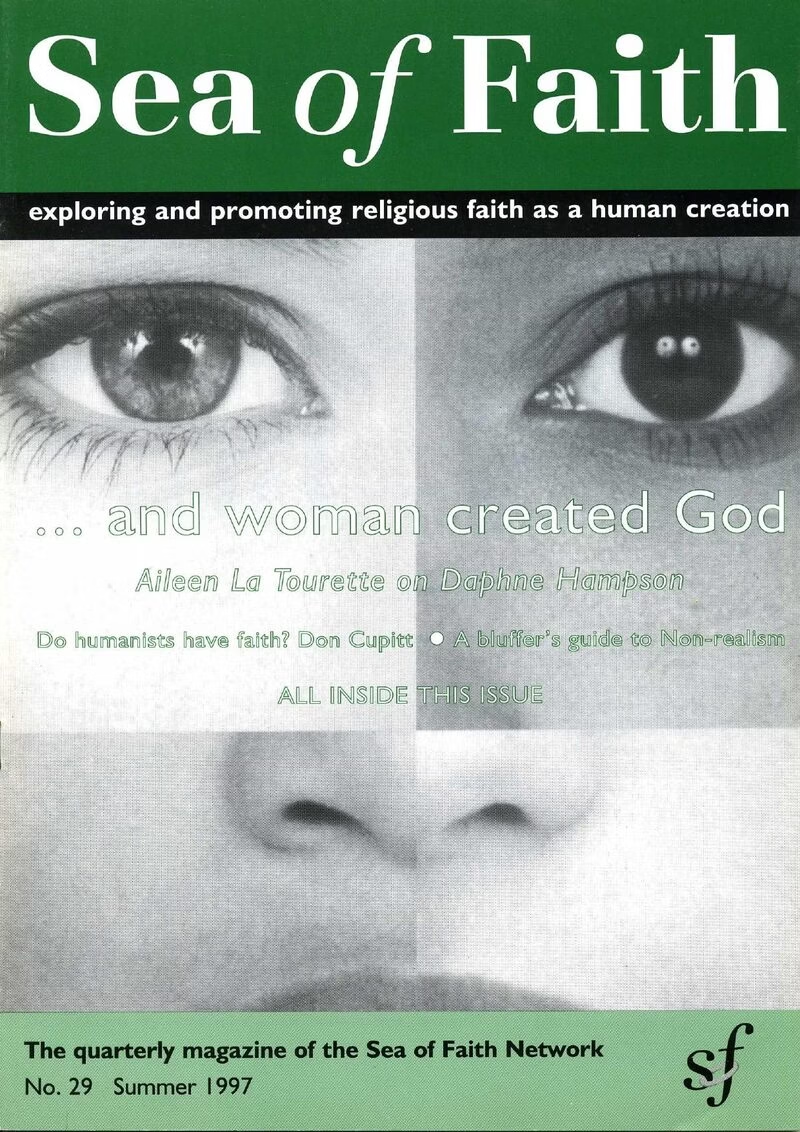
- And Woman Created God, Aileen La Tourette
Regulars and Occasionals
- Postscripts: St Tony, Seafarer
Editorial
And now we -— the Network — are ten. Or are we? Next month’s conference is our tenth — which I suppose actually makes us nine. Or are we 13, as the first Sea of Faith group met in Loughborough in 1984, the year of Don Cupitt’s TV series? Or maybe we are only eight, as the Network itself didn’t get going till 1989. Perhaps we still have a couple of years to wait for our knees to be covered and our awkward buttons to mature into Zips.* But let’s not be pedantic. Truth, we keep telling ourselves, is what we make it, and we can be 8, 9, 10 or 13 as we choose. Whatever, we do celebrate our tenth conference next month, and that’s as suitable a time as any to reflect on where we've come from, where we suppose we are, and where we think we are going.
Let’s start with the plusses.
Today, the “Sea of Faith view” is to be found within liberal Anglicanism, radical Catholicism, progressive Quakerism and all but the most fundamentalist of the nonconformist churches, as well as in liberal Judaism — and, of course, in the “secular” Humanist movement itself *Apologies to women for all this laddish imagery.
Try reading bra for long trousers. Or just stay with inclusive zips.
We have created and sustained a Network that provides a precious fellowship for thinking and caring men and women who know that supernatural “revealed” religion is no longer available, but who refuse to abandon the human values which the poetry and imagery of religion once enshrined. If We had done nothing more than provide a safe house for honest doubters, a haven for religious free-thinkers and a spiritual home for radical free spirits, our efforts together would have been well worthwhile.
We have made our non-realist or humanist approach to religious faith a lively challenge within the religious mainstream. Ten years ago there was no significant humanist tendency within any of the main churches or faith institutions. Indeed, “humanism” was the enemy. Today, the “Sea of Faith view” is to be found within liberal Anglicanism, radical Catholicism, progressive Quakerism and all but the most fusdamentalist of the nonconformist churches, as well as in liberal Judaism — and, of course, in the “secular? Humanist movement itself (but we are all secular in the literal sense of the word: of this world, and this age). Our approach is reviled, distorted, damned (sometimes with faint praise), but no longer ignored.
And we are no longer just a talking shop. We have begun (slowly) to develop our own body of literature to supplement the books and pamphlets our gifted writers — Cupitt, Freeman, Hart — have produced for the commercial publishing houses. We have our first special-interest commissions, on religious education, on youth, up and running (well, walking, and preparing to break into a trot). We are solvent. We are making waves that won’t be stilled. We are not going to go away.
But before we get too complacent...We have stopped growing.
Three years ago, marking our fifth (or seventh, or tenth) birthday, I wrote in One of those early Sea of Faith Steering Committee meetings. Note the rudimentary ‘logo idea’ sketched on the wall an editorial: “Add Network membership, magazine readership, local group subscribers and _ overseas groups...and we are pushing the thousand mark”. Well, we are still pushing the thousand mark. Scores more join us each year — but scores leave or fail to renew membership. For some, no doubt, we prove to be not what was expected: too religious, or not religious enough; too “intellectual” and plain boring, perhaps; or just too remote from real life and the real world. For some, we prove a convenient transit from religion to secular humanism — and that’s an honourable service. But it is clear that for many — including innumerable men and women who wholeheartedly share our view of religious faith as a wholly human creation — we are not yet doing the business. And that’s our problem and our failure. ebration cake at Leicester. But if we hope to have another slice in ten years’ time, we'll have to start taking seriously our declared commitment to promote the Network’s aims.
It won’t do just to leave it all to the Don with the luminous prose! We have to have the courage to risk causing offence in our churches, meeting houses and institutions. We have to explain, clearly and courteously, but honestly and without weasel words, what we mean when we say religious faith, spirituality, truth and beauty, good and evil, gods and demons are human creations. And we have to go on with equal clarity to say why the death of God and the bankruptcy of I: be among those sharing the cel- institutionalised religion, the unmasking of supernaturalism and superstition (whether called “faith”, or “spirituality’, or “the transcendent’), far from rendering life meaningless as the traditionalists claim, actually makes human meaning and human value possible.
Many of us have a horror of proselytising, perhaps because so many of us had to struggle to escape from evangelical traditions. But we have to overcome the horror. We have to grow up. If we ourselves feel liberated by our realisation that we are wholly human, that the gods reside in our breasts and not we in theirs, that God is love, that the values enshrined in our great religious myths are wholly human, made by us and by us alone in the holy communion we call fellowship, won’t we want to share the glory and the dream with others?
Freed ourselves from the Jehovahs and the Lucifers, from the miraclemakers and the Mystic Megs, don’t we want to help free others? Well don’t we?
I hear it said that, well, perhaps it’s okay to promote Sea of Faith views, but not the Sea of Faith Network. This doesn’t make sense. Which way would the landslide have gone if Tony Blair had promoted social democracy but not New Labour? Of course we must never allow ourselves to promote the Network just for the sake of numbers. But nor must we allow our English middle-class diffidence and reserve to keep our lights safely hidden away under bushells.
We've got something going over these last few years. We have challenged the irrational, and the irrational has begun to notice. As our challenge grows, so will the backlash.
But reliance on saviours from on high is not only risible, it is dangerous. It belongs to the dark ages. So let’s say so, and be ready to take the flak. “Exploring and promoting religious faith as a human creation”: that’s what we set out to do ten (or eight, or thirteen...) years ago. We’ve hardly started a “As our challenge grows, so will the backlash. But reliance on saviours from on high is not only risible, it is dangerous. It belongs to the dark ages. So let’s say so, and be ready to take the flak.” In brief...
May I congratulate you most sincerely on Sea of Faith’s new layout. Even my wife, who before used only to glimpse-read it, read the whole thing from cover to cover and was very impressed!
This coming from an extremely critical OU-educated student was, believe me, quite some compliment.
— Derek Chorley, Shepton Mallet, Somerset
It really does look splendid. It makes one proud to be a member of Sea of Faith.
— Stephen Mitchell, Barrow-upon-Soar, Leicestershire
Good appearance, content, editorial, Postscripts, illustrations, layout, typography (Graft Publications are quite a find), with Jude, Bishop Jack, Lorna and yourself all in top form. Great achievement. I'll show it to as many as I can to encourage those subscriptions.
All this and The Faith of a Quaker Humanist too!
Slow up man!
— Adrian Cairns, Henbury, Bristol
Congratulations on an excellent magazine! My own piece isn’t worthy of this! I'm very impressed indeed and want to say so.
Right away.
— John MacDonald Smith, Norton, Evesham, Worcestershire
Congratulations on the new-style Sea of Faith magazine. Nearly all the articles spoke to me where I am at, and the two exceptions (John MacDonald Smith and Loma Marsden) contained much of interest, so you have probably got the balance right, for me at least. | failed to see much of significance in the pictures, especially the one on the back page, but then I rarely do!
— Harold Yardley, Newcastle, Staffordshire
I have just finished reading your magazine — almost every word. It’s great!
On a limited budget you do a wonderful job. This last issue was very readable, but — You include six or eight articles, each one reviewing and renewing your objectives. Most laudable, but what is needed is at least one lighter article, and given the contradictions involved in your subject — God — it shouldn’t be hard for one or two of your “intellectual” members to produce something.
At present it is strictly business.
Something with a little humour is needed to make one laugh. Think it over.
— JF, Toronto, Ontario, Canada
I should like to congratulate those involved in the new presentation of the magazine. It shows the progress made over ten years from modest beginnings. I should further like to comment on three of the contributions in this issue. 1. The comments made by Seafarer in praise of the antics of the road protesters, specifically Animal and Swampy, in the final paragraph appalled me. I was shocked to read such nonsense praising these anarchists and lawbreakers. I dislike sharing membership with a person who thinks these activities are a cause for celebration rather than criticism.
These professional protesters waste time and money, causing danger and trouble for those who have to deal with them. These troublemakers have no idea of local conditions which may necessitate a bypass to prevent once attractive towns being gridlocked for a couple of hours at every rush hour.
Perhaps they should get a job and do an honest day’s work, thus contributing to the country instead of taking from it. 2. The article by Lorna Marsden makes a common mistake in trying to use scientific theories to make her points without understanding the application of these theories. The Uncertainty Principle, proposed by Heisenberg in 1927, involves a universal constant so minute that the limitations imposed by the principle are significant only in the realm of the atom.
To try to make it apply in the way suggested in the article implies a lack of understanding of basic physics. The same dangers apply to the attempt to use quantum theory in areas where at present it has no relevance. It is notable that no references are given. It is perhaps an example of the quotation from Pope about “a little learning...” 3. Perhaps John MacDonald Smith could write a new version of his article in Noddy language for people of only average intelligence like me. I do not understand what point he is making because for me his language failed to communicate his thoughts. (What is Thomism anyway?). For example, where are the references and evidence for describing the big bang theory as dubious? There have risen from time to time fears that SoF was becoming so intellectual that its ideas were inaccessible to the average person. I wonder if this is beginning to happen again. | may be sticking my neck out but I suspect that many members would not totally disagree with this. I recommend to contributors of articles such as those mentioned that they should read the works of writers such as Medawar, Feynman, Dawkins whose writings are models of the literary art as well as the art of clarity in communication.
— Keith Bamford, Eldwick
The content and layout of the Spring issue is excellent, but I wish to take issue with “Seafarer” in his/her section on “Taking leave of Mystic Meg”.
I agree that most New Age mysticisms and cults do indeed “feed...the credulity of the naive, the under-educated and the wilfully blind”, just as the monotheistic world religions do, albeit in a slightly different way or with a different presentation. But can such mystic cults not be just as useful as any religion as long as they are seen in the same light of non-realism as that proposed by the Sea of Faith for Christianity and the other monotheistic religions?
As a nurse and training psychotherapist I do object to the inclusion of reflexology and aromatherapy alongside such clearly esoteric pursuits as ghost-busting and communication with aliens.
They are clearly of a completely different order and many people, both practitioners and clients, will attest to the very real benefits in health and well-being which aromatherapy and reflexology can bring. They are not quack remedies and it is insulting to alternative health workers to include these therapies in a list of what is somewhat condescendingly called a “rag-bag of so-called ‘spiritual’ therapies and transcendental mysticisms”.
I feel very strongly that SoF will create a wrong impression if it is perceived that all such complementary therapies are considered on the same level as esoteric religions and sci-fi spirituality. They are not!
— Nicholas Smith, Birmingham
Nicholas Smith 4 Cypress Square, Alcocks Green, «Birmingham B27 6NJ Epistle to Jude Since the 1988 Education Act (and under many local authority area rules long before that) it has been compulsory for children of this country to learn about each other’s faiths.
Children have been encouraged to “Jive in the world in which the human family can meet as equals in places that are not considered more sacred than the land they occupy, where we can share the variety of sacred stories and sacred rites with each other”. The difficulty for us teachers has often been to find religious institutions and authorities who exemplify these ideals.
Frequently one takes the pupils on educational visits to places of worship and invites speakers into school to talk about their faiths — only to find the open-hearted teaching of schools is undermined by small-minded attachments to “the one true faith” or “the only real way to behave” or the necessity of an unquestioning view of God as a transcendent (usually male) being.
What glory it was to read the words I have quoted in the second sentence written by a practising priest [“Let’s go for the Kingdom! by Jude Bullock, No 28, Spring 1997]. Here was someone in touch with what is happening in such an exciting way in our secular educational places. The Education Act requires all schools to ensure that they consider a child’s “spritual and moral development” as much as its mathematical or linguistic development. Father Jude Bullock is right to call for “every human life to be valued as though it was the incarnation”. His language is Christan but, it seems to me, his call is universal — and is already being heeded by our legislators, way ahead of most of those who run our institutional religions.
— Joanna Clark, West Wickham, Kent
Joanna Clark 199 Wickham Close, West Wickham, Kent BR4 OBH Credit where due You gave me all the credit for the Website but David Herbert did a lot of research and work in the first several months, and still loads the updates for me. I certainly don’t deserve all the credit myself.
— Patti Whaley