
Contents
Articles
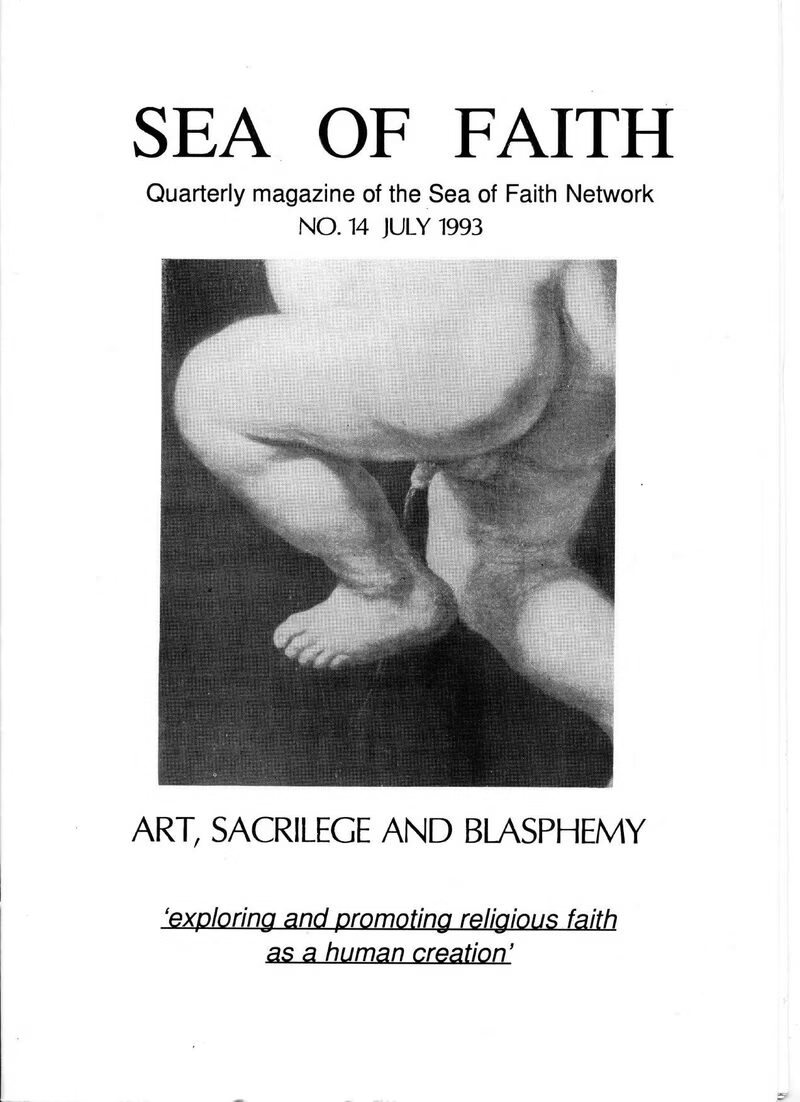
- Art and Sacrilege, Don Cupitt
- Premature Delivery?, Clive Richards, Don Cupitt
- Seeking New Solutions, Margaret Chisman
- Dialogue with Islam, Michael Stewart
Reviews
- Doing Without the Old Idol, Trudi Newton
Interviews
Regulars and Occasionals
- Postscripts, SEAfarer
Editorial
A TIME TO CONFER This, the fourteenth issue of Sea of Faith magazine, is being produced in the usual mad last-minute scramble, on the eve of the seventh annual conference of the Network in Leicester on July 27, 28 and 29. Members attending Conference will pick up their copy on arrival and those who haven't been able to make it will get their big brown envelope a few days later.
Once again some two hundred of us will be experiencing the character-building austerity of Leicester University's student accommodation and a stimulating menu of spiritual delights courtesy of Karen Armstrong, Hugh Dawes, Don Cupitt and Kulananda. We'll be frustrated that we can't get to all the workshops, short talks and sundry entertainments laid on for us, and we'll complain again that the bar is too crowded and the dining-room too noisy for the extra-curricular fellowship which makes occasions like these so richly enjoyable and stimulating.
For three summer days we won't feel quite so alone in our view of gods and religions as man-made-constructsand-all-the-better-for-it, and as Clive Richards notes elsewhere in this issue, we may even come to believe (God forbid!) that we are right!
But this little editorial is not about the Conference (which will have the bulk of the next issue devoted to it) but about the Annual Business Meeting which takes place during Conference on the evening of the 28th. In the past the Business Meeting has been the poor relation of Conference, tacked on at the end when all but the most hardened are homeward bound. This year, however, it gets a better billing, reflecting a general realisation of its growing importance.
Business sessions, let's face it, don't have quite the revivalist attraction of a Cupitt lecture. Moreover, they don't make a good fit with our notions of free networking unencumbered by formality, structure, rules and constitutions. If there has to be a businesslike structure, we feel like saying, let's leave it to the business-minded while we free spirits go our free-spirited way.
Maybe that was OK when we were small and knew each other by our Christian (sorry, first) names, but it isn't OK now that we are some five hundred strong and scattered all over the country (not to mention our growing overseas membership). We now collect several thousand pounds a year from our members: we have to be accountable to them for how we spend it. Accountability demands what our Quaker friends (who agonised over the tension between freedom and discipline back in the 1670s) call "proper ordering".
First there is the question of when and where our ABM takes place. So far it has seemed good sense to have it during Conference, the one occasion in the year when something approaching half our total membership are together in one place. But some members, including the East Angian SoF local group, have questioned this practice. Why hold the ABM, they ask, in mid-week, on what is a working day for most people? And why hold it in Leicester? Do not these arrangements (my questions now: East Anglia is too polite to put it like this) privilege the retired, the clergy and the Leicester-Loughborough SoF pioneers? Is there a case for a weekend day and more accessible venues like London and Manchester?
Second, there is the matter of how we conduct our business between ABMs. Our promotional leaflets (and this magazine) proclaim that "the Network has a steering committee elected by the membership". But in practice, up till now, the steering committee has been elected not by "the membership" but by that part of the membership which can get to a midweek Conference in Leicester and can be bothered to stay behind afterwards for the ABM.
Moreover, it isn't so much elected as self-appointed: anyone willing to share in its work is thereupon pronounced elected. It has to be said that this has produced a hard-working and dedicated team - but it isn't really an elected team, and therefore questions may legitimately be asked as to whether it is properly and democratically accountable.
Should we beat John Smith to OMOV - one member one vote? Should the new steering committee and officers be elected by the entire membership? Should local groups elect a representative to serve on the steering committee? Do we need a written constitution to embody and protect the principle that the Network belongs to all its members?
I hear the groans of those who ask "Why waste our energies on internal affairs, the formalistically 'democratic' conventions of rule-bound, point-of-order organisations: the very structures we are trying to escape from?" Because the alternative to elective, democratic organisation is not freedom but non-elective, undemocratic hierarchy. And because our concerns will be more effectively argued, debated and acted upon by an organisation, a network, which fully empowers its individual members as they grow both in numbers and maturity.
What Karen, Don and Co have to say at Leicester will be far more exciting and stimulating than all this. But business is business, and the ABM is not a mere sideshow. We should take the East Anglia group's proposals (see page 15) seriously. And we won't cease to be a Network by keeping our house in order. We'll just become a more firmly member-powered Network.
Readers may be interested to see the latest Dustin Hoffman film Accidental Hero. This is concerned with people and events appearing to be something that they are not - that is to say, the nature of reality. At the end of the film, parental advice is given to a nine-year-old: "There's no such thing as truth. There's just bullshit. One layer of bullshit on top of another. You choose which pile of bullshit you want and make it your own".
If only these words were spoken in Rome with a Polish accent by a man wearing a white cassock, what a wonderful world it would be! - Charles Legood, 21 Bulls Lane, Welham Green, Hatfield, Herts AL9 7NY.
See what I mean?
— Charles Legood, Welham Green, Hatfield
I'm sorry if Tim Miles (Sea of Faith 13) felt there had been "crossed wires". But that's what a network is about. And it did tease out Eric Stockton's letter on language and meaning.
He mentions the postman delivering my letters (wondering how they arrive if the address on the envelope is not be interpreted literally but in the light of my comment that it would be "better to talk in... a way which sees all language as metaphor through and through"). I get the letters because of the whole system of agreements that have been made concerning the marks on the envelope that make up the postcode.
Words get their meaning from the company they keep.
Change the company, change the system of agreements, and the meaning changes. So I would suggest the choice isn't between literal truth (a fine metaphor) and rampant symbolism (another one) but between authoritarian and democratic control of meaning.
— Stephen Mitchell, Barrow-on-Soar
Either way, meaning is a radically free human creation and cannot be tied down in quite the way Eric Stockton suggests. It always remains metaphorical. - Stephen Mitchell, 27 Cotes Rd, Barrow-on-Soar, Leics. LE12 8JP More truly human The chief message I received from Don Cupitt's contribution to last year's Conference, and from his latest book The Time Being, is that another "fullness of time" has corn, in which men and women of faith are to discover their true vocation: to set about making themselves and their societies more truly human.
This will involve a period of re-education and alteration in consciousness. They will discover that this generation is not the first to learn to read the "signs of the times", nor the last. Part of the re-education will be spent on looking at those strands in the history of human societies and individuals which illuminate the darkness and seeming hopelessness of "the human condition" with practical examples of holiness and goodness at work in the midst of apparently unsurmountable human depravity, squalor and apathy which are, more often than not, the result of deliberate exploitation and abuse of human weakness, frailty and helplessness by those who live to do just that. A new reading of and learning from human history is required from this generation.
Paul eloquently described the distinctively human virtues and qualities, culminating in 1 Corinthians 13. It seems obvious as we look at the history of the Christan church that "Mother Church" never taught her children to become truly New Testament Christians, but kept them in bondage to the Old Testament where the qualities of holiness and goodness are the properties of God alone and of the Messiah to come.
The raison d' etre of our local groups must be to develop and encourage their members to share individual growth points and insights in order that the groups can crreate together a new language and a milieu which not only unites them but attracts others to join and learn with them how to become "new people in a new world", moving beyond the "second threshold". - Rosemarie Wedell, 18 Cranmer Road, Manchester M20 OAW A Humanist church When we find we have non-realist views the question arises, Should we stay in the church or leave? "Stay and change things from within" is, I admit, a powerful argument providing that it doesn't mean bashing our heads against a brick wall for ever. I'm not a pessimist by nature, but I fear that this is exactly what it does mean.
— Rosemarie Wedell, Manchester
It is true that many SoF members, including priests, are happy to stay in and interpret the God-language in non-realist terms, and the numbers of such Christians may be growing. But is any church ever going to "come out" and officially declare that religion is a man-made creation and that we non-realists are "proper Christians"? Surely we are realist enough (if you'll pardon the term) to know the answer is no. Don Cupitt admits that it won't happen in his lifetime. I'd go further and suggest that it will never happen.
My own answer to the question "Should I stay in?" is "No", because even if I reinterpret the realist language, CONCLUDED ON PAGE 15 (1 ; POST BAG Parental advice?
T 10) CONTINUED FROM PAGE 9 I still feel I am taking part in a lie if I remain. If the churches we have refuse to change, surely we must eventually face up to the fact, come out, and start a new one?
Many of our members say we shouldn't go that far, and they arc entitled to their view, but I won't give up my Humanist label unless a new church appears. You might argue that I'm doing nothing to bring about the change, but we "outsiders" have a role to play, even if it is only one of protest.
— Angela Barkshire, Rickmansworth
Many realists who think of Sea of Faith as the faith at sea are often so obsessed with "mission" that they blindly ignore the real problems that modern Christianity has to face if it is to survive. Many Humanists like myself would love to attend a church, but only one that openly declares the truth of non-realism and sees us as proper Christians! - Angela Barkshire, 44B Norfolk Road, Rickmansworth, Herts, WD3 ILA [Angela adds that she sent a copy of the article "Mission to the Churches" (Sea of Faith 12) to her RC priest, "who suggested I should leave the RC church because I wasn't a proper Christian" - Ed.] Conference suggestions East Anglian SoF group, at its first meeting, produced a list of suggestions to help the Network develop. They stem from a concern to make SoF more available to those who can'i., for financial and other reasons, attend the annual conference. 1. Make the middle day of the conference available to those who can come for one day but not all three, with a main speaker, workshops and the AGM on that day. Set a one-day charge. 2. Hold smaller regional conferences, organised locally, maybe with catering and bed and breakfast offered by local members. 3. Separate the AGM from the conference, or hold it as part of a national one-day conference. 4. Set up a database to enable SoF to contact everyone who has shown any interest, e.g. attended conference, belongs to local group but not Network, etc., and send them the Network Secretary's newsletter once or twice a year with no obligation for them to join. 5. Ask those local group members who are not also national Network members what they want and need. 6. Have short local group ideas and experiences conveyed through Sea of Faith magazine. 7. Suggest SoF and TRUST advertise each other rather than just referring to each other.
We want to meet again to talk and share. This 'may be all that the Network is about, but that may be a communion in itself. - Kenneth Allchin, `Carpenters', Broad End, Elsworth, Cambridge CB3 8JD.
— Kenneth Allchin, Elsworth, Cambridge
Memo to Patten.
I'm greatly enjoying the magazine. Many thanks to all those involved in its production. A History of God is obviously a splendid and highly relevant book - sane, scholarly, logical but still "warm". I wish I could supplant John Patten and decree that it be required reading in RE! - Vivien Gibson, 60 Gordon Road, Ealing, London W5 2AR.
— Vivien Gibson, Ealing, London
Addresses please Thank you for publishing my article In Search of Community (April). It certainly read a lot better for a bit of editing! I was a bit disappointed, however, that my address wasn't included with the article, so that anyone wishing to respond less publicly than replying in the magazine was faced with a psychological barrier. I think it would encourage the operation of SoF as a network if addresses were printed with articles as well as letters (unless the author specifically wishes this not to happen).
I for one would feel more encouraged to respond if I could write direct. - David Herbert, 67 Howard Close, Cambridge CB5 8QU. [Contributors please indicate if you are happy for your address to be included. - Ed.] got to deliver is convincing evidence that there can be a new religious order, more vigorous and more liberating than the old now-declining system.
— David Herbert, Cambridge