
Contents
Articles
- Faith in a Blue Beret, Don Cupitt
- Encounters with Buddhism: 1. Love at First Sight, Jane Compson
- Encounters with Buddhism: 2. The Importance of Being..., Steven Sutcliffe
- Laugh Along with Jesus, Charles Ward
- Epistle from New Zealand's Ephesus, Ian W Harris
- Poets and the Quest for Meaning: 1. Kathleen Raine, Anne Ashworth
- Poets and the Quest for Meaning: 2. T S Eliot, Mark Rivett
- In Search of Community, David Herbert
- That's the Spirit, David Boulton
Reviews
- The God Life, David Boulton
- Blazing New Trails, Stephen Warnes
Regulars and Occasionals
- Adrian's Secret Diary: Changing Beliefs, Adrian Worsfold
Editorial
Network members will have received details of our sixth annual conference, but readers who haven't joined up yet might like to know what pleasures are in store for those who come and join us.
The Conference - SoF VI - is at the Leicester University Halls of Residence from 12 noon on Tuesday July 27 (registration) to the afternoon of Thursday 29th. The main speakers are Karen Armstrong, author of The History of God, Hugh Dawes, vicar of St James', Cambridge, and author of Freeing the Faith, and Don Cupitt, Fellow of Emmanuel College Cambridge and author of... well, The Sea of Faith among others. • SoFconf addicts - which means virtually anyone who has been before - will know that the speakers provide only a fraction of the stimulation. recreation, participation, infuriation and fellowship on offer. Workshops, discussion groups, eating, drinking, talking, worshipping and making new friends are all part of the experience. Remember too that the Network's AGM takes place during Conference, when you take the policy decisions and elect a Steering Committee for the coming year.
Member or not, do come! Details from the Conference Secretary, Roland Ellis, Shinns Croft, Bosbury, Ledbury, Herts HRS 1QD, telephone 0531 640552.
Good read Readers may want to add to the list of recommended books on radical theology, humanism, deconstructionism, post-modernism and what-not provided by Don Cupitt and circulated with the March Newsletter.
Please do! Meanwhile, I have a note from Rear-Admiral Hugh Tracey on two curiosities. One is a book published in 1904 called Do We Believe?, consisting of a selection from some 9000 letters sent to the Daily Telegraph in 1904, prompted by an early outbreak of SoF-type ideas. The other is an article by one Rev L B Ashley written in response to the outbreak of the second world war suggesting, Cupitt-like, that we should cease to mourn the downfall of institutional religion and celebrate instead "the highest and the best that we know". We should never confuse religion, he adds, with the profession of it.
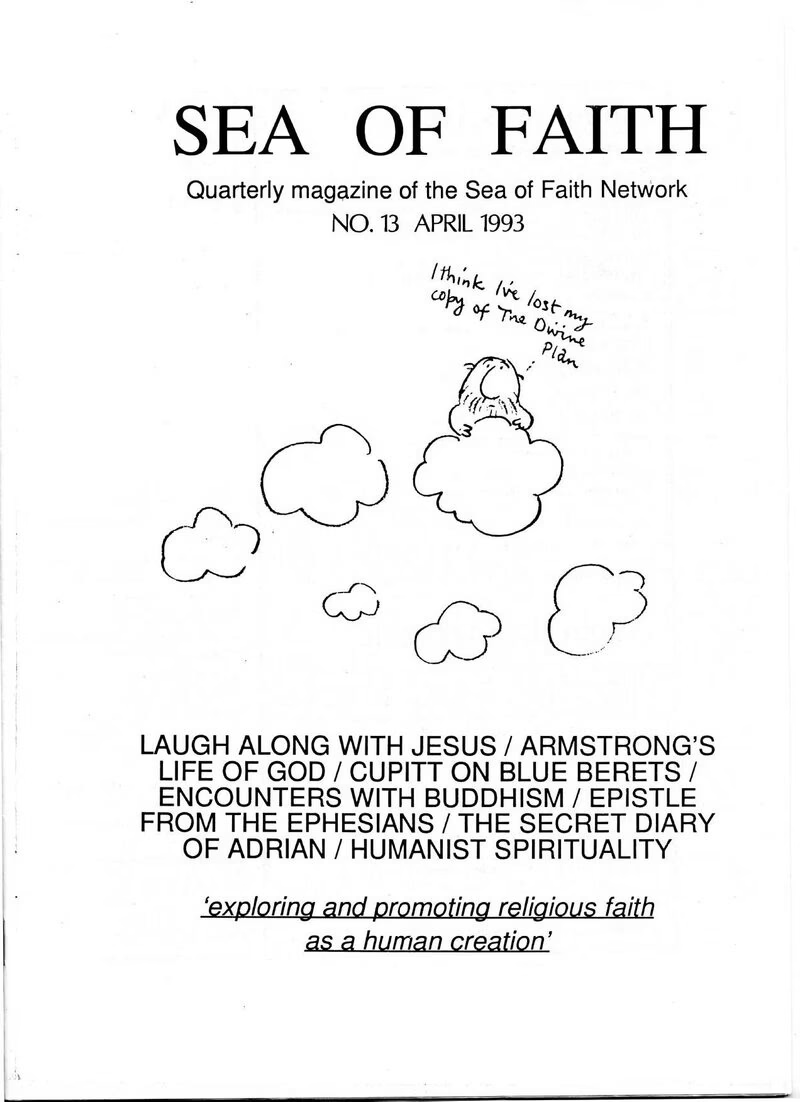
Thankyou My God Apologies to contributors to this issue who find their article or letter in smaller-than-usual type. Suffice to say that this does not reflect any editorial judgement on the value of the contribution, but rather editorial incompetence at planning adequate space for a growing spate of contributions. This has also pushed out many illustrations, but thanks to Mel Gilman of The Cartoon Gallery, 44 Museum Street, London WC1, for permission to reproduce some of the splendid cartoons originally published in his book My God. More, DV, will be spread over forthcoming issues.
Time present and time past Are both perhaps present in time future continuing with self-deprecating comments like CONCLUDED ON PAGE 18 POST 'AC Not so abrasive When I read the version of my paper which appeared in Sea of Faith 11 I eventually (too late for inclusion in SoF 12) wrote to you as follows:
The title of my article, "Why so abrasive?", was yours, not mine. The title I submitted was Religious Faith as a Human Creation: a Critique. My intention was to offer a philosophical examination of the formula on the front cover of the magazine. Although I used the word "abrasive" at one point I certainly did not mean you to give it a front seat!
Also it was your decision to use the header, "Why obfuscate our religious language with all this bad philosophy?" This sounds like rhetoric. My point was the far more sober one of carrying out a technical philosophical examination of certain uses of language which I believe to be self-defeating. Those who want to make a contrast between "human" and "divine" need to reflect very carefully on what this contrast is able to achieve.
We all agree the Sea of Faith Network has something important to say. My aim was the modest one of trying to help us say it better!
I hope this disclaimer will do something to reassure Stephen Mitchell, since it is clear that the original article gave him the wrong impression (Postbag, SoF 12). I wasn't making any "statement", and even the expression "stands accused" doesn't accurately reflect what I was trying to do. As for the things in paragraph 3 of Stephen's letter, I neither asserted nor implied any of them. This seems to be a case of crossed wires.
To clarify: it is often helpful when we reflect on different forms of words to ask "As opposed to what?". I was inviting members of SoF to ask this question in respect of the expression "religious faith as a human creation". In this connection I should like to quote Wittgenstein's dictum, "Say what you wish so long as it does not prevent you from seeing how things are.
And when you see this there is a good deal that you will not say" (Philosophical Investigations, BlackWell, 1953, section 79). It is for members of SoF to decide if there is a better "statement of intent" than the existing one. My purpose was not to make "accusations" but simply to suggest that the existing statement keeps alive a contrast which is unnecessary and divisive.
I much enjoyed John Challenor's letter. It seems to me he is absolutely right in saying that "we are planting in the middle ground between a realist theist tradition and its correlative atheism". I would even suggest that we can act as reconcilers.
Tim Miles, Llys-y-Gwynt, Llandegfan, Menai Bridge, Gwynedd LLD 5YD. [If my editing helped cross the wires I apologise. I confess to a preference for snappy rather than academic titles, and provocative, eye-catching "headers" and "call-outs" rather than bland ones. I am sorry if my shamelessly vulgar populism was thought to change the emphasis of Tim's most welcome and thoughtprovoking article. In the interests of contributors, readers should remember that while the contents of letters and articles are the responsibility of the writer, headings and typographical emphasis is down to yours truly, Ed.] Really?
— Tim Miles, Llys-y-Gwynt, Llandegfan, Menai Bridge, Gwynedd
The terms realism and non-realism must be very confusing for any newcomer to the SoF Network. Anthony Freeman (SoF 9) refers to the need for a basic introduction to radical/non-realist Christianity. But what does this mean?
Freeman's article is meant for the uninitiated, the uninformed.
Such people are likely to give words such as realism and reality the meaning they give them in everyday life. Putting the matter colloquially, a realist is a down-to-earth person, someone with his feet firmly on the ground, who believes the evidence of his own senses and takes things as he finds them. Imagine, then, the likely interpretation given by the uninitiated to non-realist!
It has to be made clear that in the Radical Christianity context the word realist is being used in a special sense which belongs to philosophy and with particular reference to the reality or otherwise of the concept of God. In philosophy. realism was the Scholastic doctrine of the objective, or absolute, existence of "universals" (Plato's "Forms"), and later (1838) was used for "the attribution of objective existence to a subjective conception". So realism, in this special context, stands for the notion that the concept of God actually represents something existing in objective reality. In other words, God really is there - out there!
For me, at any rate, the essence of Radical Christianity is the apprehension of the fact that all religion is the product of men's minds - a subjective conception. The radical adopts a non-realist attitude, asserting that traditional religious concepts like God, Heaven, Hell, life after death, resurrection, a soul (needing salvation) and the like are no more than products of men's imaginative minds.
C.B.Spurgin, 34 Dean Close, Leasingham, Sleaford, Lincs NG34 8NW. [Not forgetting, however, that there are non-Christian, postChristian, Jewish, Buddhist, Hindu, Islamic and Humanist non-realists... Ed. again] Time to deliver...what?
— C. B. Spurgin, Leasingham, Sleaford, Lincs
Having read recent comments and articles in this magazine it seems that the debate on how the SoF Network should develop is now reaching a critical stage. If SoF is going to "deliver", it is now time to decide what is to be delivered, to whom, and how this can be done most effectively.
I firmly believe that there is a need for SoF to be far more widely known, or more importantly, for the ideas and thinking which SoF stands for to be more widely known and better understood. The implications of "accepting religion as a human creation" are so important that we have a moral responsibility to ensure that as many people as possible are aware of this. A clear understanding of what religion is would open it up to those who find the traditional presentation from churches and other religious institutions difficult to relate to, or irrelevant in the world of the 1990s.
The only real options many people have been presented with are to accept a "supernatural" type of belief, which they do not find credible, or to take a non-literal view in isolation. It is hardly surprising that religion is largely ignored and that most people have only a superficial knowledge of how religious thought has developed, and of the benefits it could have for them. SoF-type ideas could be the key to a wider acceptance of religion's relevance today.
There is little doubt that the need for religion is as great as ever, both on the personal, spiritual level and in the context of the difficult ethical issues we face today. Yet we are faced with a continual decline in interest in the traditional presentation. SoF ideas can fill this void, which is why we should make the maximum effort to make our thinking known to as many people as possible. The key question for SoF now is how do we promote "the validity of creative, human-centred religion". SoF should begin to identify and address the practical issues arising from this question.
Peter Beynon, Rookwood, 5 Picton Avenue, Bridgend, Mid Clam, CF31 3HD.
— Peter Beynon, Bridgend, Mid Glam
A new moral code?
The SoF Network is growing and perhaps the time is not far distant when we will feel it right to think about what we might contribute to society. We might consider a point made by Don Cupitt in his 1984 television series The Sea of Faith: that "to speak of God is to speak about moral and spiritual goals we ought to be aiming at, and about what we ought to become".
It will be broadly accepted that there is an increasing greed, violence and intolerance in many countries and that there are many unquantifiable reasons for this state of affairs. It will also be accepted that, over the last 200 years in Europe and elsewhere, people have increasingly drifted away from the churches. We cannot say that the two trends are closely related but there is probably a connection.
People have left the churches for many reasons but the main ones may be the churches' insistence that their teachings have been revealed to them by God, and the fact that much of what they preach is not in accord with the knowledge of today, or seen as relevant to the problems of the day. One wonders how many people who leave the churches also abandon the moral teachings which have been the glue of societies for many generations.
There is probably wide acceptance that many of the teachings of the churches are valid and of real value - for example, that we should love our neighbours and not be selfish or bearers of false witness. If abandonment of the teachings of the churches means even partial abandonment of moral imperatives, then the danger to society is all too clear.
Have we, who accept that religion is a human creation and thus that moral codes are also human creations, an obligation to suggest to society the moral principles which we regard as right and essential? To put forward ideas that are not based on claims of revelation but on human experience over the years and can be justified logically? Perhaps what is needed is a relatively simple code of morals, put forward as ideas to consider, but which are based on and justified by logic and experience, and which are appropriate for the often close-knit societies of today.
Is this something which SoF should contemplate tackling or sponsoring, perhaps with others? A result might be a shortish book (perhaps a paperback) which avoided jargon and gave reasoned advice. A very difficult task, but perhaps a worthwhile one.
Jack Wood, 12 Pear Tree Close, Chipping Campden, Gloucestershire GL55 6DB.
— Jack Wood, Chipping Campden, Gloucestershire
Network resource We are invited to make our views known regarding the status of SoF. I am a very new fellow-traveller, but one of the things which caused me to join was the network idea, so I feel strongly that that should be continued with as a communication resource.
Kay Cooper, 59 Priory Street, Lewes, E Sussex, BN7 1HJ.
— Kay Cooper, Lewes, E Sussex
Wider publicity SoF Network is already an invaluable source of spiritual information. Despite keeping my ear to the ground, I only heard about it last year and I would favour much wider publicity. I like the idea of a "network" and I think that would appeal to many people. I feel I am searching for a uniting force rather than one which would aim to enter into conflict.
Therefore my vision for the future of SoF would be as "an educating arm of Christianity and a source of strength for anyone groping towards new means of spiritual expression"; encouraging unity between all people of goodwill and seeking to promote what is noble within ourselves and to recognise nobility in others. Could the aim of the Network be: 1. Education. Encouraging and arranging for SoF members and contacts to take part in television and radio discussions -Thought for the Day, Desert Island Discs, Seeds of Faith, and programmes like Brian Magee's Men of Ideas. 2. Literature. Providing as at present information concerning books, publications, etc. and helping to• make these readily available in bookshops. 3. The magazine. Arranging for this to be available on bookstalls, in libraries, health centres, etc. 4. A directory. Providing names of people of similar persuasion who do not mind being contacted; providing names of clergy or lay people who would be willing to conduct ceremonies (marriages, funerals) for radical Christians. 5. Training. Promoting the training of teachers for secondary schools, and providing speakers for community centres and halls, etc.
This would mean a much larger and more expensive organisation. Would other members favour that path? Could more members do voluntary work for the Network? I consider that the nation is spiritually starved of stimulation and that people are very interested in these matters, but they are bound up with institutional religion at present, and no-one dare speak. Perhaps SoF could provide the opportunity for them to da so.
Elizabeth Reid, Grace Cottage, Abbotsford Road, North Berwick, East Lothian EH39 5DB.
— Elizabeth Reid, North Berwick, East Lothian
Rampant symbolism Religious and related discourse is prey to two vices - restrictive literalism and rampant symbolism. The one compels its addicts to tamper with fact and logic when the sacrosanct texts are plainly untrue or inconsequential. The other compels its addicts to make such texts mean what they want them to mean - sometimes perhaps as the price of maintaining misplaced emotional loyalty to the literally untenable.
One of your correspo 'ndents, writing in SoF 12, seems to be so hooked on the latter vice that he can assert "...better to talk in a different way. A way which sees all language as metaphor through and through" (my italics). This proposition cannot be denied, much less refuted, because the reader cannot know, on the writer's own testimony, what it actually means.
What one can say is: "Heaven (so to speak) help the postman who has to work out what the inscription on the envelope means when it appears literally to refer to 'Stephen Mitchell... LE12 8JP—.
I suggest that, rather than adopt the Mitchell model, the "different way", we stick to the familiar realities of language usage (which are as old as literature itself). To do wholly without metaphor is a practical impossibility unless we are dealing with rather simple matters. Language usage exhibits a spectrum from literalist expression of operational truths (or falsehoods) to high metaphor that cannot be translated into plain discourse without sad loss of elegance, dreary loss of interest and wearisome loss of succinctness.
But the fact remains that a metaphor that cannot be translated into plain discourse, be that discourse ever so pedestrian, is about as useful as a locked room the key to which is lost.
Free-floating metaphor is just another name for rampant symbolism. Disciplined symbolism is admissible to clarify what it symbolises - not to obscure meaning or to manufacture meaning out of nothing. Symbolism and metaphor may feel and look good, but unrelated to direct exposition they cut no ice whatever in the quest for truth - whatever that overworked word may mean.
Eric Stockton (Editor Scottish Humanist), IVest Cott, Sanday, Orkney KW17 2BW.
— Eric Stockton, Sanday, Orkney