
The question facing us today, is how do we Christians, and people from all the world’s major religions and humanists respond in a world that is now contracting that circle of us so that our societies consciously begin to exclude and divide. You only have to think of the havoc and potential havoc that the US Supreme Court has caused and may cause as it battles against hard-won freedoms for women, LGBTQ people. In this era of strong man leaders the US is far from unique.
And that is my question to you all today. How do we ensure a society where no one is excluded and that hard won freedoms aren’t lost? A future in which people can be themselves – fully human. To deny those hard won rights to a person or a group is to deny their true personhood or, in Christian terms, to deny fullness of life.
I still call myself a Christian despite antipathy to the creeds of the church because for me Jesus / Yeshua remains a model of a truly human (humane) being (someone who embodies life in all its fullness). In my understanding of the gospel, there are no supernatural elements to Jesus whatsoever: no miracles, no virgin birth, no tampering with nature, no resurrection, and no second coming to wait for.
However, I will try to re-present a Jesus who is rooted to the social and political world of his day and who tries quite simply to make the world a better place, in which no one is excluded. Indeed, he responds with anger (even physical anger) at examples of exclusion – for instance when a leper is excluded by the disciples, or children are prevented from joining the community, or foreigners are excluded from the court of the gentiles in the Jerusalem Temple (the area specifically set aside for them).
Jesus was not aloof or in any way set apart from ordinary people. His message, expressed in parables and stories rooted in the everyday, was delivered on the move. He, unlike John the Baptist, went to people and did not expect themto come to him. He was totally inclusive, and tales of his life include encounters with a Roman centurion, Galilean beggars, fishermen, wealthy women benefactors and prostitutes, as well as those who through joblessness, financial necessity or mental or physical handicap, had become beggars or slaves. But although much of his life seems to be preoccupied with the least, last and lost, there is evidence that a lot of the table-talk and events happen in the homes of the wealthy and established leaders (religious and secular) of the community.
A movement such as that of Jesus was always likely to be crushed, for it threatened the status quo. When Jesus went to Jerusalem, he was arrested on the orders of the high priest, possibly because of disturbance in the temple. He was handed to Pilate, the ruthless Roman governor (26–36 CE), who had him flogged and crucified. After the crucifixion, there was no miraculous empty tomb; Jesus’ body, like the majority (many thousands of victims) of those who were crucified in Roman Palestine, would probably have been left to rot on the cross and then been buried in a shallow pit for birds, dogs and rats to scavenge.
We can’t say that this man, Jesus (or, more accurately Yeshua) in any sense died for our sins. We can say that he died because of human sin, the sin of totalitarianism, of fear, and repression, of cold-blooded tyranny. We can say that Jesus, knowing the consequences, was prepared to live and die in the service of his fellow oppressed women and men. We believe his message was of the utter worth of each and every human being, however wretched and whatever their ‘sin’, nationality or moral turpitude. This message was worth dying for. And that is remarkable and inspiring.
The name Jesus/Yeshua (the word for salvation) was a popular name for Jews. It was especially popular at the time of Roman occupation, into which Jesus was born, because it carried with it a nationalist hope of liberation, with its memories of the great leader Joshua (another Anglicised variation of the same name as Jesus), who in the Hebrew Bible is said to have led the chosen people into the promised land after the death of Moses. In the dark times of Roman occupation, the name ‘Jesus’ was common and expressed a hope for a better world, just as Joshua had won for their forbears.
What went wrong? What turned this broad, life-affirming concept of salvation into something that has become primarily a narrow concentration on saving souls from hell? For some, the work of Jesus is seen less as a call for social justice and the building of a better world and more about a man who saves us sinful folk from eternal damnation. For me the whole point of being a Christian is not primarily to worship and to give thanks for being saved from hellfire, but to live the Christian way, to try within our capabilities to live by the same values and belief that inspired Jesus – liberation based on the absolute worth of each and every human being. The Jesus story can profoundly motivate our living and acting. In that sense Jesus does live on.
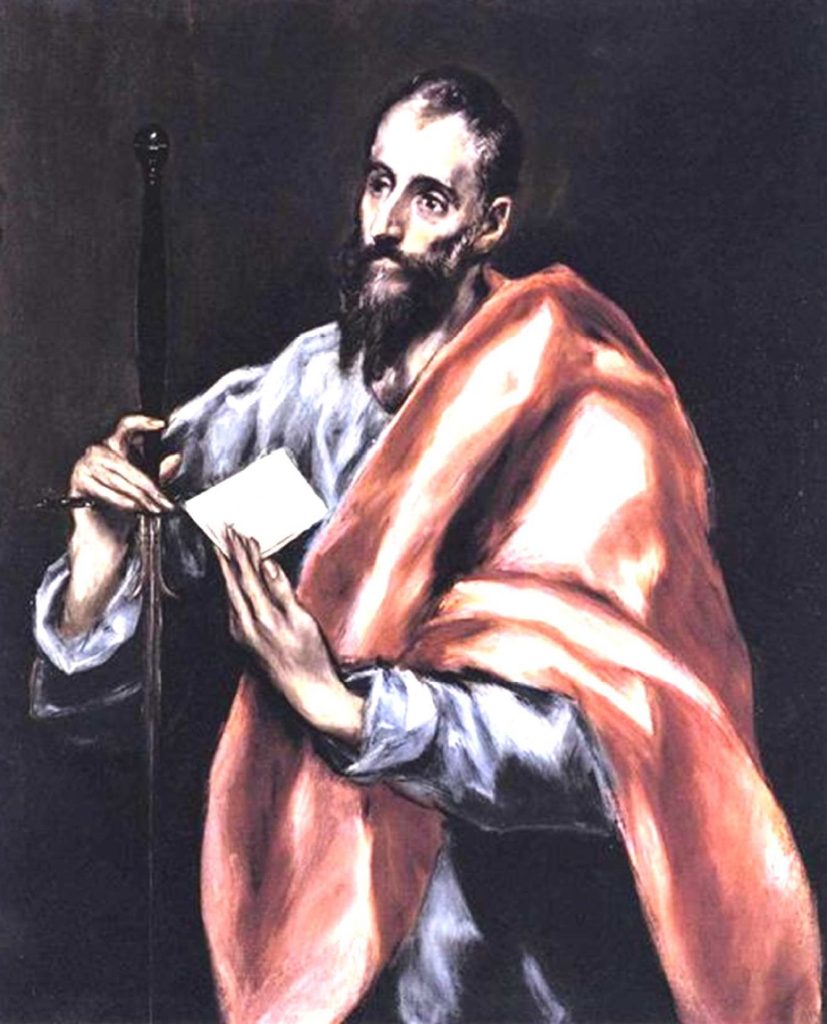
The success of early Christianity owes a great deal to the first century Christian convert, Paul of Tarsus. There are those who believe that the real founder of Christianity is Paul, certainly his letters comprise a significant chunk of the New Testament. Paul’s genuine writings pre-date the gospel accounts but not, of course, any oral and other accounts that pre-date the actual composition of the gospels. Any understanding of Christianity has to come to terms with this man Paul, whose role in shaping and founding what became a recognisable faith is pivotal, but somewhat distinct and separate from the faith of Jesus. However, to my comparatively recent surprise, closer study shows that there was less of a distinction between the message of Jesus and Paul.
Liberals like me often dismiss him as a woman hater, maybe a closet gay, and as someone who takes the simple message of Jesus and turns it into something that is sin-obsessed and concerned more about the ‘other world’, rather than this world. But Paul, too, needs a radical reappraisal. The work of the Jesus seminar on Paul, especially Arthur Dewey and others’ work on The Authentic Letters of Paul, together with that of Larry Siedentop in his book Inventing the Individual, have shown me a more radical understanding of Paul as someone whose message has been defining for all Western movements of liberation and one that is in tune with and continuous from the radical Jesus of the gospels.
The success of the early Christian community after the death of Jesus is due in large part to the skill of Paul. As far as we know, prior to his conversion to ‘the way’, Paul was a zealous Pharisaic Jew concerned with stamping out revisionists like Jesus. But Paul suddenly and dramatically underwent a transformation that turned him from persecutor of Jesus’ followers to a leader of the new movement with a commitment that was tested by imprisonment and finally, almost certainly, to his death at the hands of Roman persecutors.
Paul was not from a backwater like Jesus’ more humble beginnings in rural Galilee, but an educated and academic man. However, we need to be careful about ascribing all the letters that say they are written by Paul to his authorship. Through analysing style and theological content, it is possible only to say this of the first letter to the Thessalonians, Galatians, the bulk of the Corinthian correspondence, Philemon, Philippians, and most but by no means all of Romans.
That means a number of letters purported to be written by him are later additions with different theologies and in almost all cases a desire to conform to social structures and the conventions of the Roman Empire. The original Paul is much more in tune with the radical spirit of Jesus. As Pauline scholar, Arthur Dewey suggests in his book The Authentic Letters of Paul:
We can see Paul as a man who joins in the cultural debate of his time over what constitutes the value and meaning of humanity. This is a man who can imagine those considered outsiders as equals, a man who has found freedom and meaning in the rag-tag communities of nobodies.
The revolutionary nature of Paul’s message is emphasised by the cultural historian, Larry Siedentop, who sees early Christian equality and inclusion as defining for secular Western liberal democracies. In his book Inventing the Individual Siedentop points out that this equality and inclusive message is the basis for all our demands for equality of opportunity and of all those movements of liberation – feminism, slavery, LGBTQ, racism as well as disability. Christian equality, as practised by the early followers, provides the unrecognised moral bedrock behind all Western secular liberalism.
When Paul, echoing the teaching of Jesus, states that there is no longer any distinction between ‘Jew or Greek, slave or free, male or female,’ (Gal 3:28), he was saying something revolutionary and liberating for those who were on the wrong side of those binaries of entitlement. Paul’s reciting of those words is, some suggest, echoing something that was perhaps an early Christian baptismal formula or perhaps a well-known hymn of the early Christian community in Galatia. The understanding of inclusion and equality were of utmost importance (even defining) to the early Christians.
I think we are inclined to forget that in such a hierarchical world as the Roman Empire or, indeed, first century Judaism, a group of people who declared that amongst them there is no distinction to be made on the basis of gender, wealth, religion, nationality or economic status was bound to be lauded by those who were without power and viewed with suspicion and hostility by the powers that be.
This is the same message (although more philosophically presented and nuanced by Paul) that was felt by the poor of Galilee through the teaching and example of Jesus, who taught that they were as important to God (and each other) as those of the highest social, political or religious standing. There is absolute equality – all are children of God and equally prized. If there was a bias in Jesus’ mission, it was to those who were oppressed, the poor, women, those discarded as unproductive or labelled as unclean or irreligious, to those who needed to be lifted up. This is the truth that the educated Paul was blind to and to which he suddenly woke up, saw and understood. Blind and now I see!
It is this powerful message of equality and liberation that remains after the death of Jesus. In a sense, therefore, it is a ‘bodily’ resurrection, for in his first letter to the community of believers in Corinth, Paul coins the phrase ‘the body of Christ’ to refer to the followers of Jesus. He expects believers to be the walking, talking body of Christ, so much so, that in a real and tangible sense Jesus lives. Early Christianity spread incredibly quickly through the trade routes of the Roman Empire; its message was dynamite for slaves, the poor, women and those excluded from belonging to Judaism. Open to anyone – no exclusion zones.
The spirit, which I like to follow the Latin American Jesuit Jon Sobrino in calling ‘a profound motivation’ was for those early followers infectious and liberating. Anyone, absolutely anyone, could be inspired and become a follower of this revolutionary way. Jesus and the early church were open, welcoming and inclusive, in sharp contrast to the control and exclusions of religion, society and even family. They were peddlers of fullness of life and that was dynamite that led to the explosion of believers in the early years of the Christian faith and appealed especially to those who were condemned to not being their true selves. Followers of the way (those profoundly motivated by Jesus) will be on the side of those struggling to be their true selves or to shed societal shackles.
I have an image that lives with me. I was attending, as the Scottish delegate, the Anglican Peace and Justice forum in USA. At the headquarters of the International Monetary Fund, I stood next to the liberation theologian Gustavo Gutiérrez as he spoke to the room full of international bankers and politicians. He said today, as in the Bible, the name Pharaoh means ‘those who live in big houses’ and today the message is the same: ‘Let my people live.’ Freedom means being able to be our true selves without the shackles of debt and despair: ‘Let my people go.’ And Gutiérrez spoke about his compatriots being given ‘room to be people’. Before the room returned to their canapés and white wine, there was a long uneasy silence when we confronted raw truth. We were all confronted with the question of whether we were for life or death.
It is striking how the strong men of the world today Trump, Putin, Erdogan, Modi, Orban, Kaczynski, Duterte, Bolsanaro, Netanyahu, Xi Jinping – all have, in their various ways, relied on religious and political attitudes that are exclusive and excluding and define themselves over against liberal attitudes to politics, religion, morality, a liberal education and open borders. Jesus and his followers today should have a commitment to ensuring fullness of life to all people regardless of gender, sexual orientation, race: everyone should have room and space to be their true selves. That fullness of life, the freedom to be one’s true self is in the very DNA of Christianity.
Bibliography
Naomi Alderman, The Liars’ Gospel ( Penguin, 2018)
Kathleen E Corley, Women & The Historical Jesus (Polebridge, 2002)
John Dominic Crossan, Jesus: A Revolutionary Biography (Harper, 1994)
Don Cupitt, Jesus & Philosophy (SCM, 2009)
Don Cupitt, Reforming Christianity (Polebridge, 2001)
Arthur J Dewey, The Authentic Letters of Paul (Polebridge, 2010)
Peter Francis, The Widening Circle of Us (Chester University Press, 2021)
Robert W Funk, The Five Gospels (Harper Collins, 1993)
Robert W Funk, A Credible Jesus (Polebridge, 2002)
Kathy Galloway, Struggles to Love (SPCK,1994)
Amy-Jill Levine, The Misunderstood Jew (Harper One, 2006)
Gideon Rachman The Age of the Strong Man (Bodley Head, 2022)
Larry Siedentop, Inventing the Individual (Allen Lane, 2014)
John Shelby Spong, Unbelievable (Harper One, 2018)
Joan Taylor, Helen Bond, Women Remembered (Hodder & Stoughton, 2022)
Brenda Watson, The Jesus Puzzle (Chris@an Alternative, 2023)
______________________________________________
Peter Francis worked as a priest in Glasgow and Ayr in Scotland and the West Midlands and London in England. From 1997 he was Warden of Gladstone’s Library (Hawarden, Wales) and has recently retired. His book The Widening Circle of Us was published by Chester University Press in 2021. peter.francis@gladlib.org
This is a shortened version of the talk he gave to the 2022 SOF Annual Conference.